
Access for all: closing the language, location, and parent equity gaps in career readiness
Every district wants a Career Readiness and Development program that reaches every student. Here's the data on who gets left out, and what closes the gap.
Every district I talk with wants the same thing: a Career Readiness and Development program that reaches every student, not just those who happen to live near an employer, speak English at home, or have a parent who can get off work for a 6 p.m. information session.
That gap between intention and reach is bigger than most of us want to admit. It shows up in who gets invited to shadow a nurse and who doesn't. It shows up in whether a career interest survey can be read aloud to a student who is blind or has low vision. It shows up in whether a parent who speaks Portuguese at home ever learns that their child signed up for an internship that requires a signature.
Career readiness only works when it works for everyone. And closing that access gap has become one of the most urgent, and most solvable, challenges in K–12 education.
The access gap is bigger than most districts realize
Start with language. English learners are the fastest-growing student population in the country. More than 5.3 million students, roughly 10.6 percent of all K-12 enrollment, were identified as English learners as of fall 2021, and Spanish is the most common home language, spoken by 8.4 percent of all public school students.
Now add disability. 7.5 million public school students, about 15 percent of enrollment, received services under the Individuals with Disabilities Education Act in 2022–23, and these two populations overlap more than people expect: 15.8 percent of English learners are also students with disabilities.
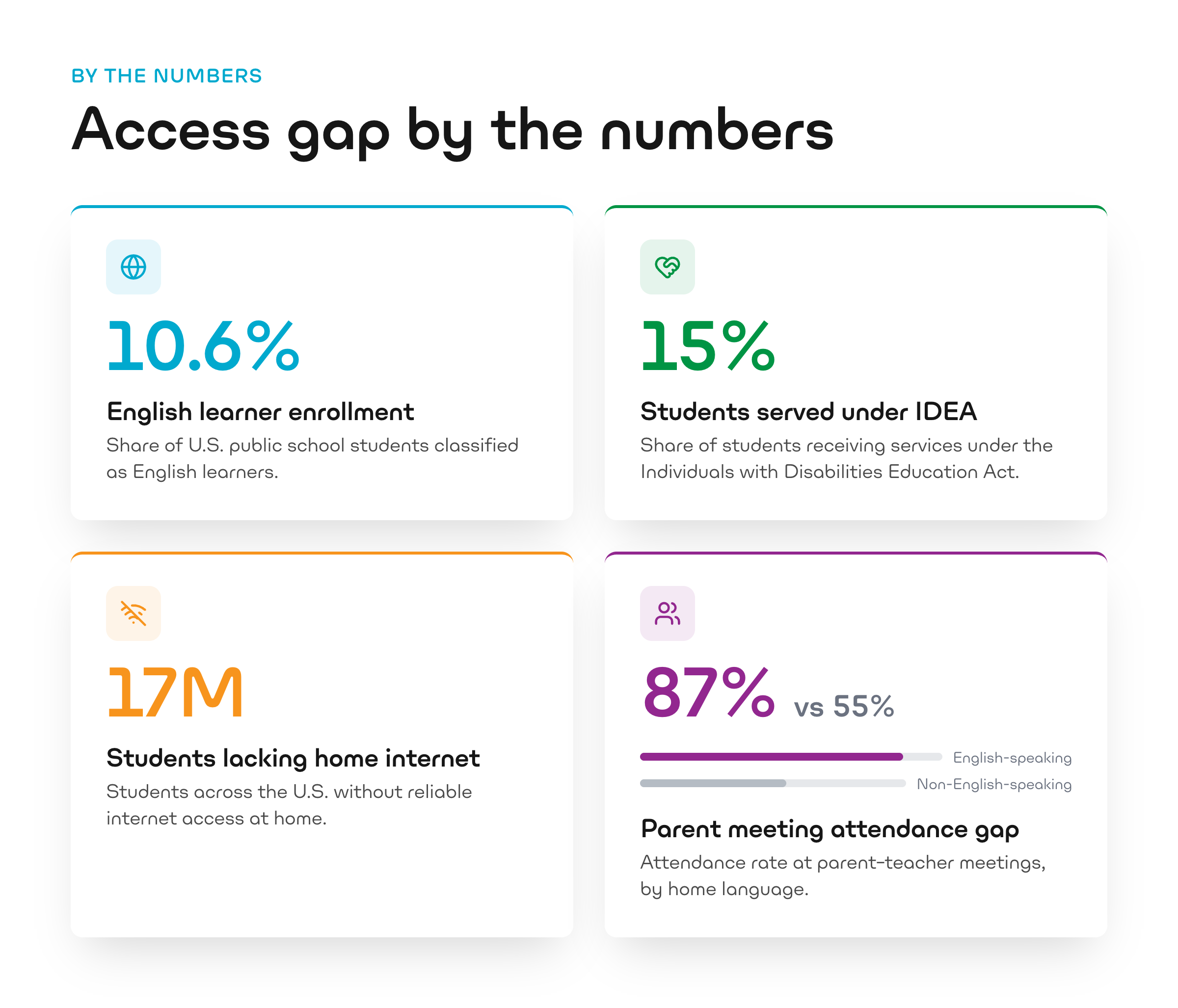
Then there is geography and connectivity. Nearly 17 million school-age children lack internet access at home, and rural students face fixed-broadband access rates well below their suburban peers. Stack all of that on top of the parents who cannot get through the front door of a career conversation because of a language barrier, and the picture becomes clear: accessibility equity is not a niche concern. It touches a majority of the students and families most districts serve.
Location access: when a zip code decides who gets a career experience
More than 98 percent of public school districts offer some form of Career and Technical Education, but the internships, job shadows, and dual-enrollment courses that make CTE meaningful almost always happen off campus, on schedules that fixed-route school buses were never built to serve. For rural students, that gap is not an inconvenience. It is often the deciding factor in whether a student ever sets foot in a workplace at all.
Students in rural districts frequently travel a considerable distance outside their own county to reach a work-based learning site, and researchers studying rural CTE access have found that students may face language barriers and limited access to translated program information on top of transportation and geography challenges, meaning location and language barriers frequently stack on the same student. This is exactly why Perkins V requires every district's Comprehensive Local Needs Assessment to examine progress toward equal access to high-quality CTE programs and strategies to overcome barriers for specific student groups. Access and equity is not an optional chapter in a Perkins application. It is a required one, and for good reason.
Pathful CRD's Virtual Job Shadows, Informational Interviews, and Industry-Led Projects give students authentic exposure to careers and working professionals without requiring a bus route, a car, or a nearby employer.
Language access: barriers students and families can't see past
Language access has two sides, and districts tend to only plan for one of them. The verbal side is home language: whether a student or parent who speaks Spanish, Portuguese, Arabic, or any of dozens of other languages can actually understand what a career program is offering. The visual side is just as real but far less discussed: whether a student who is blind, has low vision, or relies on a screen reader can access that same information at all.
The verbal side of the gap is measurable and growing. Spanish was the most commonly reported home language among English learners as of fall 2021, followed by Arabic and, notably, English itself, spoken by students living in multilingual households. And roughly 43 percent of children enrolled in K-12 public schools come from culturally and linguistically diverse backgrounds, which means career content built for a single-language audience is, by definition, incomplete.
The visual side of the gap has now become a legal requirement, not just a best practice. The Department of Justice's Title II rule under the Americans with Disabilities Act now requires public school district websites and apps to meet WCAG 2.1 Level AA standards, with large districts required to comply by April 2027 and smaller districts by April 2028. That deadline matters because most digital career tools are not there yet: 93 percent of websites have at least one inaccessible image and 38 percent of images are missing alt text altogether, and 86.4 percent of home pages have low-contrast text that is difficult for people with low vision or color blindness to read. A student who cannot see the screen or read the language is not disengaged from career planning. They were never given a way in.
Parental access: when the family is locked out of the conversation
Career planning does not happen in isolation. It requires permission slips, consent forms for work-based learning, and, ideally, a parent who is actually part of the conversation about their child's future. Research on parental involvement is consistent and clear on why that matters.
A 2019 American Psychological Association review of 448 independent studies found that when parents are involved in their children's schooling, students show higher academic achievement, school engagement, and motivation. But federal data show that involvement is not distributed evenly. In 1999, about 79 percent of English-speaking parents attended a general school meeting compared to 69 percent of non-English-speaking parents; by 2024, the gap had widened, with 87 percent of English-speaking parents attending compared to just 55 percent of non-English-speaking parents. During the 2023–24 school year, 79 percent of Spanish-speaking parents who tried to engage with their child's school said language barriers made it difficult to participate. That gap is not shrinking on its own. It is widening.
When schools address those barriers, they can boost family engagement among multilingual parents, which in turn can lead to improvement in students' academic achievement.
— Elisabeth O'Bryon, co-founder, Family Engagement Lab
For career readiness specifically, that engagement is not a nice-to-have. A parent who cannot read a work-based learning consent form cannot sign it, and a student without a signed form cannot participate in the internship, job shadow, or apprenticeship that program was built to offer.
Why this is a CRD responsibility, not a side project
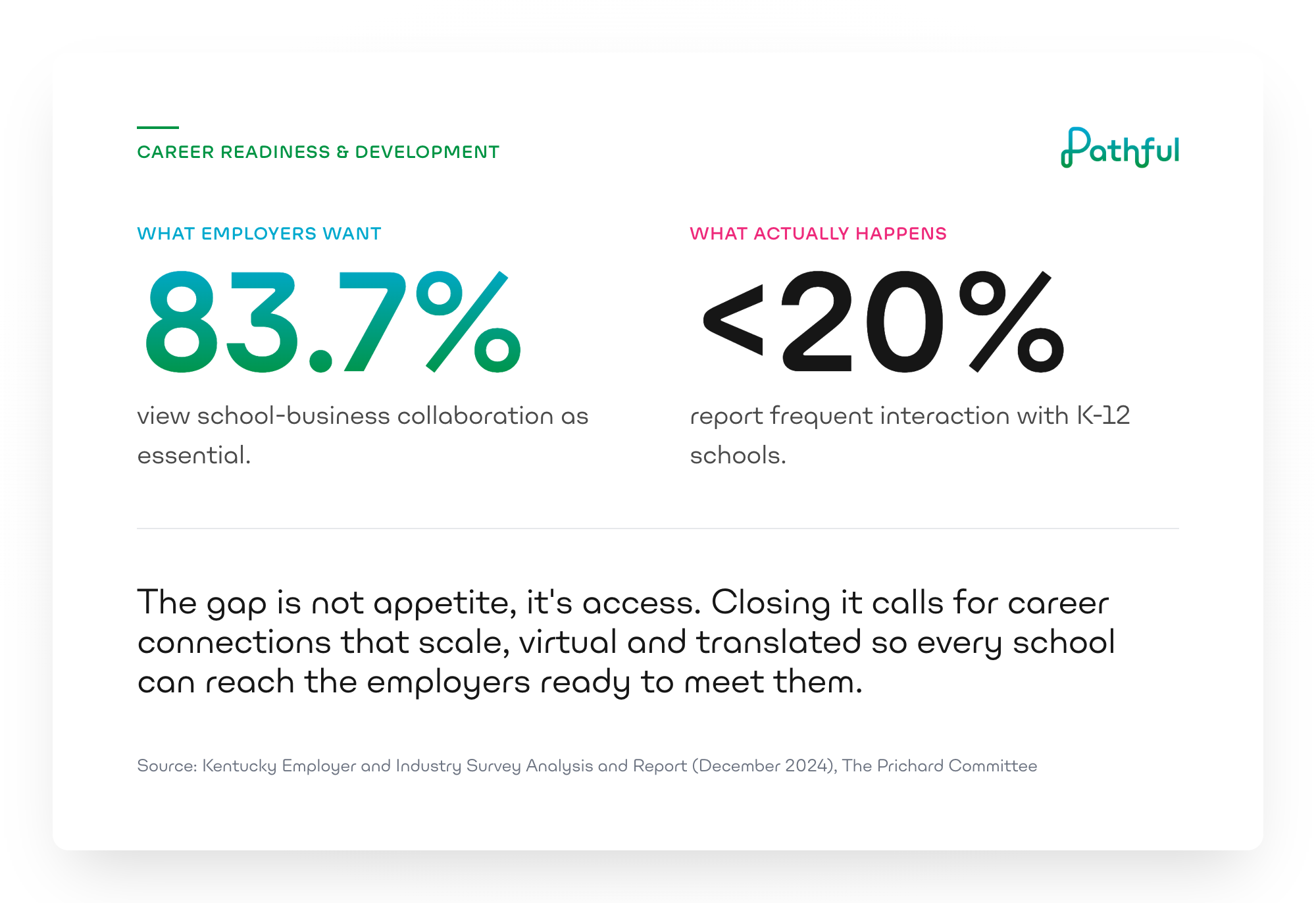
Pathful is built as a Career Readiness and Development platform, not simply a compliance tool, and that distinction matters here. A CRD platform is measured by whether every student, regardless of language, ability, geography, or family circumstance, actually gets to move through Awareness, Exploration, Preparation, and Placement. The access gaps are not evenly distributed either. Our own research found that Black, Latino, and first-generation students are consistently less likely to participate in internships, and when they do participate, they are less likely to be compensated for it. Closing an access gap that falls disproportionately on the students who most need the opportunity is not an equity initiative bolted onto career readiness. It is what career readiness is supposed to do in the first place.
How Pathful is closing the gap
None of this changes by writing a stronger equity statement into a strategic plan. It changes by building the access into the platform itself, so districts are not left to solve language, location, and parent access one manual workaround at a time. That is the philosophy behind three things we have built directly into Pathful CRD:
- Location access: Virtual Job Shadows, Informational Interviews, and Industry-Led Projects that give rural, low-transportation, and underserved students real professional exposure without requiring a ride to get there.
- Language access, verbal and visual: AI-powered Spanish translation across our career video library, paired with a UserWay integration that gives every student screen-reading, text-to-speech, resizing, and on-page translation tools built into the platform.
- Parental access: Direct, translatable visibility into Career Plans and work-based learning activity through Course Planner, with online forms parents can review and sign without needing to be physically present or fluent in English.
Districts do not need to choose between meeting Perkins V equity requirements, ADA Title II accessibility deadlines, and actually engaging every family. Built well, one platform can do all three at once.
If your district is evaluating how to close these gaps, or preparing for the upcoming ADA Title II compliance deadlines, we would welcome the conversation.
Frequently asked questions
Accessibility equity means every student, regardless of home language, disability, location, or family circumstance, has a genuine path through career discovery, exploration, preparation, and placement. It covers verbal language access, visual and screen-reader accessibility, transportation and geography, and whether parents can meaningfully participate in the process.
English learners make up roughly 10.6 percent of the K-12 population, and research shows that when schools remove language barriers for families, engagement and academic outcomes improve. Career content that is only available in English, or only accessible visually, excludes millions of students and their parents from the career planning process before it even starts.
The U.S. Department of Justice's ADA Title II rule requires public school district websites, apps, and digital services to meet WCAG 2.1 Level AA standards. Large districts serving populations of 50,000 or more must comply by April 26, 2027, and smaller districts have until April 26, 2028. Confirm current deadlines with the Department of Justice, as compliance dates have been extended before.
Career plans, work-based learning placements, and internships typically require parent review and signed consent. Research shows non-English-speaking parents attend school meetings and engage with career planning at significantly lower rates than English-speaking parents, largely due to language and logistical barriers, which limits the opportunities their children can access.
Pathful CRD offers virtual job shadows, informational interviews, and industry-led projects that remove transportation and geography barriers, AI-powered Spanish translation across its career video library, a UserWay integration for screen reading and visual accessibility, and parent-facing tools that make Career Plans and work-based learning forms visible and signable online.
Pathful integrates UserWay's accessibility technology to provide screen-reading, text resizing, contrast adjustment, and translation tools directly within the platform, supporting students who use assistive technology to navigate career content.
Sources
- New America. English Learner Changes Over the Last 20 Years. 2025.
- National Center for Education Statistics. English Learners in Public Schools. Condition of Education, 2024.
- Migration Policy Institute. English Learners in K-12 Education by State.
- National Center for Education Statistics. English Learners in Public Schools (PDF). Condition of Education, 2024.
- Pew Research Center. Key Facts About US Students with Disabilities, for Disability Pride Month. 2023.
- National Center for Education Statistics. Students With Disabilities. Condition of Education, 2024.
- EdWeek. Language Barriers Keep Parents From Attending School Activities, New Data Show. 2024.
- LanguageLine Solutions. Study: School Involvement Drops Dramatically for Non-English Speaking Parents. 2025.
- EdWeek. Does Parent Involvement Really Help Students? Here's What the Research Says. 2023.
- NASET. Parental Involvement within Culturally and Linguistically Diverse Families: Misconceptions, Barriers, and Implications.
- Association of Illinois Rural and Small Schools. Driving Equity: Understanding and Addressing Transportation Barriers in Rural Illinois.
- Association of Illinois Rural and Small Schools. Place, Race, and Resource Gaps: Evaluating Socioeconomic Disparities and Equity in Rural Illinois CTE.
- TN SCORE. Work-Based Learning in Tennessee High Schools.
- Sterling Roberson. Career and Technical Education Can Open Doors, But Students Still Need a Way to Get There. 2026.
- Georgia Policy Labs. Career and Technical Education in Rural Areas.
- EdWeek Events. The Road to Opportunity: Making CTE Accessible for All. 2026.
- KWALL. ADA Title II Website Compliance Deadline: 2026 Guide.
- Accessibility.Works. Public School ADA Title 2 Website Compliance Requirements.
- AudioEye. Web Accessibility Statistics (2026): Research & Data from AudioEye.
- Acquia, citing WebAIM. 12 Common Web Accessibility Issues for Visual Impairment.
- Federal Communications Commission. Bridging the Digital Divide.
- National Center for Education Statistics. Rural Students' Access to the Internet. Condition of Education.
- Benton Institute for Broadband & Society. Lack of Broadband Leaves Students Behind.
- The Prichard Committee. Kentucky Employer and Industry Survey Analysis and Report. December 2024.
Keep reading.
Every student deserves to see their future
Over 5 million K–12 English learner students face language barriers in career exploration.
Connecting career exploration to high school ILPs
How school counselors and CTE leaders can turn exploration into a living, documented roadmap for every student.
The complete Perkins V application toolkit
A step-by-step guide for CTE directors — CLNA templates for all five required elements, a budget worksheet, and the mistakes to avoid.
Ready to make career readiness more meaningful?
Let's talk about how Pathful can support your students and meet your goals.