
Entry-level jobs are disappearing. Here's how work-based learning gets students ahead of the curve
Entry-level hiring has dropped 73% in four years. Here's why Career Readiness and Development and work-based learning must start in high school.
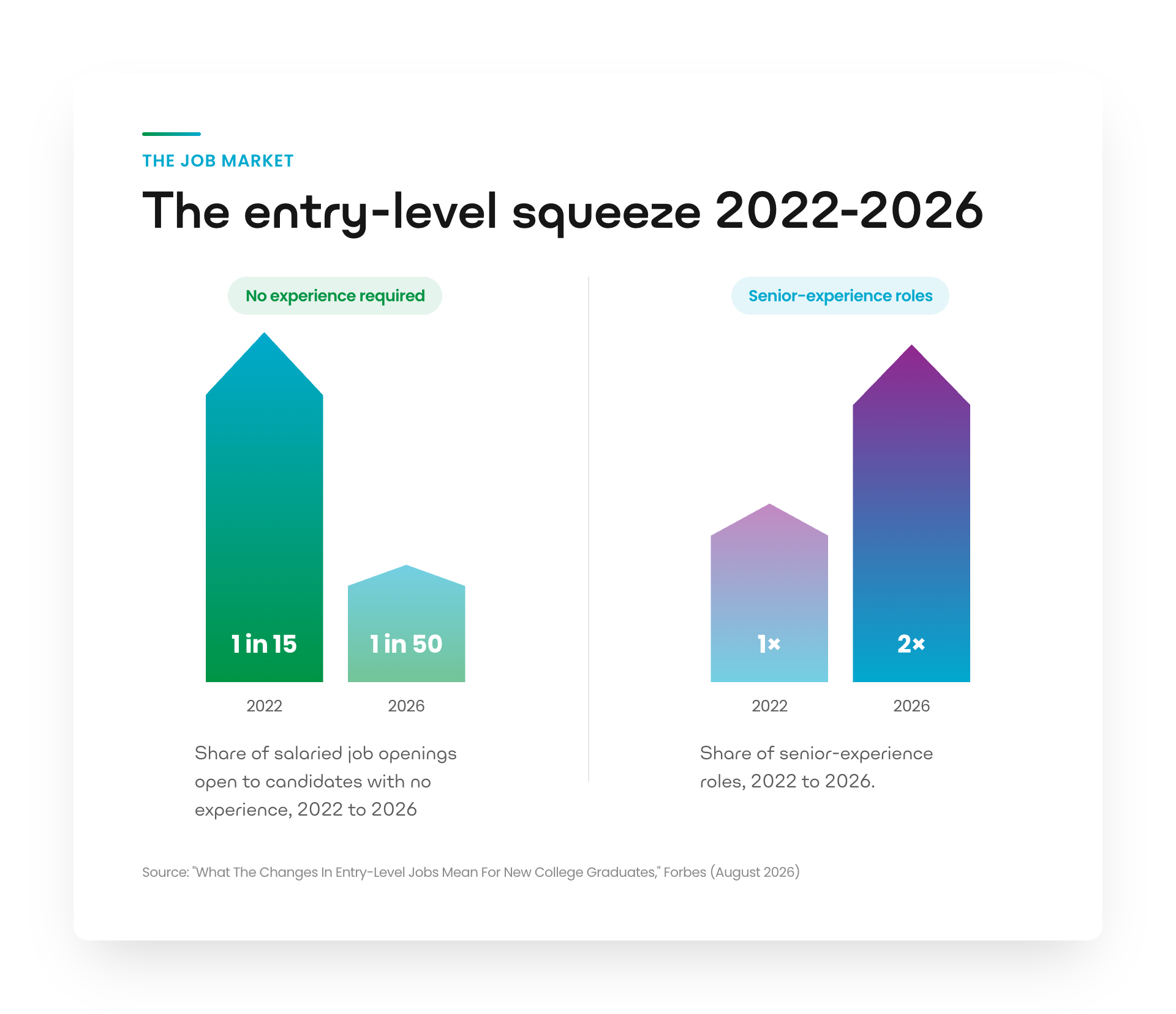
A few weeks ago, a Forbes analysis stopped me mid-scroll. Drawing on new data from the hiring platform Cadient, the article documented something I have been watching build for years: the entry-level job, the one that used to ask for little more than a diploma and a willingness to learn, is vanishing. Across a stable panel of employers in healthcare, government, utilities, and transit, the share of salaried openings welcoming candidates with no prior experience has fallen 73% in four years. In 2022, roughly one in 15 salaried postings was open to someone starting from zero. Today it is one in 50.
That statistic comes from Forbes' reporting on Cadient's analysis of nearly 8,000 salaried job openings, and it lines up with what the broader labor market is showing. The unemployment rate for recent college graduates now sits at 5.6%, higher than the 4.2% rate for the workforce as a whole. Roles requiring senior-level experience have doubled over the same stretch. Employers are not just hiring fewer people, they are hiring more experienced people, and the door for first-timers is closing fast.
The experience paradox, and why it is a structural problem
Cadient CEO Bill Mastin put it plainly in the Forbes piece: the real issue is not that entry-level jobs are disappearing, it is that employers increasingly expect candidates to arrive with experience before they are given the opportunity to gain it. He also pointed to a mechanical culprit behind the trend: applicant tracking systems that filter resumes by keywords, years of experience, and credentials before a hiring manager ever sees a name. A college internship might satisfy that filter. It might not. Either way, a graduate who spent four years in a classroom and never set foot in a workplace is now competing in a system built to screen out exactly that profile.
The Forbes article is written for a higher education audience, and understandably so. Colleges are now facing their own reckoning under the U.S. Department of Education's new Student Tuition and Transparency System and Earnings Accountability rule, which requires undergraduate programs to show that graduates out-earn a typical high school graduate or risk losing eligibility for federal student loans and Pell Grants. But nothing about the underlying problem is unique to college seniors. If employers are filtering for demonstrated experience before anyone reaches the interview stage, the moment to start building that experience is not the summer before a job search. It is years earlier, while a student is still in high school and still has time to build a record that speaks for itself.
Why the fix starts long before graduation day
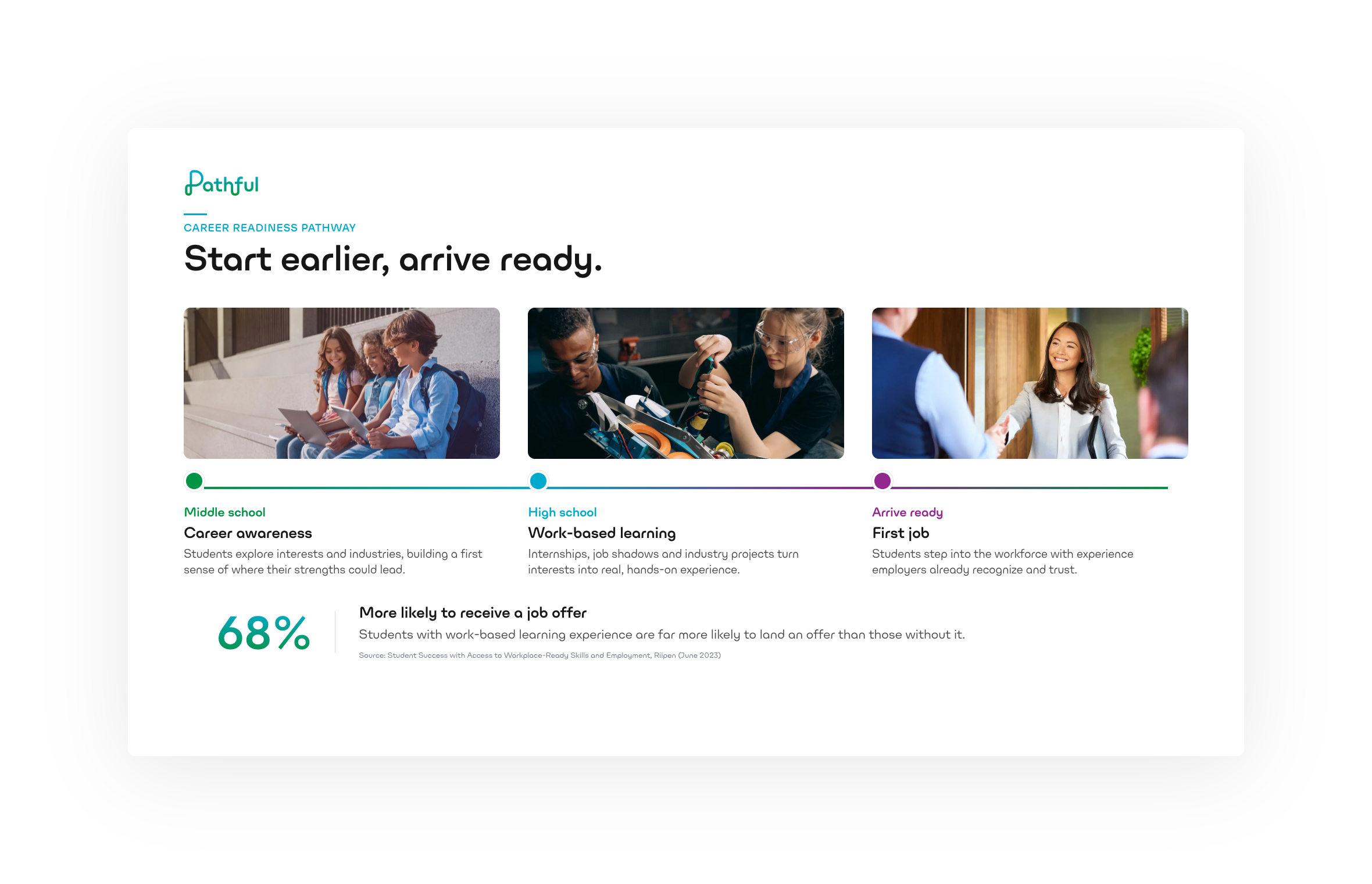
This is where Career Readiness and Development (CRD) has to move from a nice-to-have to a district priority. Career Readiness and Development is not a single event, a resume workshop in senior year, or a one-time interest survey. It is a continuous process of discovery, exploration, preparation, and placement that, done well, starts in middle school and builds year over year. A student who job shadows a nurse in ninth grade, completes an informational interview with a manufacturing supervisor in tenth grade, and finishes a supervised internship or industry-led project before graduation is not walking into the same applicant-tracking-system wall the Forbes article describes. She is walking in with a documented record of exactly the kind of experience employers now say they want to see upfront.
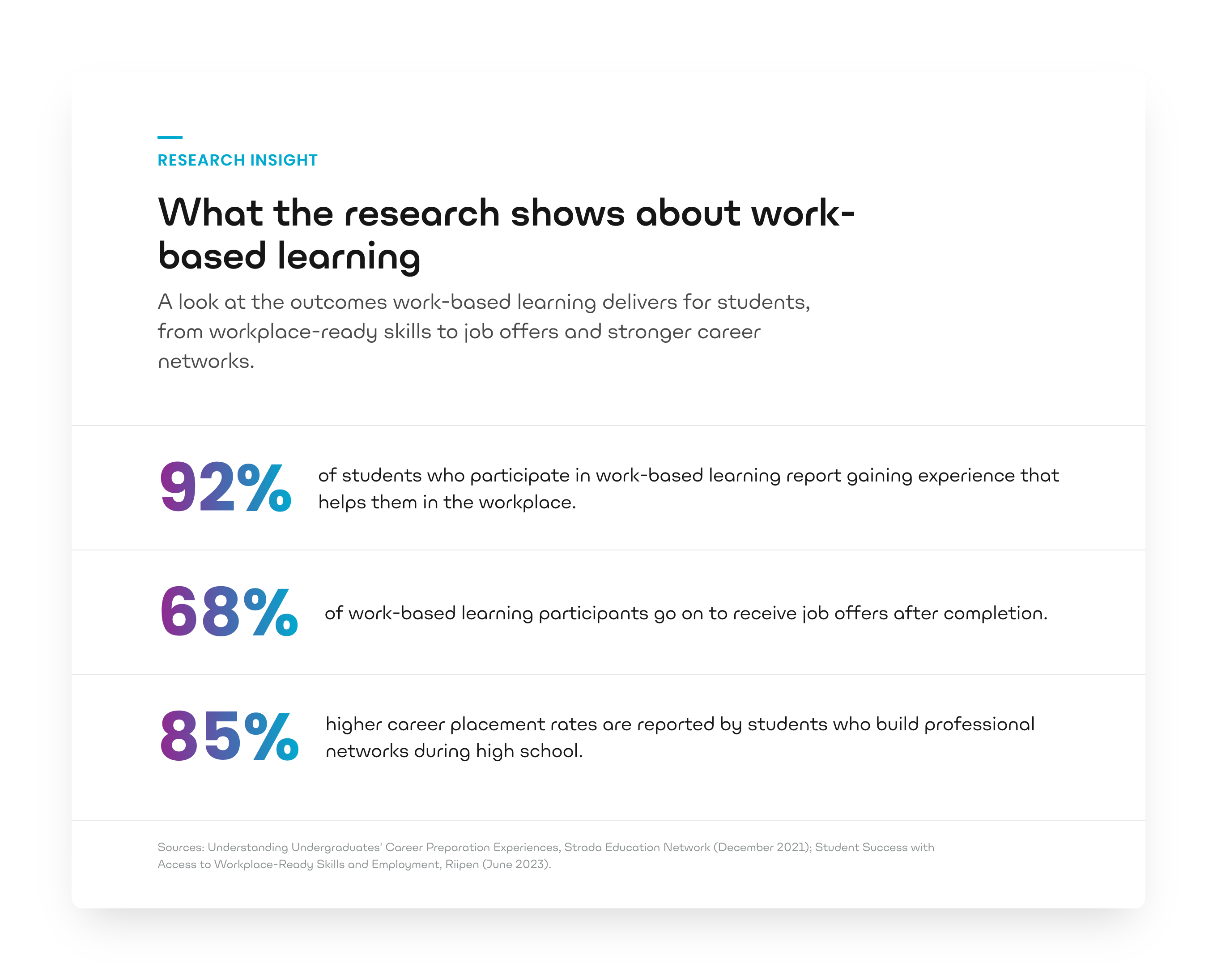
The research on this is consistent, and it is not new. Employers responding to the National Association of Colleges and Employers' 2026 Job Outlook consistently point to teamwork, problem-solving, and communication as the qualities they screen for on a resume, and NACE's Spring Update found that 70% of employers now use some form of skills-based hiring to identify candidates with potential, degree or no degree. Work-based learning is one of the few tools schools have that builds exactly those skills while producing something concrete a student can point to: hours logged, a supervisor evaluation, a completed project, a professional reference.
Work-based learning is not just for CTE concentrators
It is worth being direct about something districts sometimes assume: work-based learning is not a benefit reserved for Career and Technical Education (CTE) concentrators headed straight into a trade. The work-based learning continuum runs from low-commitment career awareness activities, guest speakers, workplace tours, career fairs, all the way up to paid internships and pre-apprenticeships. A future biology major benefits from a job shadow at a hospital lab just as much as a future welder benefits from a job shadow on a manufacturing floor. The continuum is built so every student, regardless of postsecondary plan, can find an entry point that matches their age, interests, and readiness.
- Career awareness (any grade): guest speakers, workplace tours, career fairs, career interest surveys.
- Career exploration (middle school and early high school): job shadowing, informational interviews, career research projects, mock interviews.
- Career preparation (high school): short-term internships, mentorships, industry-led projects, service learning.
- Career training (upperclassmen): paid internships, pre-apprenticeships, apprenticeships, cooperative education.
This is also why Perkins V explicitly ties funding to work-based learning infrastructure. The law requires districts to complete a Comprehensive Local Needs Assessment that examines labor market alignment and program quality, and work-based learning access is one of the clearest ways to demonstrate that a program is meeting that bar. CTE directors evaluating budget priorities already have a mandate to build this out. The question is no longer whether to invest in work-based learning access, it is how to do it at a scale that reaches every student, not only the ones whose parents happen to know a business owner.
What high school students can do right now
The Forbes article is aimed at college seniors staring down a hiring freeze they cannot easily undo. High school students do not have to end up in that position, because they still have runway. A ninth grader has four years to build a record. A junior has two. Even a senior has a semester to close the gap. Here is what that looks like in practice, mapped to the work-based learning continuum.
- Start with career interest assessments and career research projects to identify two or three fields worth exploring, rather than guessing.
- Attend a career fair or workplace tour early in high school, before the pressure of college applications narrows attention.
- Request an informational interview with a professional in a field of interest. It is low-commitment for both sides and produces real insight a resume cannot.
- Complete a job shadow before junior year, so there is time to pursue a more advanced experience afterward if the field is a fit.
- Pursue an internship, industry-led project, or mentorship in eleventh or twelfth grade, and document it with a supervisor evaluation.
- Build a portfolio and a career plan alongside these experiences, so the record is organized and ready to share with a college admissions officer or a hiring manager.
None of this requires a student to already know their exact career. It requires a structure that makes exploration low-risk and well-documented, and it requires adults, counselors, CTE directors, and WBL coordinators, who have the tools to connect students with real employers rather than relying on personal networks alone.
The access problem: most districts cannot do this at scale yet
Here is the uncomfortable part. Most schools want to offer more work-based learning. Most employers say they are willing to participate. The gap between those two groups is almost entirely logistical: an employer does not know how to reach a school, a coordinator does not have time to cold-call sixty businesses, and a student's access to opportunity ends up depending on whether their family already has a professional network. That inequity compounds directly on top of the entry-level hiring squeeze the Forbes article describes, because the students least likely to have a personal connection to an employer are also the students least likely to get a foot in the door once they graduate.
What this means for CTE directors and WBL coordinators
If the entry-level hiring data tells us anything, it is that the return on work-based learning investment is only going to grow. Districts building out their Perkins V budget and Comprehensive Local Needs Assessment this year have a genuine opening to make the case that work-based learning access is not a nice-to-have line item. It is the single most direct way a district can move the needle on the outcome families, school boards, and now the federal government are all asking about: does a student leave this school prepared to earn a living?
- Audit current work-based learning participation by subgroup. Perkins V requires equity data on special populations, and access gaps often mirror the demographic disparities employers already report.
- Use Pathful Opportunities and JobreadyWBL together to track outreach, placements, hours, and compliance documentation in one system rather than a spreadsheet.
- Bring work-based learning data to your next advisory board meeting as evidence for budget requests tied to your CLNA findings.
- Start younger. Middle school career awareness activities build the foundation that makes high school placements land better.
The bottom line
The Forbes data is a warning shot, not a prediction about one graduating class. Applicant tracking systems are not going away, and employers are not going to lower the experience bar back to where it sat in 2022. What schools can control is how much real, documented experience a student has accumulated by the time they walk across the graduation stage, whether that stage is a high school gym or a college arena. Work-based learning is how districts answer that challenge, and it works best when it starts early, reaches every student, and is built on infrastructure, not luck.
Frequently asked questions
Why are entry-level jobs disappearing?
Data from the hiring platform Cadient, reported by Forbes, shows that the share of salaried job openings open to candidates with no prior experience has fallen 73% in four years, from about one in 15 postings in 2022 to one in 50 today. Employers are increasingly relying on applicant tracking systems that filter for demonstrated experience, and roles requiring senior-level experience have doubled over the same period.
Does this trend affect high school students, or only college graduates?
The Forbes reporting focuses on recent college graduates, but the underlying shift, employers wanting demonstrated experience before they will consider a candidate, affects anyone entering the workforce, including high school graduates going directly into jobs, apprenticeships, or the military. Starting work-based learning in high school gives students a multi-year head start on building that experience.
What can a high school student do to prepare for a tougher job market?
Students can move through the work-based learning continuum: career interest assessments and research projects, career fairs and workplace tours, informational interviews, job shadowing, and eventually internships, mentorships, or industry-led projects. Documenting each experience in a career plan or experience tracker turns exploration into a record employers and admissions officers can evaluate.
Is work-based learning only useful for students pursuing a trade or CTE pathway?
No. The work-based learning continuum applies to any postsecondary path, four-year university, community college, apprenticeship, military service, or direct employment. A student headed to college benefits from the same employability skills, professional network, and documented experience as a student headed into a skilled trade.
What is Pathful Opportunities?
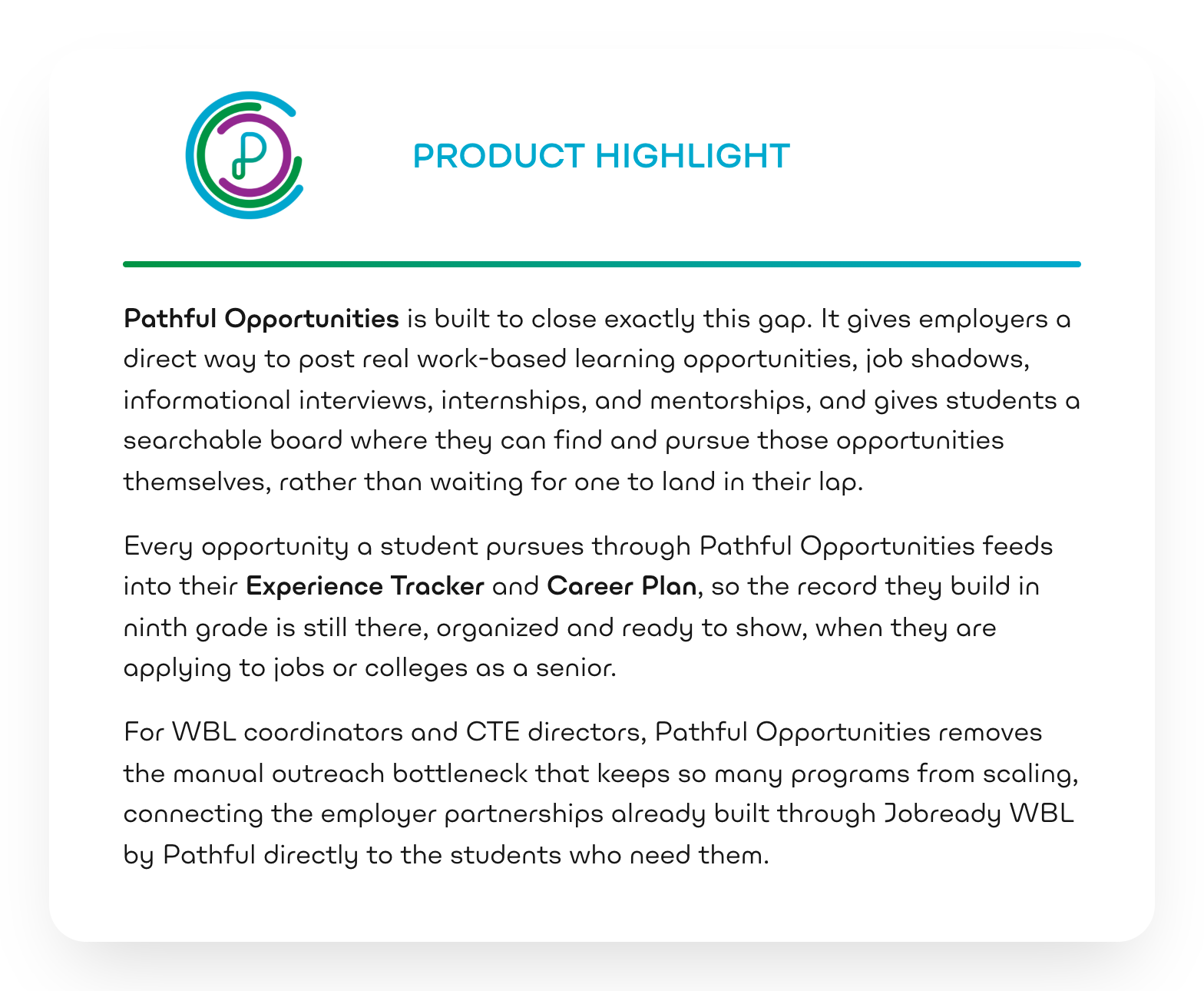
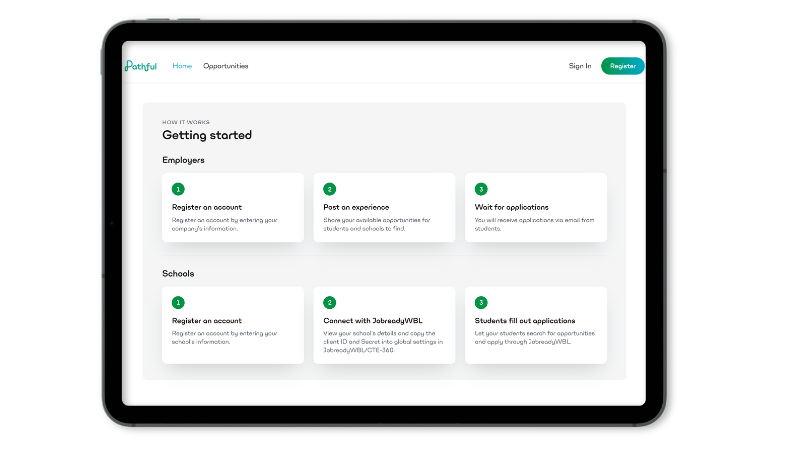
Pathful Opportunities is a feature that lets employers post real work-based learning opportunities, such as job shadows, informational interviews, internships, and mentorships, directly to a searchable board where students can find and pursue them. Opportunities completed through the platform sync automatically to a student's Experience Tracker and Career Plan.
How should CTE directors and WBL coordinators respond to this trend?
Districts should audit current work-based learning participation for equity gaps, use Perkins V's Comprehensive Local Needs Assessment to justify continued investment, and adopt tools like Pathful Opportunities and JobreadyWBL to scale employer outreach and placement tracking beyond what manual coordination can achieve.
Sources
- Forbes. What The Changes In Entry-Level Jobs Mean For New College Graduates. August 2026.
- Federal Reserve Bank of New York. The College Labor Market.
- U.S. Department of Education. U.S. Department of Education Issues Final Rule to Hold Colleges and Universities Accountable for Low-Earning Programs.
- Cadient. AI-Powered Hiring Platform.
- National Association of Colleges and Employers. Job Outlook 2026 Spring Update.
- National Association of Colleges and Employers. Hiring Flat for the College Class of 2026.
- National Association of Colleges and Employers. Trends and Predictions: Job Market.
- National Center for Education Statistics. Fast Facts: Career and Technical Education.
- Congressional Research Service, Library of Congress. Career and Technical Education: A Primer.
- Education Week. The State of Career and Technical Education, in Charts.
- AAC&U. The Career-Ready Graduate: What Employers Say About the Difference College Makes. May 2023.
- Riipen. Student Success with Access to Workplace-Ready Skills and Employment. June 2023.
- Strada Education Network. Understanding Undergraduates' Career Preparation Experiences. December 2021.
- ResearchGate. The Effectiveness of Career Guidance and Counseling Services in Secondary Schools. April 2025.
- U.S. Bureau of Labor Statistics. Employment Situation Summary. September 2025.
- U.S. Bureau of Labor Statistics. Job Openings and Labor Turnover Summary. September 2025.
- The Prichard Committee. Kentucky Employer and Industry Survey Analysis and Report. December 2024.
- Education to Workforce Organization. Indicator: Participation in Work-Based Learning.
- EdNC. Momentum Grows for CTE in North Carolina. April 2026.
- Pathful. Products: Pathful Opportunities, JobreadyWBL, JobreadyCTE.
- Pathful. Pathful Opportunities.
- Pathful. The Complete Perkins V Application Toolkit.
- JobreadyWBL by Pathful. The WBL Management System Playbook.

Ready to make career readiness more meaningful?
Let's talk about how Pathful can support your students and meet your goals.