
From Iowa Tests to Interest Inventories: The History of Career Assessment and What It Means for Students Today
One hundred and sixteen years after Frank Parsons asked how young people find the work they're meant to do, the tools have changed. The obligation hasn't.
There is a question that has sat at the center of education for well over a century, long before we had the technology to answer it well: how do we help young people figure out what kind of work they are meant to do?
It sounds simple. In practice, it has driven educators, psychologists, policymakers, and researchers to build some of the most consequential instruments in American schooling. Career assessments, in their many forms, have shaped guidance counseling, informed federal legislation, and in some cases, changed the direction of individual lives. They have also, at times, fallen short. They have oversimplified. They have pigeonholed. They have given students a score and little else to act on.
Understanding that history matters today, not as a curiosity, but as context. Because the way we assess students' career readiness is once again changing, and the stakes are real. More than 7.2 million jobs remain unfilled in the United States, even as over 7.1 million people are currently unemployed. The gap is not a shortage of workers. It is a shortage of workers who know what they want, who have been given the tools to explore it, and who have had real opportunities to develop toward it.
This post traces the arc of career assessment from its earliest roots through its modern evolution, and explains why the most meaningful shift happening right now is not just what we measure, but what we do with what we learn.
The Beginning: Vocational Guidance and the Progressive Era
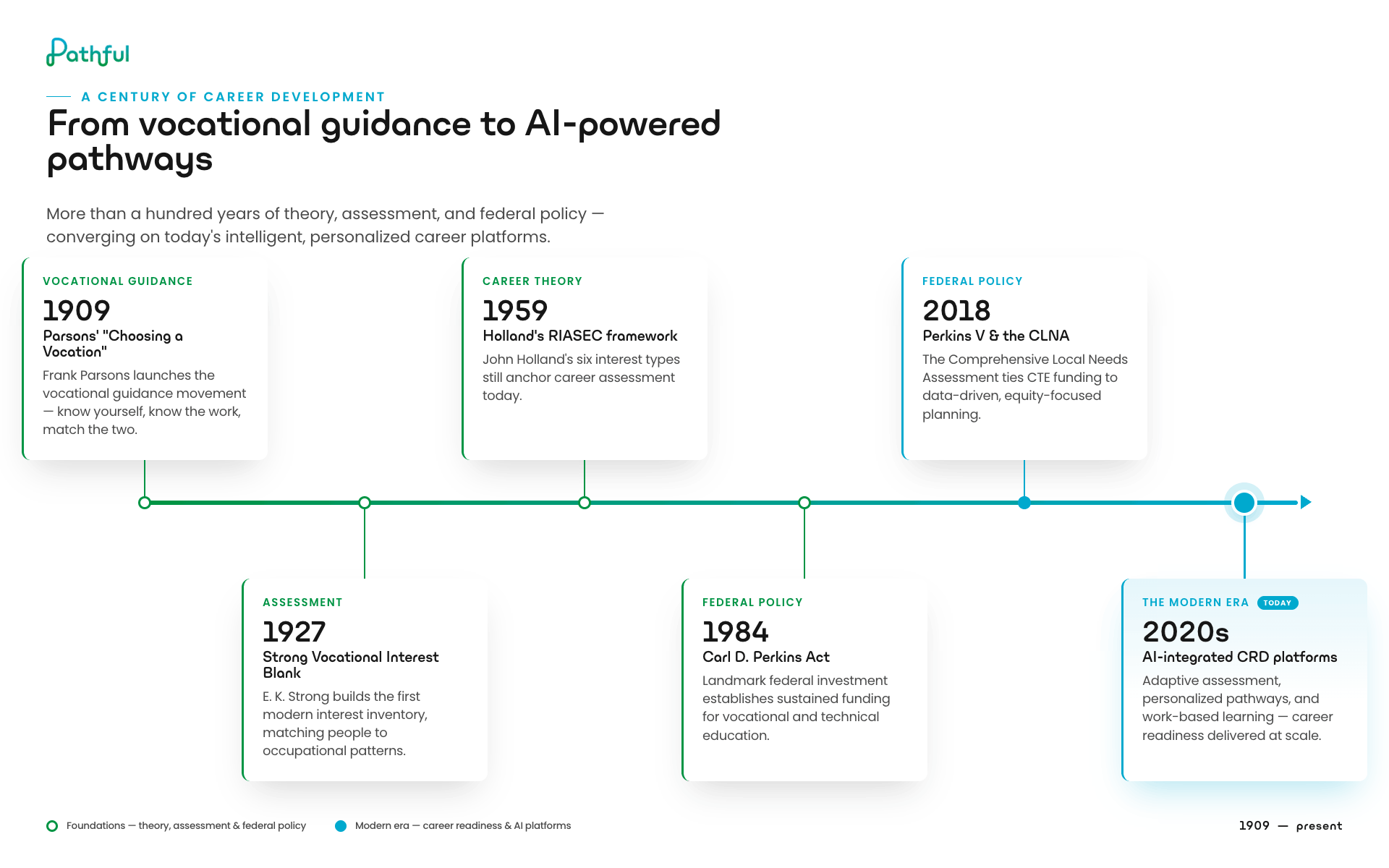
The formal history of career guidance in American schools begins in 1909, with a Boston civic reformer named Frank Parsons. In his landmark text Choosing a Vocation, Parsons articulated a deceptively straightforward framework: know yourself, know the world of work, and apply true reasoning to find the fit between the two. He called this the trait-and-factor approach, and it became the intellectual foundation for a field that would grow dramatically over the following decades.
Parsons was not working with adolescents in schools. He was working with young men in settlement houses, helping immigrants and the urban poor navigate an industrial economy that had more jobs than pathways into them. But his framework migrated quickly into public education, where a growing progressive movement argued that schools had a civic obligation to prepare students not just academically, but vocationally. By the 1910s, Boston, Cincinnati, and New York had established formalized vocational guidance programs, and the movement was spreading.
At this stage, assessment was largely qualitative. A counselor had a conversation. The student identified interests. The counselor matched those interests to available occupations. It was relational, imprecise, and entirely dependent on the knowledge and assumptions of the individual counselor doing the matching.
The Rise of Standardized Testing: Intelligence, Aptitude, and World War I
The first real shift toward standardized assessment came not from schools, but from the military. When the United States entered World War I in 1917, the Army faced the unprecedented challenge of placing nearly four million recruits into appropriate roles as quickly as possible. Psychologists, led by Robert Yerkes, developed the Army Alpha and Army Beta tests, the first large-scale group intelligence assessments ever administered. Alpha was for literate recruits; Beta was for those who could not read English. Together they tested nearly 1.75 million men.
The Army's success with mass testing created enormous enthusiasm for what standardized instruments might do in civilian life. Schools began adopting intelligence testing in the 1920s, and the broader culture developed a strong, if often naive, confidence in the idea that a test could reveal something essential and fixed about a person's potential. This confidence had troubling dimensions, particularly as testing was used to justify racial and class hierarchies. But it also planted the seed of a more constructive idea: that assessment could help match individuals to contexts where they were most likely to succeed.
In 1927, a Stanford psychologist named E.K. Strong published the first edition of what would eventually become the Strong Interest Inventory. Rather than measuring intelligence, Strong's instrument asked respondents about their preferences, whether they liked or disliked particular activities, occupations, and kinds of people. Strong had collected data from professionals who reported high job satisfaction, and he found that satisfied workers in particular fields tended to share similar interest patterns. If a student's pattern resembled that of satisfied engineers, they were more likely to find engineering satisfying too. The logic was empirical rather than theoretical, and it worked well enough to make the Strong one of the most widely used career assessments of the 20th century.
Mid-Century Expansion: Holland, Super, and the Theory of Career Development
By the 1950s, the field of vocational psychology was maturing rapidly, and two theorists in particular would shape how educators thought about assessment for generations. The first was Donald Super, whose 1957 book The Psychology of Careers challenged the trait-and-factor model in a fundamental way. Super argued that career choice was not a single event but a developmental process, a lifelong series of decisions through which people built and revised what he called their self-concept. Career development, in Super's view, had to begin early, unfold over time, and be revisited continuously as circumstances and identities changed.
Super's developmental framework was enormously influential in school counseling because it gave counselors a reason to engage with students well before they were making immediate vocational decisions. It also suggested that the quality of the process mattered as much as the accuracy of any single assessment result.
The second towering figure of this era was John Holland, whose 1959 theory of vocational choice gave the field one of its most durable frameworks. Holland proposed that most people's career interests could be described using six broad types: Realistic, Investigative, Artistic, Social, Enterprising, and Conventional. He abbreviated this framework as RIASEC, and the hexagonal model he used to map relationships among the types became one of the most recognizable images in all of vocational psychology. Holland's theory powered new assessment instruments, including the Self-Directed Search, and its influence can be felt today in virtually every career interest inventory used in schools.
What Holland contributed that was genuinely new was a language for talking about career fit that was accessible to students themselves. Rather than producing a score that required expert interpretation, Holland's framework gave students a profile they could understand and apply on their own. That accessibility mattered enormously for scale.
Federal Policy and the School Counselor: From NDEA to Perkins
While theorists were refining the psychological frameworks for career assessment, federal policy was increasingly shaping how those frameworks reached students. The National Defense Education Act of 1958, passed in the wake of Sputnik, included significant funding for school counseling programs. The logic was partly national security: policymakers wanted to identify students with aptitude for science and mathematics and guide them toward careers that would strengthen the country's competitive position. Testing and guidance were tools of talent identification as much as student support.
This federal investment in school counseling expanded the infrastructure through which career assessments could reach students, but it also embedded a particular set of assumptions. Assessment was largely about sorting, matching students to occupations based on measured traits, rather than empowering students to explore and build their own direction.
The passage of the original Carl D. Perkins Vocational Education Act in 1984 shifted the policy frame in an important way. Perkins funding was directed specifically at career and technical education, and it came with an expectation that programs would be connected to real labor market needs. Subsequent reauthorizations, particularly Perkins IV in 2006 and Perkins V in 2018, deepened those expectations significantly. Perkins V requires districts to complete a Comprehensive Local Needs Assessment, the CLNA, that examines student performance data, labor market alignment, program quality, and equity. Within that framework, career assessments are not simply tools for individual student guidance. They are data sources for system-level program improvement.
For CTE directors today, this means that the quality and utility of the career assessments students complete has implications that extend well beyond any individual student's experience. Assessment data feeds into concentrator tracking, postsecondary placement rates, and Perkins V performance indicators, particularly 5S1 and 5S2, which measure work-based learning participation and credential attainment.
The Digital Turn: From Paper Inventories to Online Platforms
Through the 1970s, 1980s, and into the 1990s, career assessment was predominantly a paper-and-pencil experience. Students completed printed inventories, often under the guidance of a school counselor, and received results that pointed toward general career clusters or occupational families. The instruments were well-validated and theoretically grounded, but the experience of taking them and acting on the results was often disconnected. A student might learn that her profile was strongly Social and Artistic, receive a list of suggested occupations, and then have very little structured support for exploring what any of those occupations actually felt like.
The internet changed that infrastructure. By the late 1990s and early 2000s, career assessment was moving online, and with it came the possibility of linking assessment results to databases of career information, salary data, educational pathways, and local labor market projections. The Occupational Information Network, known as O*NET, launched by the U.S. Department of Labor in 1998, became a foundational resource. Platforms could now take a student's interest profile and connect it directly to detailed occupation descriptions, required skill sets, wage ranges, and projected job growth, all in a single digital environment.
This integration was a genuine advance. It reduced the gap between knowing what you were interested in and understanding what that interest might mean for a career. But it still left a significant piece of the puzzle unaddressed. Knowing that you have a strong Investigative profile and that biochemists earn a median of over $100,000 per year tells you something. Watching a biochemist talk about what she actually does on a Tuesday afternoon tells you something entirely different.
The Modern Era: From Results to Real Exploration
The most significant shift in career assessment over the past decade is not in the assessment instruments themselves. The Strong Interest Inventory, the Holland typology, and the trait-and-factor logic that Parsons articulated in 1909 are all still present in modern tools. The shift is in what happens after the results come back.
For most of the 20th century, assessment was the destination. You completed the inventory, you received a profile, and the guidance relationship might help you interpret it. Today, assessment is increasingly understood as the starting point for a structured journey of exploration, preparation, and connection. And the platforms that make that journey possible are qualitatively different from anything that existed before.
Consider what it means for a student to receive an interest assessment result in an environment that immediately connects that result to a library of virtual job shadows, where real professionals walk through what their days actually look like. Or to an informational interview experience, where the student can hear directly from someone working in that field. Or to a career plan that maps the connection between the student's current course selection and the credential or degree that leads to that occupation. Or to labor market data that shows how much demand for that role exists in the local economy. Each of those connections transforms a static data point into a dynamic invitation to explore.
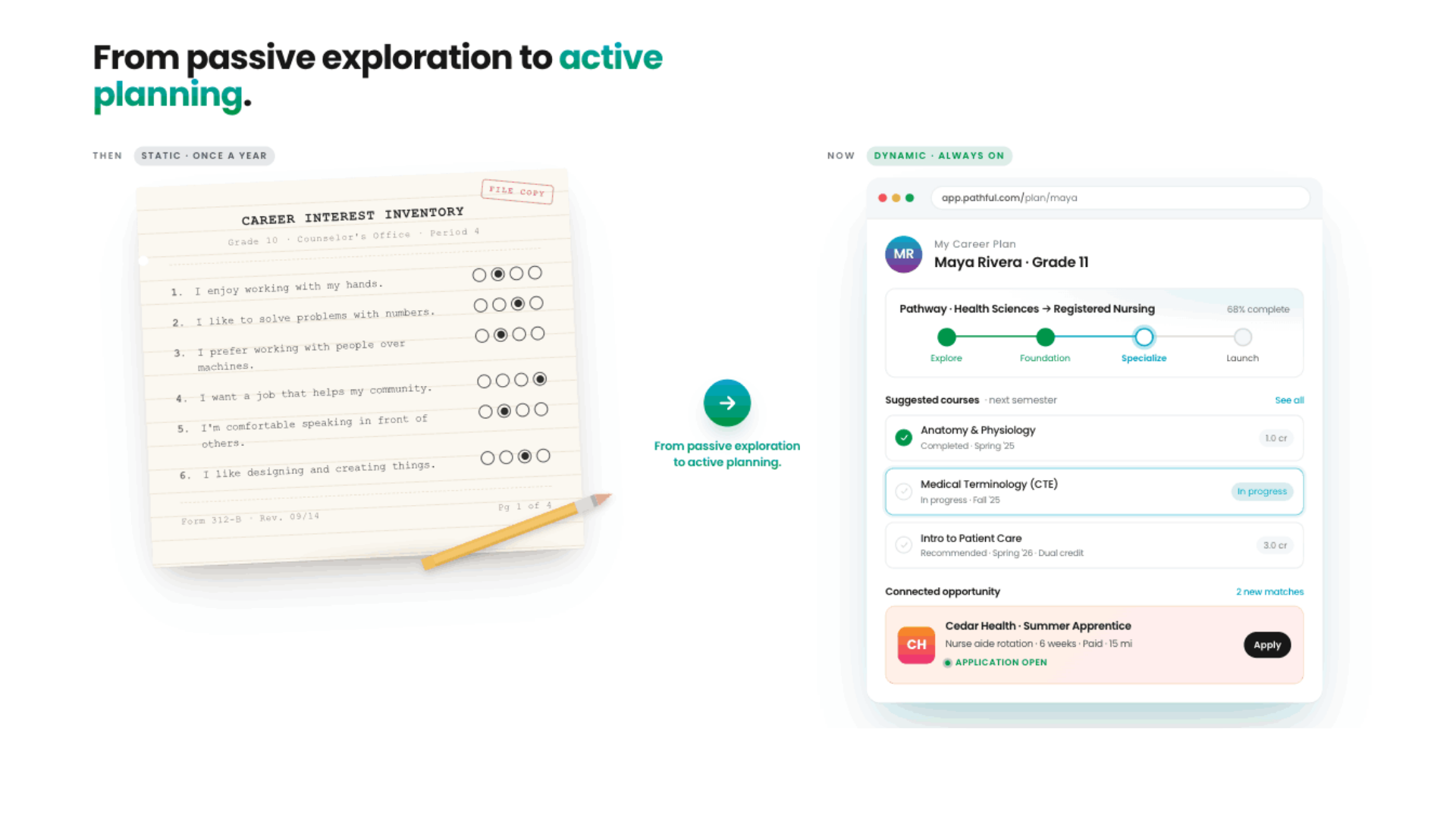
This is not a minor convenience. For students who have limited access to professional networks, who are first-generation college students, or who come from communities with less exposure to diverse career pathways, the difference between a printed list of suggested occupations and an immersive digital experience showing what those occupations look like from the inside is the difference between abstraction and reality.
Research supports the impact of this kind of integrated approach. Students who experience structured career development activities show an average 23 percent improvement in career and workforce outcomes compared to those with limited exposure. Career decision-making difficulties can be reduced by as much as 50 percent when students have access to structured career development interventions. These are not marginal effects. They are the kind of numbers that should reshape how we think about the purpose of career assessment in school.
Aptitude, Personality, and the Push Beyond Interest
One of the meaningful advances in modern career assessment is the expansion beyond pure interest measurement. Interest inventories tell us what students like and dislike. But they do not tell us everything we need to know about fit. Aptitude measures, which examine what students are naturally good at, whether that is spatial reasoning, verbal fluency, numerical analysis, or interpersonal attunement, add a dimension that pure interest data lacks. So do personality frameworks, which help students understand not just what fields they are drawn to, but how they tend to approach tasks, manage relationships, and handle challenges.
Modern platforms increasingly integrate these multiple dimensions, helping students develop a richer and more accurate picture of their own strengths and preferences. This matters because students do not always know what they do not know about themselves. A student who has never encountered a career in data analysis may not realize she is strongly Investigative until she completes an aptitude assessment that surfaces her pattern recognition strengths. The assessment opens a door she did not know was there.
It also matters because the labor market itself is more complex than any single framework captures. Artificial intelligence, automation, and shifting industry structures mean that the specific occupational titles available today will not be the same as those available in ten years. The students in our schools right now will likely change careers multiple times across their working lives. What they need from career assessment is not a fixed destination. They need a growing understanding of their own strengths, values, and ways of working that will serve them across whatever landscape they encounter.
What This Means for CTE Directors and School Counselors
If you are a CTE director reading this, the history of career assessment is not just a story about psychology and pedagogy. It is a story about the infrastructure you are responsible for maintaining and improving. The Perkins V performance indicators your district is accountable for, graduation rates, postsecondary placement, credential attainment, and work-based learning participation, are all downstream of the quality of career development experiences your students have. And career assessment is where many of those experiences begin.
If you are a school counselor, you know that the student-to-counselor ratio in American schools averaged 385 to 1 in the 2022–2023 school year, according to the American School Counselor Association. No counselor working at that scale can provide individualized career guidance to every student through one-on-one conversation alone. The platform matters. The tools your students have access to, and what those tools do with assessment results, directly shape what is possible.
The question worth asking as you evaluate your current approach is not whether you are using an assessment, but what the assessment is connected to. Does a student's interest result lead somewhere? Does it connect to real exploration experiences? Does it feed into a career plan that gets revisited and refined over time? Does it generate data that is useful for your CLNA and your Perkins application?
Conclusion: The Assessment Was Never the Destination
Frank Parsons believed in 1909 that young people deserved a thoughtful process for connecting who they were to the work they would do. One hundred and sixteen years later, that belief is still right. What has changed is the sophistication of our tools, the breadth of our understanding of human development, and the scale at which we can deliver meaningful career exploration experiences to every student, not just those lucky enough to have a well-connected counselor or a family with professional networks.
The history of career assessment is ultimately a story about a field trying to honor a simple obligation: to see students as full human beings with potential, and to give them the best possible chance of finding work that is meaningful to them and valuable to the world.
The tools available today are the best we have ever had for fulfilling that obligation. The question is whether we use them to stop at the score, or to open the door.
Frequently asked questions
Career assessments in K-12 education date back to the early 20th century, beginning with broad aptitude and IQ tests in the 1920s. Over time, instruments evolved to measure vocational interests, with the Strong Interest Inventory emerging in 1927 and Holland's RIASEC theory shaping modern career inventories in the 1950s and 60s. Today's assessments are highly personalized, integrating interest inventories, aptitude measures, labor market data, and career exploration experiences to help students identify meaningful pathways.
Career interest inventories help students identify patterns in their preferences, personality traits, and strengths, then match those patterns to career clusters and specific occupations. When paired with real-world exploration tools such as virtual job shadows and informational interviews, interest inventories help students move from passive awareness to active career identity formation.
Perkins V requires districts to complete a Comprehensive Local Needs Assessment (CLNA) that examines student performance data and program quality. Career assessment tools that support concentrator tracking, postsecondary placement, and credential attainment directly inform Perkins V performance indicators, particularly 5S1 and 5S2, which measure work-based learning participation and credential attainment rates.
Career assessment has shifted dramatically in the past two decades from standardized paper tests to dynamic, digitally delivered platforms that combine interest inventories, aptitude measures, personality frameworks, and real-time labor market data. Modern tools also integrate with career planning software, allowing students to see direct connections between their results and available career pathways, educational requirements, and local job market demand.
Pathful's Assessment Suite provides students with interest and aptitude assessments that connect directly to career exploration experiences including Virtual Job Shadows, Informational Interviews, and Industry-Led Projects. These tools support the full Career Readiness and Development journey, moving students from self-discovery through active career preparation.
Sources
- Holland, J.L. (1959). A theory of vocational choice.
- National Defense Education Act of 1958, Pub. L. No. 85-864, 72 Stat. 1580.
- Carl D. Perkins Career and Technical Education Act of 2006 (Perkins IV), Pub. L. No. 109-270. Strengthening Career and Technical Education for the 21st Century Act (Perkins V), Pub. L. No. 115-224 (2018).
- Advance CTE. (2025). State Policies Impacting CTE: 2025 Year in Review.
- Strada Education Network. (2021). Understanding Undergraduates' Career Preparation Experiences.
- National Association of Colleges and Employers. (2025). Job Outlook 2026.
- Pathful, Inc. (2025). Why Career Readiness and Development Matters.
- U.S. Bureau of Labor Statistics. (2025). Occupational Outlook Handbook.
- XQ Super School. (2023). High School and the Future of Work.
- Riipen. (2023). Student Success with Access to Workplace-Ready Skills and Employment.
- American School Counselor Association. (2024–2025). Student-to-Counselor Ratio Data.

Keep reading.
The students running CTSOs today are running companies tomorrow
The quiet pipeline that's producing America's most work-ready graduates.
Why career readiness and development matters
Closing the gap between graduate preparation and employer expectations.
Building confidence, not just credentials
How schools are supporting student mental health around post-secondary planning.
Ready to make career readiness more meaningful?
Let's talk about how Pathful can support your students and meet your goals.