
What is Perkins V reporting for school districts?
The federal performance indicators, who has to report, and how career readiness platforms centralize the data compliance requires.
Perkins V reporting is one of the most data-intensive responsibilities a Career and Technical Education (CTE) program carries, and for many school districts it is also one of the most time-consuming. Every year, districts must document how their CTE concentrators perform against federal accountability measures and submit that data to their state. As these requirements have grown more complex, many districts have turned to career readiness platforms to centralize the performance data, documentation, and reporting workflows that Perkins V demands.
Pathful is a Career Readiness & Development company that serves millions of students and adult learners through thousands of schools and districts nationwide. This guide explains what Perkins V reporting involves, which performance indicators districts are accountable for, and how modern tools reduce the administrative burden of compliance.
What is Perkins V reporting?
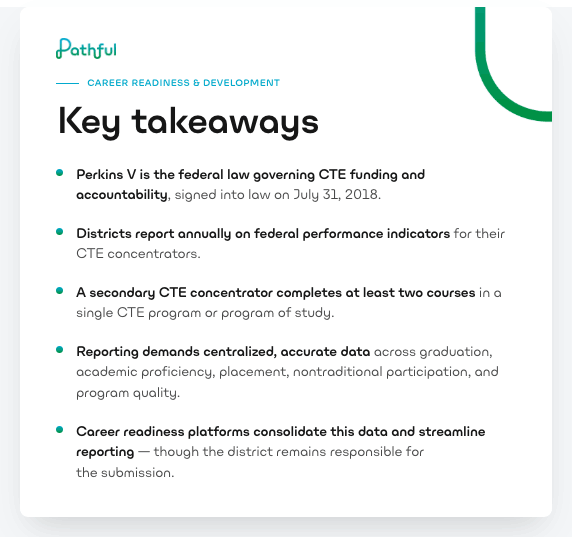
Perkins V reporting is the annual process by which school districts document and submit data showing how their CTE students perform against federally required accountability measures. Districts report outcomes for CTE concentrators to their state education agency, which aggregates the data and reports it to the U.S. Department of Education to maintain federal CTE funding.
The law behind it is the Strengthening Career and Technical Education for the 21st Century Act, commonly called Perkins V. It reauthorized the earlier Carl D. Perkins Act and provides almost $1.43 billion in federal support for CTE programs across all 50 states and U.S. territories. Reporting is the mechanism that ties that funding to demonstrated student outcomes.
What are the Perkins V performance indicators?
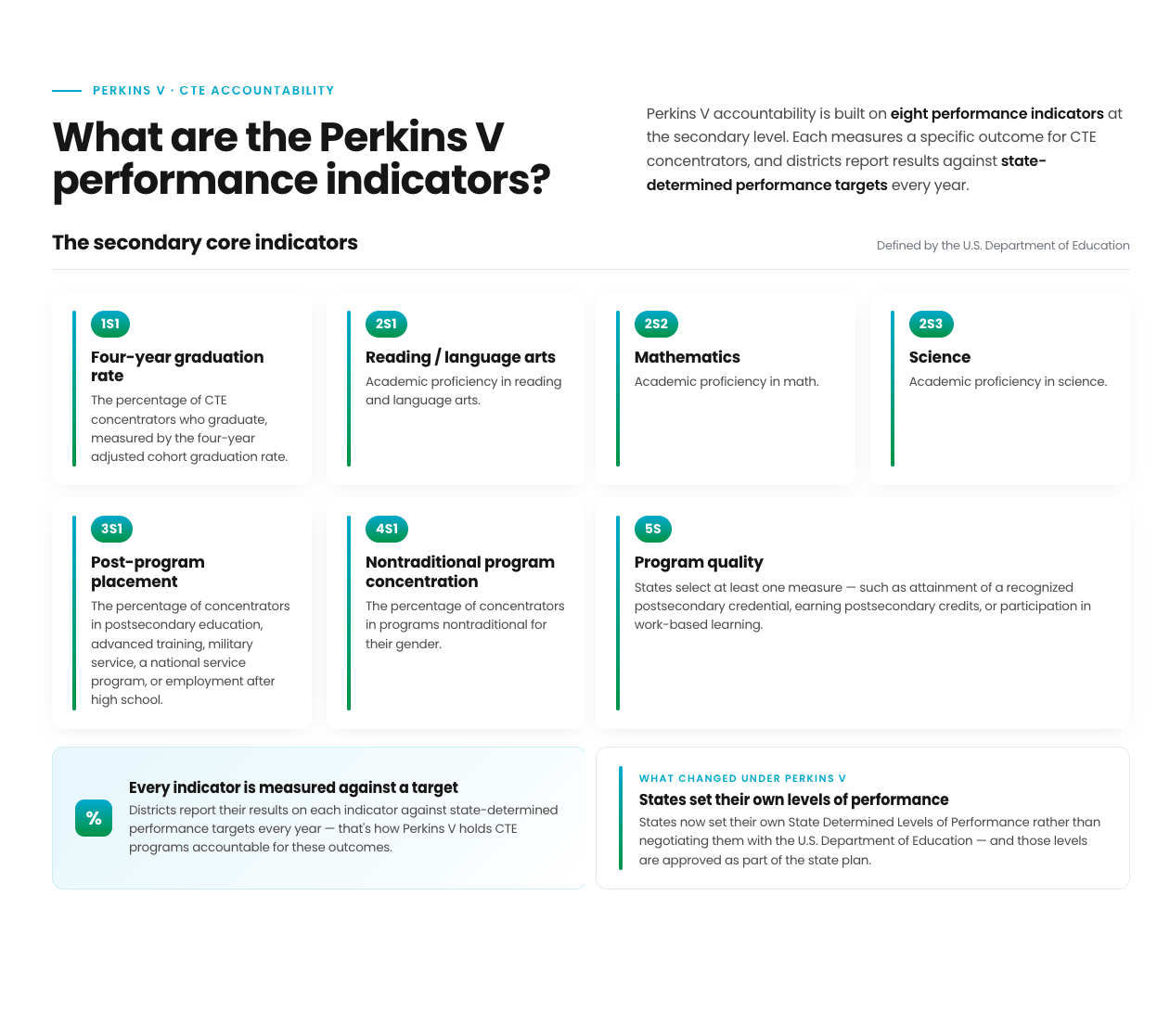
Perkins V accountability is based on eight performance indicators at the secondary level. Each one measures a specific outcome for CTE concentrators, and districts report their results against state-determined performance targets every year.
The secondary core indicators are defined by the U.S. Department of Education and generally include:
- 1S1 (Four-Year Graduation Rate): the percentage of CTE concentrators who graduate, measured by the four-year adjusted cohort graduation rate.
- 2S1 (Reading/Language Arts): academic proficiency in reading and language arts.
- 2S2 (Mathematics): academic proficiency in math.
- 2S3 (Science): academic proficiency in science.
- 3S1 (Post-Program Placement): the percentage of concentrators in postsecondary education, advanced training, military service, a national service program, or employment after leaving high school.
- 4S1 (Nontraditional Program Concentration): the percentage of concentrators in programs nontraditional for their gender.
- 5S Program Quality: states select at least one measure such as attainment of a recognized postsecondary credential, postsecondary credits, or participation in work-based learning.
A key change under Perkins V is that states now set their own State Determined Levels of Performance rather than negotiating them with the U.S. Department of Education, with those levels approved as part of the state plan.
Who has to report under Perkins V?
Eligible recipients of Perkins funding, primarily local school districts and postsecondary institutions, must report. At the secondary level, the reporting population is CTE concentrators. The federal statute defines a secondary CTE concentrator as a student who has completed at least two courses in a single CTE program or program of study, and states are not permitted to narrow that definition with extra requirements such as a minimum GPA.
Districts also complete a Comprehensive Local Needs Assessment, a planning requirement introduced by Perkins V that asks recipients to engage stakeholders and identify performance gaps, including gaps for special populations.
What data do districts have to collect for Perkins V?
To report accurately, districts must track enrollment and course completion to identify concentrators, then connect each student to outcome data across all eight indicators. That means pulling from graduation records, state assessment results, post-graduation placement surveys, credential and work-based learning records, and demographic data disaggregated by special populations.
The challenge is rarely a single data point. It is that the data lives in separate systems: the student information system, assessment platforms, work-based learning logs, credential trackers, and counselor spreadsheets. Pulling it together accurately, every year, is where most of the administrative burden lives.
Why is Perkins V reporting so challenging for districts?
Perkins V reporting is challenging because the required data is scattered across disconnected systems and must be reconciled against precise federal definitions. Many CTE coordinators still manage competency tracking, work-based learning documentation, and audit evidence manually, which is slow, error-prone, and difficult to defend during a state audit.
I lived this problem before I worked in EdTech. As a CTE instructor, I tracked competencies and audit evidence in rooms full of three-ring binders, with no system built for CTE-specific data. That experience is common across districts, and it is exactly the gap that purpose-built tools are designed to close.
How do career readiness platforms support Perkins V reporting?
Career readiness platforms support Perkins V reporting by centralizing the performance data, documentation, and reporting workflows in one system. Instead of reconciling spreadsheets across departments, districts can capture concentrator activity, work-based learning, and credential attainment as they happen, then generate the records needed for state submission.
Pathful's Career Readiness & Development platform connects K-12 students with 45,000+ professionals across 5,000+ companies through virtual job shadows, live industry sessions, skills assessments, and work-based learning management tools. Pathful organizes career readiness around a continuous four-phase framework: Awareness, Exploration, Preparation, and Placement. The Preparation and Placement phases generate exactly the kind of evidence that Perkins V indicators measure, including work-based learning participation, demonstrated competencies, and post-program outcomes.
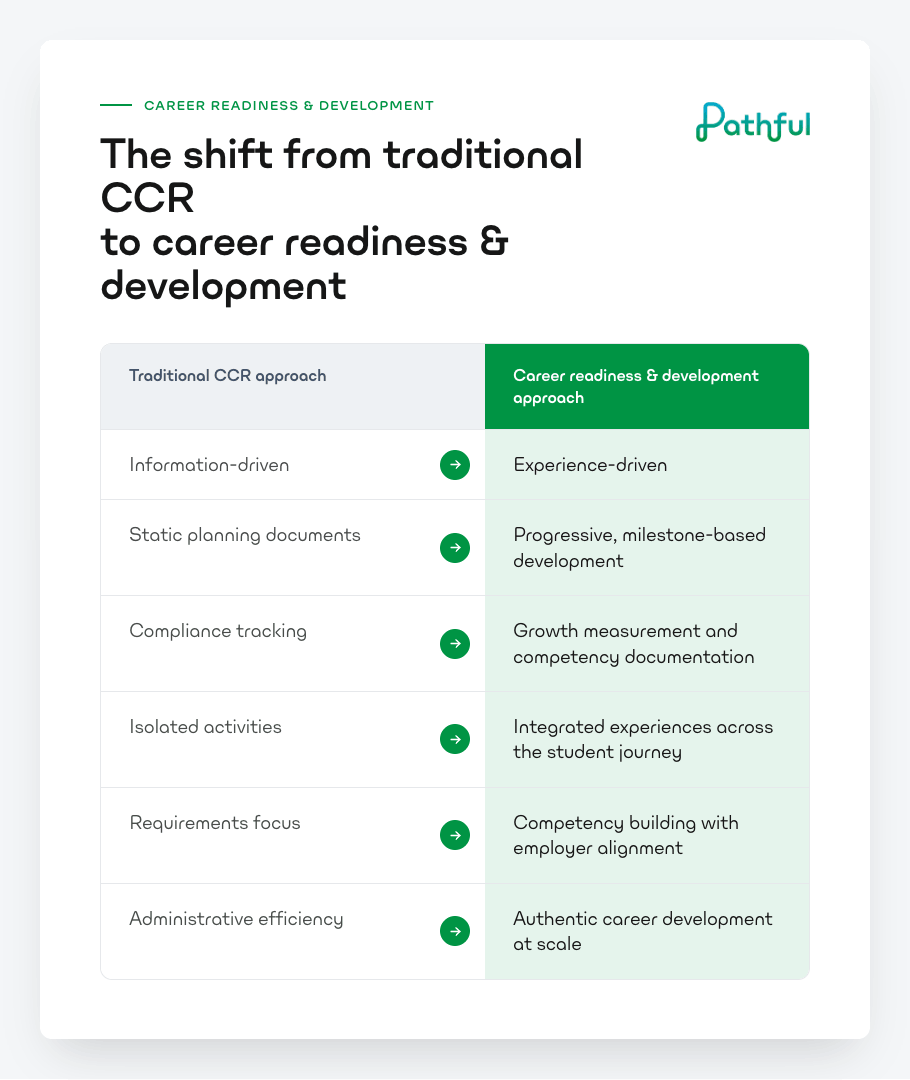
It is worth distinguishing two complementary categories of tools. Traditional College and Career Readiness (CCR) platforms are strong at planning and requirement tracking. A Career Readiness & Development platform builds on that foundation by adding authentic experiences, progressive skill development, and professional connections, which produce the documented outcomes that increasingly anchor accountability reporting.
One honest caveat: no platform "guarantees" Perkins V compliance. The district remains accountable for the accuracy and submission of its data. What the right tools do is reduce manual effort, improve data quality, and make the evidence easier to assemble and defend.
Frequently asked questions
When was Perkins V signed into law?
Perkins V, the Strengthening Career and Technical Education for the 21st Century Act, was signed into law on July 31, 2018. It reauthorized the Carl D. Perkins Career and Technical Education Act of 2006.
What is a CTE concentrator under Perkins V?
At the secondary level, a CTE concentrator is a student who has completed at least two courses in a single CTE program or program of study. States cannot add requirements such as a minimum GPA to this federal definition.
What is the difference between a CTE participant and a concentrator?
A participant generally completes one or more CTE courses, while a concentrator has completed at least two courses in a single program or program of study. Perkins V accountability reporting focuses on concentrators.
How often do districts report Perkins V data?
Districts report annually. State agencies aggregate district data and submit it to the U.S. Department of Education each year to demonstrate progress against state-determined performance levels.
What is a Comprehensive Local Needs Assessment?
The Comprehensive Local Needs Assessment is a Perkins V requirement that asks recipients to engage stakeholders, evaluate program performance, and identify gaps, including gaps affecting special populations, to guide how funds are used.
Can a career readiness platform guarantee Perkins V compliance?
No. A platform can centralize data, streamline documentation, and make reporting faster and more accurate, but the district remains responsible for the accuracy and submission of its accountability data.
Sources
- U.S. Department of Education. Perkins V Frequently Asked Questions. December 2024.
- Iowa Department of Education. Perkins V.
- Wisconsin Department of Public Instruction. Perkins V Accountability Reports.
- Nebraska Department of Education. Perkins Performance Indicators.
- Illinois Community College Board. Data and Accountability.
- Association for Career and Technical Education (ACTE). Perkins 101: Accountability. February 2025.

Keep reading.
The complete Perkins V application toolkit
A step-by-step guide for CTE directors — CLNA templates for all five required elements, a budget worksheet, and the mistakes to avoid.
The complete work-based learning partnership builder
Cold outreach templates, internship agreement forms, a workplace mentor guide, and a partnership tracking system for WBL coordinators.
Connecting career exploration in high schools to student ILPs
How school counselors and CTE leaders can turn exploration into a living, documented roadmap for every student.
Ready to make career readiness more meaningful?
Let's talk about how Pathful can support your students and meet your goals.