
How professional volunteers, authentic experiences, and AI are working together to maximize career readiness and development
Mentoring, work-based learning, and AI each move the needle on student outcomes. Here is what happens when districts combine all three.
Ask any school counselor what they wish they had more of, and the answer is rarely "another dashboard." It is time. Time to build real relationships between students and working professionals. Time to get students into an actual workplace instead of just reading about one. And increasingly, time to figure out where artificial intelligence actually helps that work rather than getting in its way. After nearly two decades in edtech, I have come to believe the strongest Career Readiness and Development (CRD) programs are not choosing between human connection and technology. They are combining professional volunteers, authentic work-based experiences, and AI into a single system, and the data on why that combination works is stronger than most districts realize.
The Readiness Gap Is Real, and It Is Not Closing on Its Own
Employers continue to report that graduates arrive underprepared in the durable skills that matter most on the job: communication, critical thinking, adaptability, and collaboration. The Association of American Colleges and Universities has tracked this gap for nearly twenty years, and its research consistently shows employers value these human competencies as much as, if not more than, a student's major or GPA. At the same time, the World Economic Forum's Future of Jobs Report projects that a large share of workers' core skills will need to change by 2030, driven largely by AI and automation. Those two data points sit side by side for a reason. The workplace is changing fast, and the skills employers say they cannot find are precisely the ones that develop through relationships and real experience, not through a worksheet or a single class period.
Professional Volunteers Bring Something Curricula Cannot
Mentoring is one of the best-researched interventions in youth development, and the long-term numbers are striking. A re-analysis of a thirty-year Big Brothers Big Sisters study, conducted in partnership with Harvard University and using data collected over three decades, found that mentored youth saw a fifteen percent increase in earnings between ages twenty and twenty-five and were projected to earn fifty-six thousand dollars more by age sixty-five than their non-mentored peers. Mentored youth were also ten percentage points more likely to enroll in college. In 2025 alone, the MENTOR National Mentoring Partnership connected over sixteen thousand people to local mentoring opportunities and extended relationship-centered mentoring initiatives to two hundred eighty-five thousand young people nationwide.
The benefit is not one-directional. Research on skills-based volunteering shows that professionals who mentor or teach students report measurable gains in their own workplace skills, including communication, leadership, and project management, particularly when the volunteering experience is structured and sustained rather than a single one-off event. The Organisation for Economic Co-operation and Development has described volunteering as a genuine pathway to career readiness and personal growth for the young people involved, not just a feel-good add-on to a school calendar. When a CTE director or WBL coordinator recruits an advisory board member, a job shadow host, or a classroom guest speaker, they are not filling a compliance checkbox. They are activating one of the most evidence-backed levers available for student outcomes.
Authentic Experience Turns Exposure Into Readiness
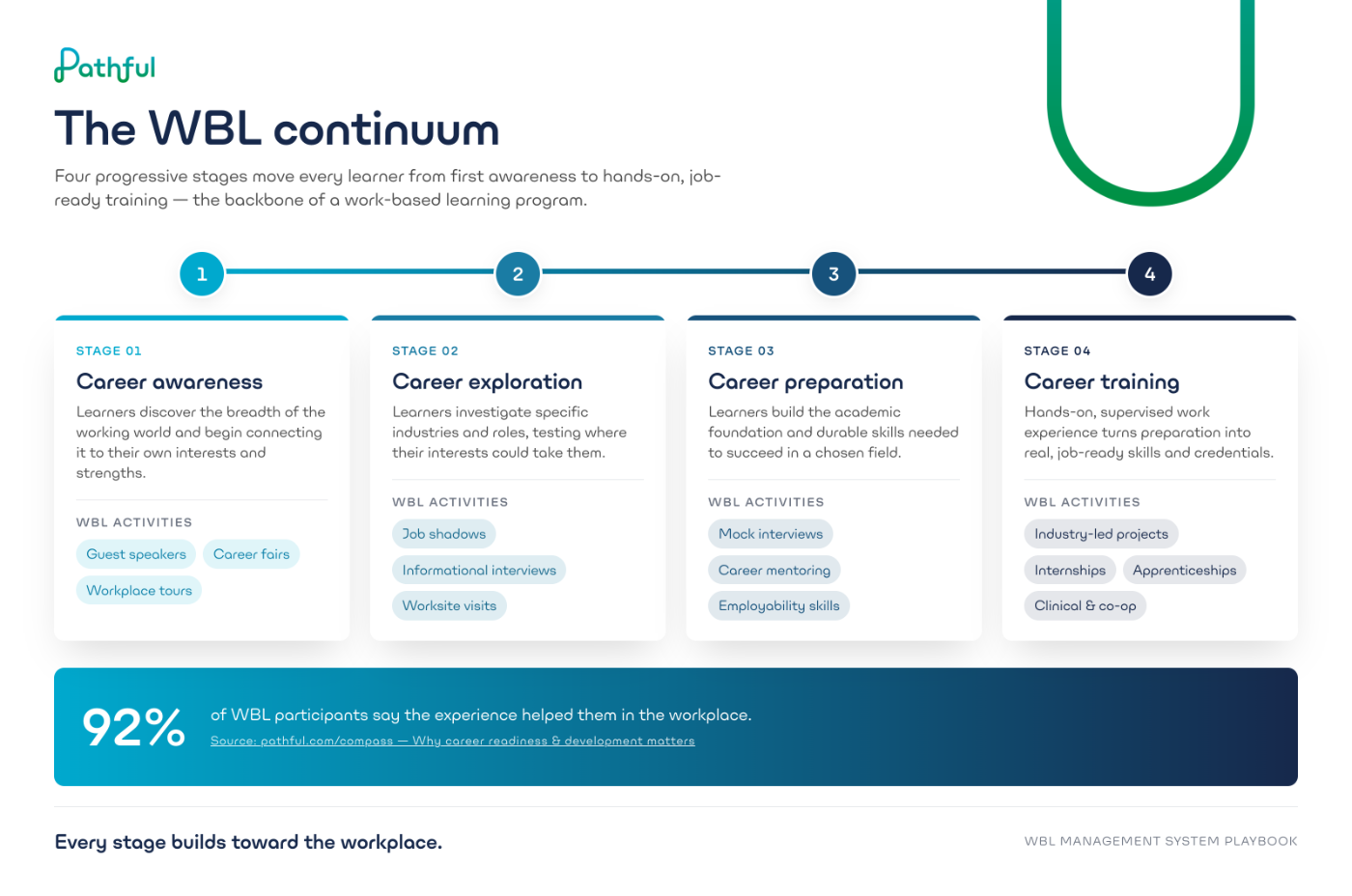
Volunteers matter most when they are connected to real, structured experience rather than a single afternoon presentation. Work-based learning, spanning everything from job shadowing and informational interviews to internships and cooperative education, gives students the chance to apply classroom learning in an actual workplace and to be evaluated against real standards. The data on outcomes is consistent across sources: ninety-two percent of students who participate in work-based learning report gaining experience that helps them in the workplace, and sixty-eight percent receive job offers after completing their placement. Students who build professional networks while still in school report eighty-five percent higher career placement rates than peers who do not.
Yet access to these experiences remains uneven. Employer surveys show that more than eighty percent view collaboration between schools and businesses as essential, but fewer than twenty percent report frequent interaction with K-12 schools. That gap between stated intent and actual practice is exactly where a coordinated volunteer and employer engagement strategy, the kind built into a Comprehensive Local Needs Assessment under Perkins V and formalized through an active industry advisory committee, turns willingness into participation. Perkins V explicitly permits state and local agencies to spend federal CTE funds on work-based learning coordination, employer partnership development, and student transportation to job sites, which means districts already have a funding pathway to build exactly this kind of program.
Where AI Actually Fits
Students are not waiting for permission to use AI. A nationally representative RAND Corporation survey found that fifty-four percent of middle and high school students reported using AI for school in 2025, up more than fifteen percentage points in just two years, and high school usage alone reached sixty-one percent. Teacher use has grown just as quickly, jumping from twenty-five percent to fifty-three percent in a single year. Used well, AI can help a counselor surface a labor market data point in seconds, help a student draft a first version of a resume, or help a WBL coordinator match student interests to available placements faster than a spreadsheet ever could.
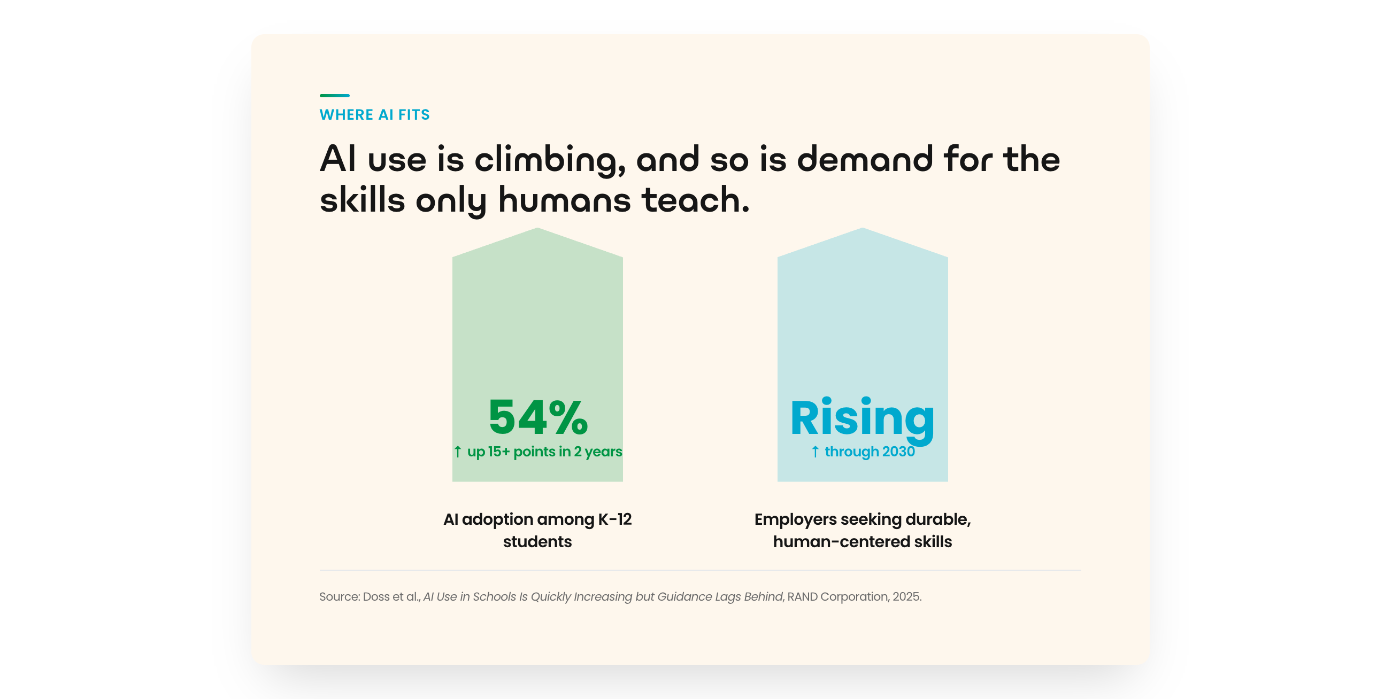
But AI is reshaping career preparation, not replacing the human parts of it. The National Association of Colleges and Employers found that among employers seeking early career talent with AI skills, the specific capabilities they want are ones that let a person use AI to complement human judgment, not substitute for it. Research from the World Economic Forum and McKinsey Global Institute reaches a similar conclusion from the other direction: demand for durable, human-centered skills such as adaptability, collaboration, and leadership is rising even as AI adoption accelerates, because the vast majority of the skills employers want show up in both automatable and non-automatable work. AI is a tool for scaling access to career information and streamlining coordination. It is not a substitute for a mentor's feedback, a supervisor's evaluation, or the trust built during a semester-long internship.
The Combination Is the Point
None of these three elements performs at its best in isolation. A mentor without a structured placement is a nice conversation but not a career pathway. A work-based learning placement without any technology behind it is difficult to track, document, and scale across a district. And AI without human mentorship and real-world experience risks giving students information without judgment, guidance without relationship, and exposure without accountability. The research on integrated career development bears this out directly: students who experience career development woven consistently throughout their education, rather than as a single unit or a single semester, show a twenty-three percent improvement in career and workforce outcomes and a fifty percent reduction in career decision-making difficulty compared to students with limited exposure.
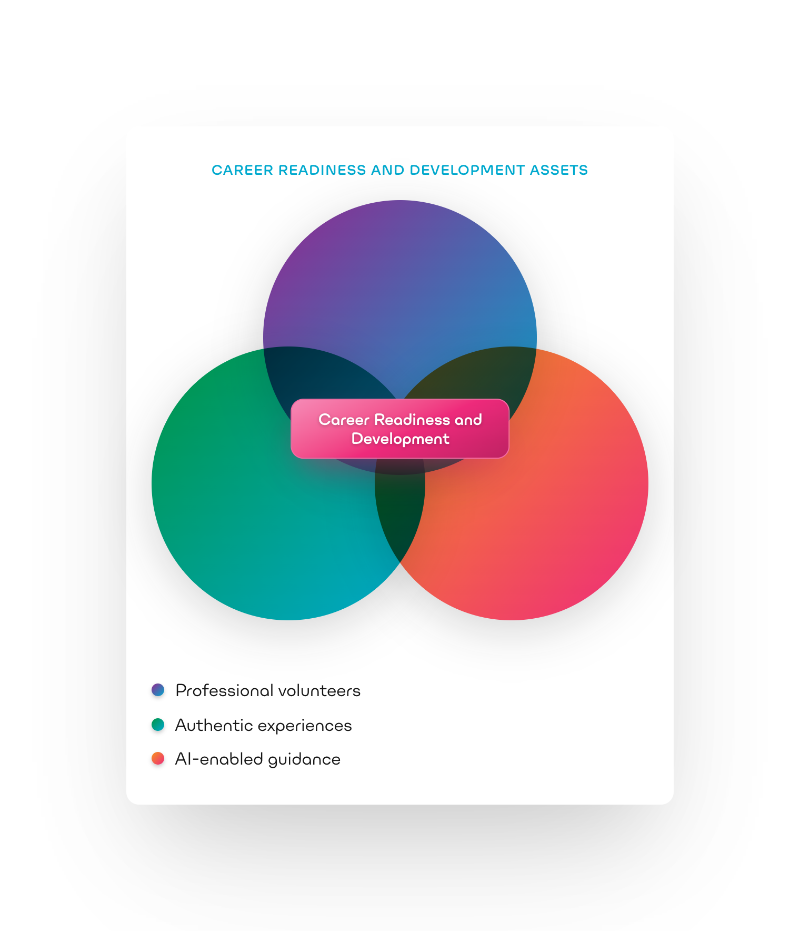
A well-designed Career Readiness and Development strategy treats professional volunteers, authentic experience, and AI as three legs of the same stool. Volunteers and advisory board members shape what students learn and who they meet. Work-based learning turns that exposure into documented, credential-connected experience. AI-enabled tools help schools track it all, personalize it for more students, and free up counselor and coordinator time to spend on the relationships that actually move the needle. Districts that already run a WBL advisory committee, a CLNA-informed Perkins application, and a career exploration platform are closer to this integrated model than they may realize. The next step is usually not adding a fourth initiative. It is connecting the three that already exist.
Where to Start
If your district already has an industry advisory board, an active WBL program, and some form of career exploration technology in place, look for the seams between them. Are volunteers connected to a documented placement, or do they show up once and disappear? Is your technology tracking student growth over time, or just logging attendance at a single event? Is AI freeing up staff time for more relationship-building, or adding one more login nobody uses? Career Readiness and Development works best when it is designed as a connected system rather than three separate initiatives competing for the same class period.
A Note on Getting Started
Districts do not need to solve for all three elements at once. Start by strengthening whichever leg is weakest. If your advisory board has not met this year, that is the first call to make. If your WBL tracking still lives in a shared spreadsheet, that is the next process to fix. And if staff are spending hours on manual coordination that a career readiness platform could handle, that is worth a conversation. The goal is not more programs. It is a more connected one.
Read more about Pathful's Professional Volunteer Impact here.
Frequently Asked Questions
Can AI replace mentors and professional volunteers in Career Readiness and Development programs?
No. Research from the World Economic Forum and McKinsey Global Institute, and from NACE, consistently shows employers want graduates who can use AI to support human judgment, not substitute for it. AI can help schools scale access to career information and streamline coordination, but the relationship-building, feedback, and accountability that come from mentors and real workplace experience remain distinctly human contributions.
What is the role of professional volunteers in career readiness?
Professional volunteers serve as mentors, guest speakers, advisory board members, and work-based learning hosts. Long-term research, including a thirty-year Big Brothers Big Sisters and Harvard University study, links youth mentoring to measurably higher lifetime earnings and higher college enrollment rates.
How do work-based learning and AI work together in schools?
AI-enabled career readiness platforms can help schools track work-based learning participation, match students to placements, and document outcomes for compliance and continuous improvement, while the actual learning happens through the human relationships built during the placement itself.
How can a district fund a combined volunteer, work-based learning, and technology strategy?
Perkins V funds are explicitly allowable for work-based learning coordination, employer partnership development, career exploration tools, and related technology, provided the expenditures trace back to needs identified in a district's Comprehensive Local Needs Assessment.
Sources
- Pathful, Inc. Why Career Readiness & Development Matters: Closing the Gap Between Graduate Preparation and Employer Expectations. October 2025.
- Jobready360 by Pathful. The WBL Management System Playbook.
- Pathful, Inc. The Complete Perkins V Application Toolkit.
- MENTOR: National Mentoring Partnership. 2025 Impact Report.
- U.S. Department of Justice, Office of Juvenile Justice and Delinquency Prevention. Mentoring.
- Afterschool Alliance. Thirty years of data reveal the long-term impact of youth mentorship. July 2025.
- ScienceDirect. Skills-based volunteering: A systematic literature review of the intersection of skills and employee volunteering.
- Frontiers in Psychology. Widely Assumed but Thinly Tested: Do Employee Volunteers' Self-Reported Skill Improvements Reflect the Nature of Their Volunteering Experiences?
- OECD Education and Skills Today. Volunteering: The pathway to personal growth and career success. February 2025.
- National Association of Colleges and Employers. Demand for AI Skills in Entry-level Jobs Nearly Triples Since Fall 2025. April 2026.
- America Succeeds. The Future of Work is Human: Why Durable Skills Are the Key to Workforce Success. December 2025.
- America Succeeds. The Durable Skills Advantage: Preparing Students for Work, Life, and What Comes Next. December 2025.
- AAC&U. The Career-Ready Graduate: What Employers Say about the Difference College Makes. May 2023.
- RAND Corporation. AI Use in Schools Is Quickly Increasing but Guidance Lags Behind: Findings from the RAND Survey Panels. September 2025.
- RAND Corporation. More Students Use AI for Homework, and More Believe It Harms Critical Thinking: Selected Findings from the American Youth Panel. March 2026.
- Stanford Accelerator for Learning. Artificial Intelligence in K-12 Schools. SCALE Initiative.
- Education Commission of the States. Perkins V: Expanding Opportunities for Work-Based Learning.
- Thomas B. Fordham Institute. The new Perkins Act is a great opportunity to invest in work-based learning.
- U.S. Bureau of Labor Statistics. Job Openings and Labor Turnover Summary. September 2025.
- U.S. Bureau of Labor Statistics. Employment Situation Summary. September 2025.
- ResearchGate. The Effectiveness of Career Guidance and Counseling Services in Secondary Schools. April 2025.
- Inside Higher Ed. Overconfident Students, Dubious Employers. February 2018.
- Pathful Compass. 28,458 Students. 891 Professionals. 100% Authentic.

Ready to make career readiness more meaningful?
Let's talk about how Pathful can support your students and meet your goals.