A library of short-form FlexLessons pairs one academic skill with one real professional who uses it every day, giving core teachers a ready answer to "when am I ever going to use this?"
Every core teacher has heard some version of the same question: "When am I ever going to use this?" It usually comes up during a fractions unit, a persuasive essay, a lab report, or a civics lesson, and it rarely comes with an easy answer in the middle of a lesson plan already packed to the minute.
Academics in Action FlexLessons were built to give teachers that answer, without asking them to build it themselves.
What Academics in Action actually is
Academics in Action is a library of short-form FlexLessons, each one built around a single academic skill and a single real professional who uses that skill for a living. Every lesson runs 30 to 45 minutes, fits inside a class period, and follows the same activity flow so students (and teachers) always know what's coming next:
- Concept Reading and Quiz — a short passage that introduces the academic concept through the lens of the featured career, followed by questions that get students thinking before they've even met the professional.
- Video Job Shadow — students watch a real working professional talk through their job, then answer a short quiz that checks what they picked up, with a "listen for" list that points them toward the moments that matter.
- Skill-Based Challenge — the heart of the lesson. Students step into the professional's role and apply the academic concept to a scenario modeled on real, on-the-job decisions, not a generic word problem.
- Career Connection — a narrative reading that tells the professional's career story and grounds the academic skill in the bigger picture of their day-to-day work.
- Reflection — one closing prompt that has students name something the lesson changed or added to how they think about school skills showing up in real careers.
Plug and play, built for real-world application
Because every lesson follows the same shape, a teacher who has never used Pathful before can assign one with almost no ramp-up. It's already written, already aligned, and already anchored to a real person doing the job. There's no unit to redesign and no career content to research and build from scratch. A teacher picks a lesson that matches the skill on the calendar, whether that's scaling recipes with fractions or drafting a persuasive paragraph, and assigns it as-is. Whatever academic standard the teacher is required to teach stays exactly where it belongs, front and center, with the career simply standing in as proof that the skill matters outside the classroom.
That plug-and-play design is also what makes Academics in Action genuinely cross-curricular. The same lesson shows up in Math, ELA, Science, and Social Studies classrooms as Career Readiness and Development (CRD) content, without becoming "one more program" layered on top of a teacher's existing curriculum. CTE teachers, meanwhile, can assign those same lessons to reinforce academic skills their students need but don't always get enough practice with, tying that practice directly to the career pathway students are already interested in. Two audiences, two different goals: a core teacher builds career awareness into an academic skill, while a CTE teacher builds academic skill into a career context.
Four lessons worth a look
The library spans Math, ELA, Science, and Social Studies, with many lessons available across each subject. Here's a look at one lesson from each core area.
Math: Financial Analyst
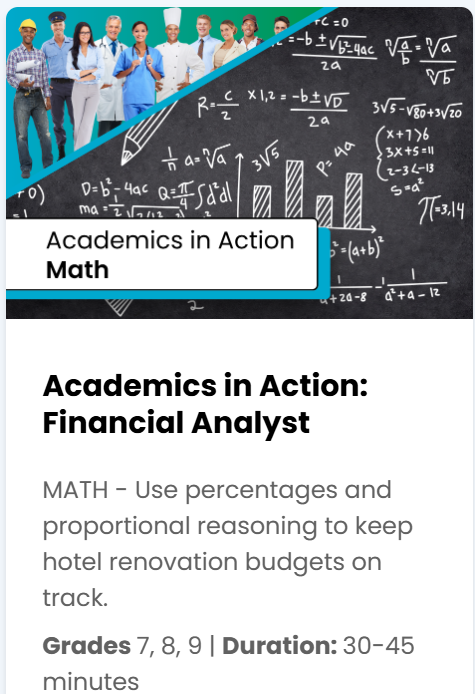
Kyle Spurr crunches numbers for a living at Elements Hospitality in Washington, and this Math lesson, built for grades 7 through 9, uses percentages and proportional reasoning to show students what that actually looks like day to day: spotting trends, calculating growth, and making the case for a business decision. Students work through the same kind of proportional thinking Kyle uses to help a hospitality business understand where its money is going and where it's headed next.
Science: Veterinary Pathologist
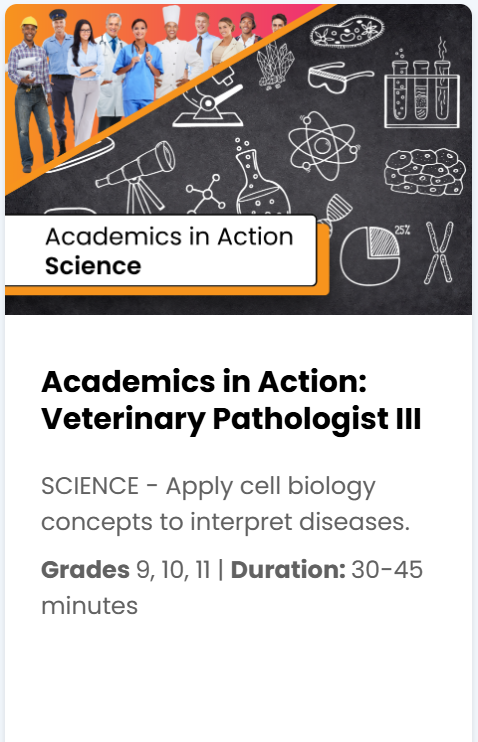
When Dr. Nancy Steadman diagnoses illness in animals at Busch Gardens Tampa, she's relying on cell structure, cell division, and disease concepts most students only meet in a textbook. This Science lesson, offered for grades 9 through 11, connects the two, showing why understanding what happens at the cellular level matters when the patient can't describe its own symptoms. The lesson is built across multiple grade bands, so the same career can support a middle school life science standard or a more advanced high school biology course.
ELA: Grant Coordinator
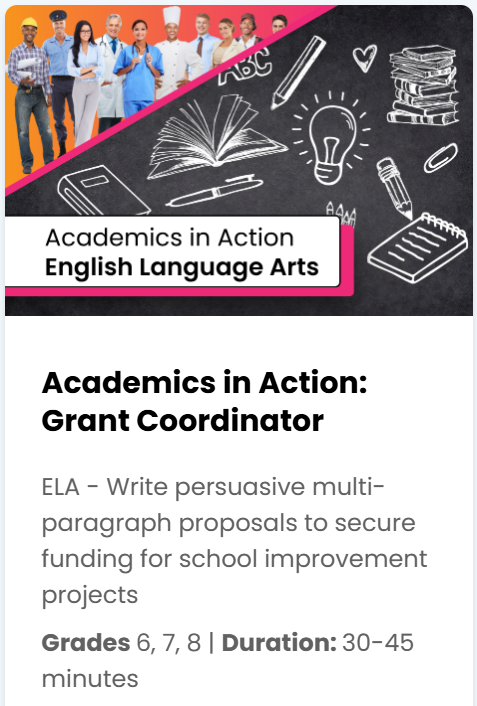
For Frank Davis, who coordinates a subsidized training and employment grant for the Colorado Department of Labor and Employment, writing clearly isn't just a school skill. This lesson, geared toward grades 6 through 8, has students learn that a single unclear sentence in a federal report or a disorganized paragraph in a proposal can cost an organization real funding, and real funding means real job training for real people. The Skill-Based Challenge has students draft their own four-paragraph mini-grant proposal, competing for a fictional $5,000 in school improvement funding, using the same persuasive structure and audience awareness Frank relies on every day.
Social Studies: City Council Member
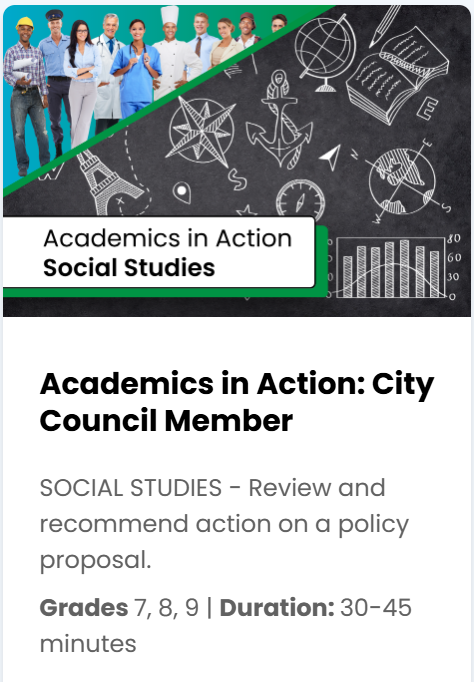
James Brown sits on the city council in Lexington, Kentucky, and this Social Studies lesson, for grades 7 through 9, connects civics standards to the practical, everyday skills of local government: how policy actually gets made, how a council member represents constituents, and how compromise and communication turn an idea into a decision that affects a whole community. It's civics with a face and a name attached, not just a chapter in a textbook.
Why this matters for your role
- Classroom teachers get a plug-and-play way to bring CRD into a subject area without giving up a unit of instruction or building anything from scratch. Assign a lesson, and students get real-world application of the skill already on the lesson plan.
- Counselors and CTE directors can use these lessons as a low-lift entry point for CRD in classrooms that don't otherwise have one, especially where core teachers are stretched thin.
- WBL coordinators already have a first step built in: every lesson doubles as a Video Job Shadow experience students can build on toward a live session or workplace visit.
- District and school leaders get proof that Career Readiness and Development isn't confined to a single CTE elective. It's already showing up in Math, ELA, Science, and Social Studies classrooms, one lesson at a time.
Search, assign, go
New Academics in Action lessons are added to the library on an ongoing basis, and they live in Pathful's Career Lessons library alongside the rest of the FlexLesson catalog. To find them, hover over Career in the top menu, click Career Lessons, and type "Academics in Action" into the search bar. From there, you can browse by core subject, grade band, or career. Pick out the lessons that align with your content area so you have the answer to when they'll ever use this queued up.
Was this article helpful?
Thanks for letting us know!

Keep exploring.
Can't find what you need?
Our support team is here to help you make the most of Pathful.