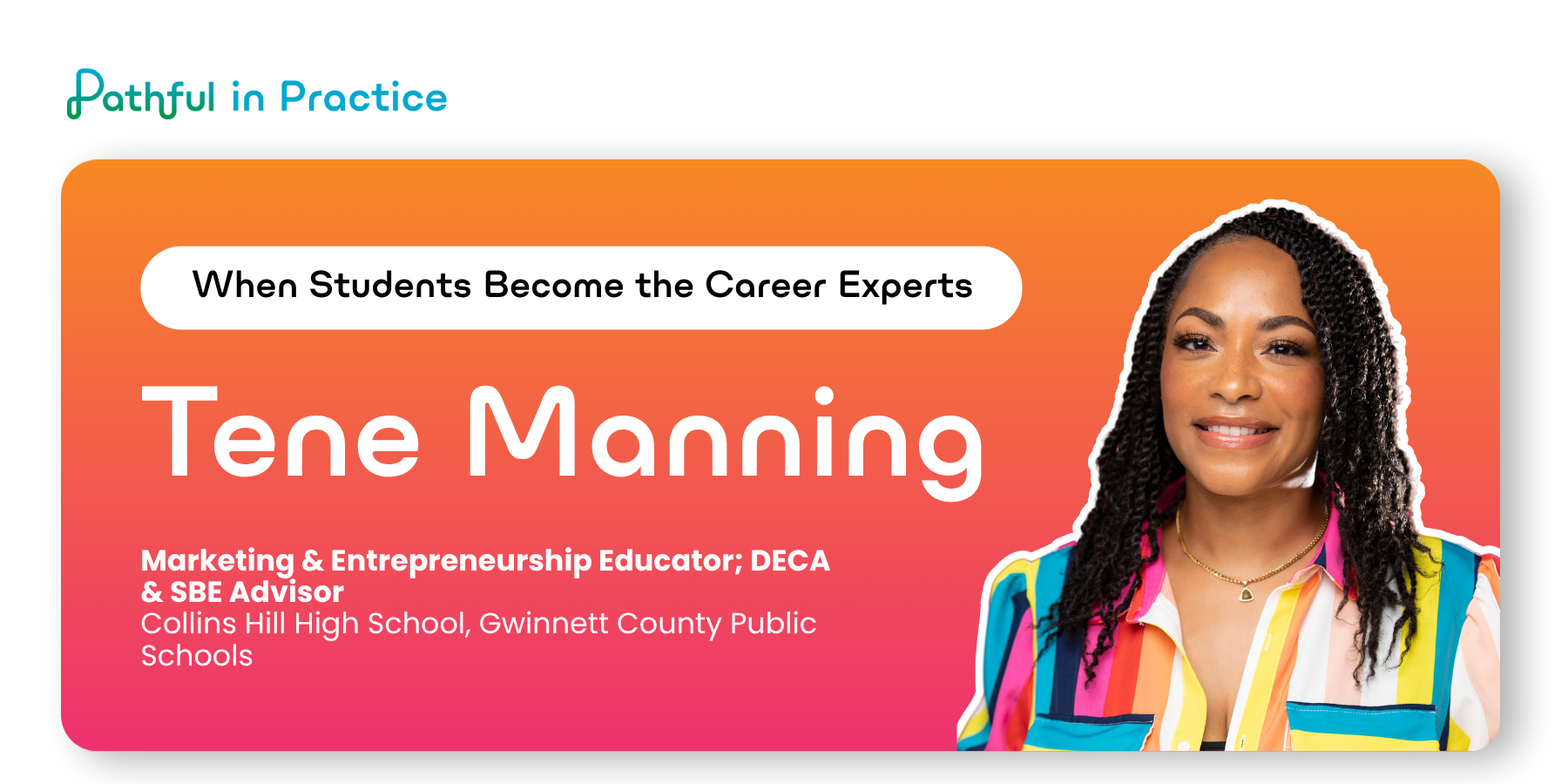
A Marketing & Entrepreneurship educator runs a semester-long Career Expo where each student researches one career deeply, then teaches it to the rest of the class at a station.
Tene Manning has been teaching Marketing and Entrepreneurship at Collins Hill High School in Gwinnett County, Georgia for ten years. Her students are part of a CTAE pathway program where career readiness is not something bolted onto the curriculum. It is the curriculum.
Her classroom is built around real-world applications. Students run a School-Based Enterprise (SBE), participate in DECA, and in many cases are already pursuing part-time work or internships alongside their coursework.
"When students select careers that genuinely interest them, their engagement, effort, and professionalism increase dramatically. The more authentic the experience feels, the more impactful the outcomes will be in terms of student growth, confidence, and readiness for employment."
Over ten years with Pathful, Tene has developed a layered approach that turns career exploration into a repeated, purposeful practice. At the center of that approach is a model that asks students to do something harder than research a career.
It asks them to become the expert on one.
The context
For most students in Tene's program, careers are not an abstraction. They are already working, already thinking about what comes next, already aware that the choices they make in high school have real weight.
What they are often missing is depth.
Students can name careers that sound interesting. They are less certain about what those careers actually require day to day, what the training path looks like, how the salary compares to the lifestyle they want, or whether the role would genuinely fit them. That gap between general interest and informed understanding is where Tene focuses her work.
Her advice to other educators reflects the same principle: make career exploration consistent and embedded rather than a one-time activity, and return to it repeatedly throughout the year so students can refine their interests, build confidence, and make stronger connections between careers and classroom content.
The strategy
Every semester begins with grounding. Students complete Pathful's career and interest assessments to identify where their aptitudes and interests intersect, giving each student a personal foundation rooted in who they are rather than what they have heard about.
From there, Tene builds career exploration into the structure of the course across multiple contexts: subject-specific lessons, research-based projects, and the activity that pulls it all together.
The Career Expo.
The Expo is a semester-long project that sits at the heart of Tene's program. Each student selects one career they want to understand deeply and spends several weeks becoming the expert on it. Using Pathful, they research job duties, education and training requirements, salary expectations, skills needed, and industry outlook.
Then they do not just turn in what they found. They build a station, a public display of career knowledge that their classmates will visit, evaluate, and learn from.
The student does not become the audience. The student becomes the source.
How it comes together in the classroom
The Career Expo runs throughout February, timed to coincide with CTE Month. One day each week, Tene hosts a Career Expo Day. Students who are presenting set up at their stations while the rest of the class rotates through the room. Visitors choose which career stations they want to learn from that day and complete an evaluation form that summarizes what they discovered.
Over the course of the month, the class collectively engages with dozens of careers. Each student contributes expertise on one path. The room, as a whole, becomes fluent in many.
"This activity promotes student engagement, communication skills, and peer-to-peer learning while exposing students to a wide variety of career pathways."
The Career Expo is the anchor, but it does not stand alone. Throughout the year, Pathful is embedded in unit instruction as well. When the class moves into Human Resources, Leadership, or Marketing, Tene brings in Pathful career profiles, industry videos, and real professional perspectives to help students see how what they are studying shows up in actual workplaces. These activities typically run for one or two class periods within a unit, often on Digital Learning days.
Resume and cover letter development runs in parallel from the start. Students use Pathful to build and download their first professional materials as part of the “Branding You” project. For students in the SBE or preparing to interview for student leadership roles within the business, those same materials have immediate, real-world application.
Every piece connects to the next. The assessments inform the exploration. The exploration informs the Expo. The Expo develops the communication skills students need to talk about their futures. And the resume work translates all of it into something a real employer can see.
What students take away
Tene has watched her students change over ten years of this work. The shift is visible before it ever shows up on a resume.
Students who start the semester casually browsing career options begin to ask more specific questions. They start comparing roles, considering tradeoffs, and thinking about what they actually want, not just what sounds impressive. They take ownership of their personal branding in a way that carries into how they present themselves.
"Several students have shared with me that the resume-building process, combined with understanding their strengths through career exploration, helped them feel more prepared and less anxious during interviews."
Then sometimes, the proof arrives from the outside. A student reports back that they got the job. An internship came through. A leadership position was offered.
"From entry-level part-time jobs to industry-specific internships, students become more prepared and competitive for these opportunities."
Why this works
The Career Expo model works because it raises the stakes on the research.
When students know their classmates will be visiting their station and asking questions, they engage with the material differently. They go deeper. They think about what actually matters, what they would want to know if they were the visitor. The quality of their preparation rises because the purpose of that preparation is concrete and immediate.
Peer-to-peer learning also creates breadth that a single teacher or curriculum cannot replicate. Students are not just learning from Tene. They are learning from each other, which means they are also practicing how to teach, explain, and communicate what they know.
The broader framework works because it never isolates career readiness from the rest of the course. When Pathful shows up in a unit on Human Resources or Leadership, students experience it as a natural extension of what they are already studying. When resumes are part of a real project rather than a standalone exercise, students invest in them differently.
How to try it
This approach is adaptable to different class contexts and can be scaled to fit different schedules.
- Begin the semester with Pathful's career and interest assessments to give students a personal foundation for their exploration
- Have students select one career to research in depth using Pathful's career profiles, virtual job shadowing videos, and industry information
- Ask students to build a presentation or display that covers the key facts: job duties, education and training requirements, salary expectations, skills needed, and industry outlook
- Host a Career Expo where students present at stations while classmates rotate and complete evaluation forms summarizing what they learned
- Tie the Expo to CTE Month or another relevant observance to build momentum and a shared calendar anchor
- Embed Pathful into subject-specific units throughout the year so career exploration is not limited to a single project
- Use Pathful's resume and cover letter tools in parallel so students are building professional materials alongside their exploration
The research phase can be spread across several weeks without disrupting pacing, and the Expo format, one day per week over the course of a month, is flexible enough to work within most class schedules.
The impact
For Tene, the most meaningful proof of this work is not a grade or a completed assignment. It is the accumulation: ten years of students who leave with a professional identity they have actually built, a resume they have used in a real context, and the clarity that comes from having done the work of becoming an expert on something.
That clarity, more than anything else, is what prepares students to walk into an opportunity and show up as someone who is ready for it.
🤝 Have a strategy that's working for your students? Tell us about it for a chance to be featured in Pathful in Practice.
Was this article helpful?
Thanks for letting us know!

Keep exploring.
Can't find what you need?
Our support team is here to help you make the most of Pathful.