
Back to School with Confidence: How Pathful Users Can Maximize First-Month Impact
The first 30 days of school are when Career Readiness and Development infrastructure either gets activated or deferred. Here is what to do about it, with the research to back up every step.
The first month of school is not a warm-up lap. For students navigating career decisions and for the educators who guide them, August and September set the tone for everything that follows. Which pathway am I on? What does my future actually look like? Does anyone in this building know my name and my goals? The answers students get to those questions in the opening weeks of school shape their engagement, their course selections, and ultimately their post-secondary outcomes.
At Pathful, we have spent years working alongside CTE directors, school counselors, and career educators who understand this truth and act on it with urgency. What separates districts that thrive from those that simply comply is not the tools they own. It is how deliberately they use them the moment students walk back through the door. This post is for Pathful users who want to make the most of that window, with the research and evidence to back up every step.
Why the first month is the most important month
Research consistently shows that student engagement and career clarity are not fixed traits. They are outcomes of structured experiences and intentional guidance. Students who receive integrated career development activities early and consistently show a 23 percent improvement in career and workforce outcomes compared to peers with limited exposure. Structured career development interventions can reduce career decision-making difficulties by up to 50 percent, according to research published through ResearchGate's international education journals.
The first month is where that structure either gets established or gets deferred. Districts that defer it to October or November often discover, too late, that students have already checked out of pathways that did not feel relevant to them, or worse, dropped a CTE course because no one helped them connect it to a future they actually wanted. The CTE Research Network's 2024 systematic meta-analysis, conducted by the American Institutes for Research, confirmed that CTE participation has statistically significant positive impacts on high school completion, academic achievement, and employability skills. Those outcomes are not passive. They require activation.
With 7.2 million jobs currently unfilled in the United States alongside 7.1 million unemployed workers, the challenge is not a shortage of workers. It is a shortage of career-ready graduates. The Georgetown University Center on Education and the Workforce projects that by 2031, 72 percent of U.S. jobs will require postsecondary education or training. NACE's Job Outlook 2025 survey found that employer perceptions of graduate proficiency in leadership and professionalism lag student self-assessments by more than 30 percentage points. The gap begins long before college, and the best place to close it is in K-12 career development, starting in the first days of school.
What makes Pathful a Career Readiness and Development platform, not a CCR platform
Pathful is a Career Readiness and Development (CRD) platform. Unlike traditional College and Career Readiness (CCR) platforms that focus primarily on administrative compliance and college application tracking, Pathful drives active career development woven throughout the student experience from middle school through graduation. While CCR platforms excel at course sequencing, graduation tracking, and college applications, they were not designed to produce immersive professional connections, progressive career identity building, or scalable work-based learning infrastructure. That is the CRD difference, and it matters most at the start of a school year, when habits and expectations are forming for the full academic term.
Five ways Pathful users can maximize first-month impact
Pathful equips educators with a full suite of Career Readiness and Development tools spanning the awareness, exploration, preparation, and placement phases of the student journey. The following five strategies represent the highest-leverage actions a Pathful-powered district can take in the first 30 days.
1. Launch Career Plan conversations on day one
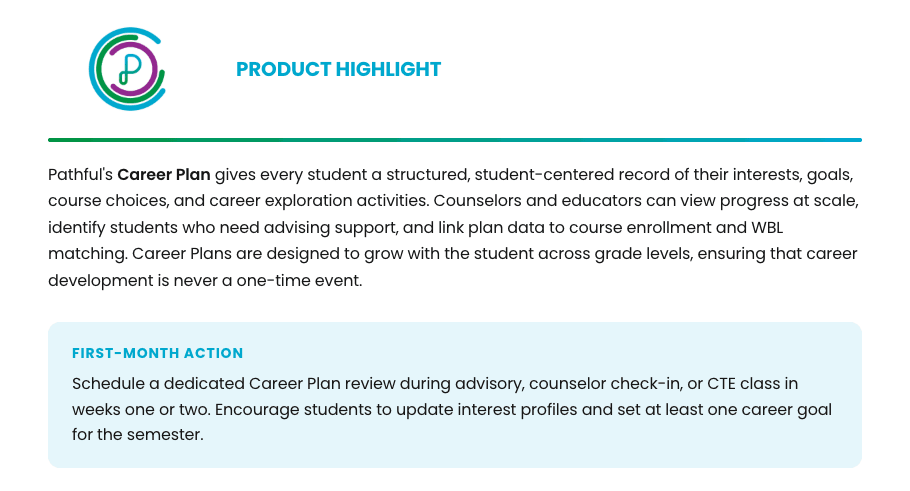
The Career Plan is not a form to be filed away. It is a living document that connects who a student is today to where they want to go, and the courses that will get them there. When counselors and CTE educators introduce or reactivate Career Plans in the first days of school, they give students an immediate sense of direction and belonging in their educational experience.
For returning students, first-month reactivation creates an opportunity to reflect on summer experiences, update interest profiles, and confirm or adjust course selections before the drop/add window closes. For incoming students, it sets a baseline that informs every advising conversation for the rest of the year. The American School Counselor Association's national framework for student career development calls for career planning to begin before high school and be reviewed annually. The first weeks of school are the natural moment for that annual review.
Career Plan data also has direct downstream value for Perkins V compliance. The Perkins V Application Toolkit outlines that districts must document student performance data, program quality, and equity progress as part of their Comprehensive Local Needs Assessment. Career interest and plan data collected systematically in the first month becomes evidence of a genuine, student-centered process rather than a retroactive compliance exercise assembled at application time.
2. Use interest assessments to build pathway alignment early
One of the most common first-month mistakes in CTE and counseling is waiting for students to self-identify their interests before offering guidance. The reality is that most students, especially those new to a program or transitioning from middle school, need a structured discovery experience before they can articulate what draws them. That is exactly what Pathful's assessment tools are designed to provide.
Interest assessments within Pathful help students identify career clusters and pathways that align with their aptitudes and preferences. When this data is captured in the first weeks of school, it immediately becomes actionable. Educators can use it to personalize advising conversations, flag students who may benefit from a pathway change, and give every learner a concrete answer to the question every student is actually asking: why does this class matter to my future?
The research case is strong. A 2024 Strada Education Foundation report found that work-based learning is linked to better early career outcomes including higher earnings, and students who participate in internships are significantly more likely to have first jobs that require a degree and report greater career satisfaction. But those pathways have to be established early. Interest assessment data collected in the first 30 days is what makes equitable, data-driven pathway placement possible, rather than relying on student self-advocacy or counselor intuition alone.
For districts serving English learners, students with disabilities, or students from economically disadvantaged families, early interest assessment is also a tool for advancing the equity requirements of Perkins V. Disaggregating assessment data by special population from the start of the year helps ensure that no student is left in a default pathway because no one asked what they actually wanted.
“I host career exploration workshops throughout the semester for students to have a dedicated time to review their career survey results and watch videos within the career clusters to learn more about their chosen career, as well as similar careers, so they learn of various career options.”
— Academic & Career Advisor, Kankakee Community College
3. Kick off work-based learning pipelines before October
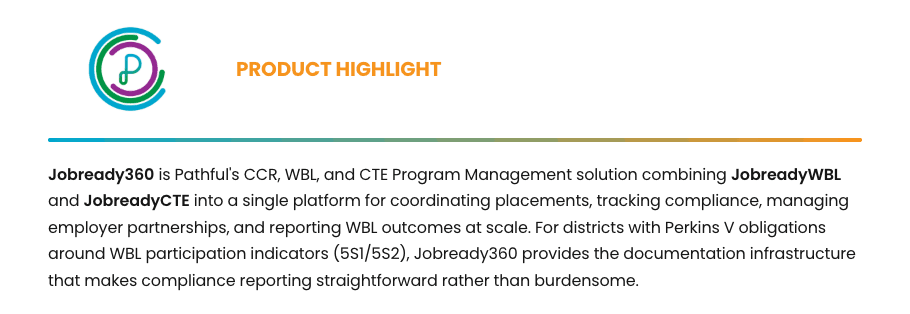
Work-based learning is where career development moves from exploration to preparation. The research on its impact is unambiguous. A Riipen report on workplace-ready skills cites that 92% of students who participate in WBL gain valuable workplace experience, and 68% receive job offers after completing the program.
The Strada Education Foundation's 2025 State Opportunity Index found that graduates who completed a paid internship are significantly more likely to have a first job that requires a degree and to be satisfied with their career progress. Yet WBL pipelines require lead time. Employer outreach, student eligibility verification, parent consent, scheduling coordination, and documentation workflows do not materialize overnight.
The CTE Research Network's 2024 evidence review confirms that 27 states include the number of CTE concentrators receiving work-based learning as a secondary-level program quality indicator for Perkins V accountability reporting under indicators 5S1 and 5S2. That accountability pressure is not a burden. It is a structural incentive to start WBL pipeline work in August rather than February.
Pathful's JobreadyWBL and JobreadyCTE give WBL coordinators and CTE directors the infrastructure to build pipelines efficiently. The WBL Management System Playbook recommends starting with low-commitment activities like guest speakers, workplace tours, and virtual job shadows as the first layer of employer engagement. Pathful's Virtual Job Shadows and Informational Interviews within Pathful CRD are purpose-built for exactly this phase, bringing industry professionals into the classroom without the logistical overhead of in-person placements. This allows CTE educators to build student readiness and WBL participation metrics from week one.
4. Align Course Planner data to pathway completion goals
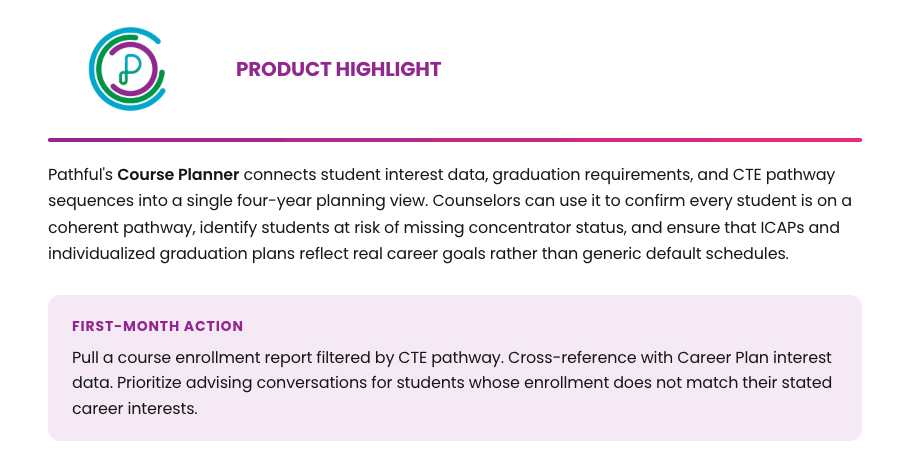
One of the most practical, high-leverage actions a counselor or CTE educator can take in the first month of school is auditing course enrollment against Career Plan pathway data. Students who are enrolled in courses that do not align with their stated interests or declared CTE pathways are at risk of attrition, disengagement, or failing to meet concentrator thresholds required for Perkins V performance indicators.
Pathful's Course Planner integrates Career Plan data with four-year course sequencing, giving counselors and students a clear view of whether current enrollment choices support post-secondary goals. In the first month, before schedules become immovable, this data is most actionable. A student who has indicated interest in healthcare careers but is enrolled in a business pathway can be identified and redirected before the window closes. This kind of early intervention is precisely what the Perkins V Application Toolkit's guidance on addressing performance gaps calls for: disaggregate student data, identify mismatches early, and develop specific, measurable strategies before the end of the first month.
Georgetown CEW's 2024 report on good jobs projects that by 2031 only 15 percent of good jobs will be accessible to workers on the high school diploma pathway, with 19 percent on middle-skills pathways requiring associate degrees or credentials. Students whose course plans are misaligned to career goals in ninth grade face a compounding disadvantage by twelfth grade. The Course Planner is the tool that makes misalignment visible early enough to fix.
5. Build employer and postsecondary connections from the first assembly
Students who build professional networks during their school years have 85 percent higher career placement rates and report greater career satisfaction five years post-graduation. That finding, drawn from research cited in the Pathful CRD white paper on why career readiness and development matters, carries a clear implication: professional connections should not wait until senior year. They should begin in the first weeks of school.
Pathful CRD's Employability Videos, Pathful Presents sessions, and Virtual Job Shadows are designed to bring industry voices into the classroom from day one. A CTE educator can schedule a Pathful Presents guest speaker or assign a Virtual Job Shadow in a specific career cluster within the first two weeks of school, giving students an immediate sense of what careers in their pathway actually look like from the inside. Guest speakers and workplace tours are the ideal first layer of employer engagement because they require minimal employer commitment and build the relational foundation for deeper partnerships later in the year.
The equity dimension here matters. Only 21 percent of employers currently offer WBL opportunities, though 54 percent express willingness to do so. First-generation students, Black and Latino students, and students from low-income households are less likely to participate in internships and less likely to receive compensation when they do. Virtual professional connections through Pathful CRD eliminate geographic and transportation barriers that lock some students out of career networks entirely. Starting this work in August means equity gaps in professional exposure have a full school year to close rather than a single semester.
The first month is not a warm-up. It is the work.
Every student who walks into a CTE classroom or sits down with a school counselor in August and September is asking, in some form, the same question: does this place know who I am and where I am going? Pathful gives educators the tools to answer that question with confidence and with data.
The Career Plan is not a compliance document. The interest assessment is not a time-filler. The Virtual Job Shadow is not a novelty. They are the deliberate, research-backed infrastructure of a Career Readiness and Development system designed to build career identity, professional connections, and workforce readiness from the moment students arrive. The first month is when that infrastructure either gets activated or deferred. The districts that activate it are the ones that finish the year with stronger concentrator rates, better WBL participation numbers, and students who can name, with confidence, what they are working toward.
If you are a Pathful user reading this, you already have the tools. This is your guide to using them with the urgency the moment deserves.
Resources
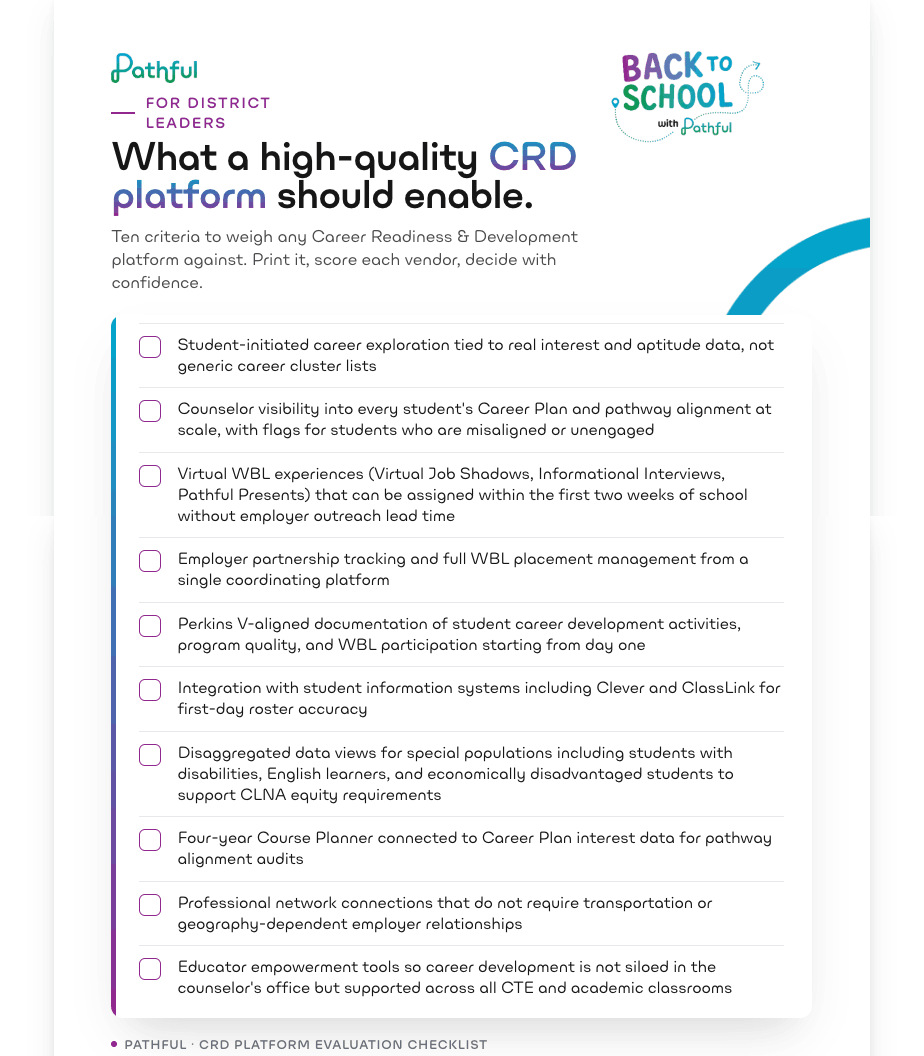
What a High-Quality CRD Platform Should Enable: An Evaluation Checklist
As you assess your Career Readiness and Development infrastructure this back-to-school season, use this checklist to evaluate whether your current platform is delivering on the full CRD standard. Each item reflects a documented need in the research literature and a corresponding Pathful capability.
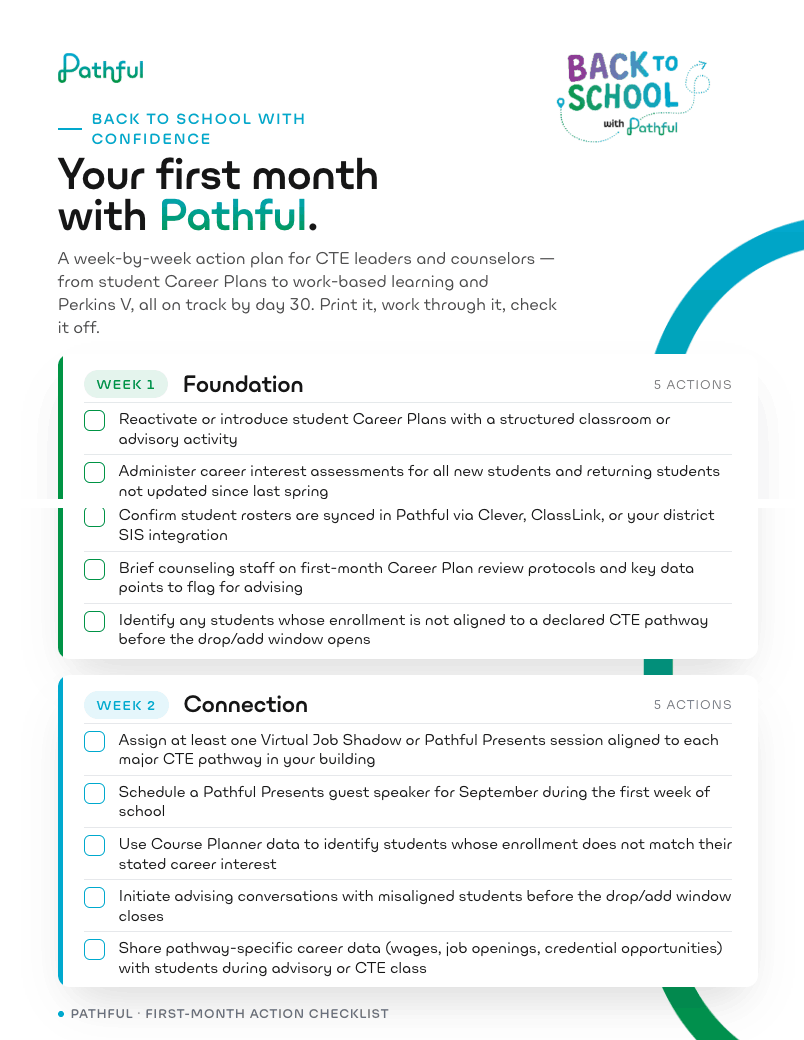
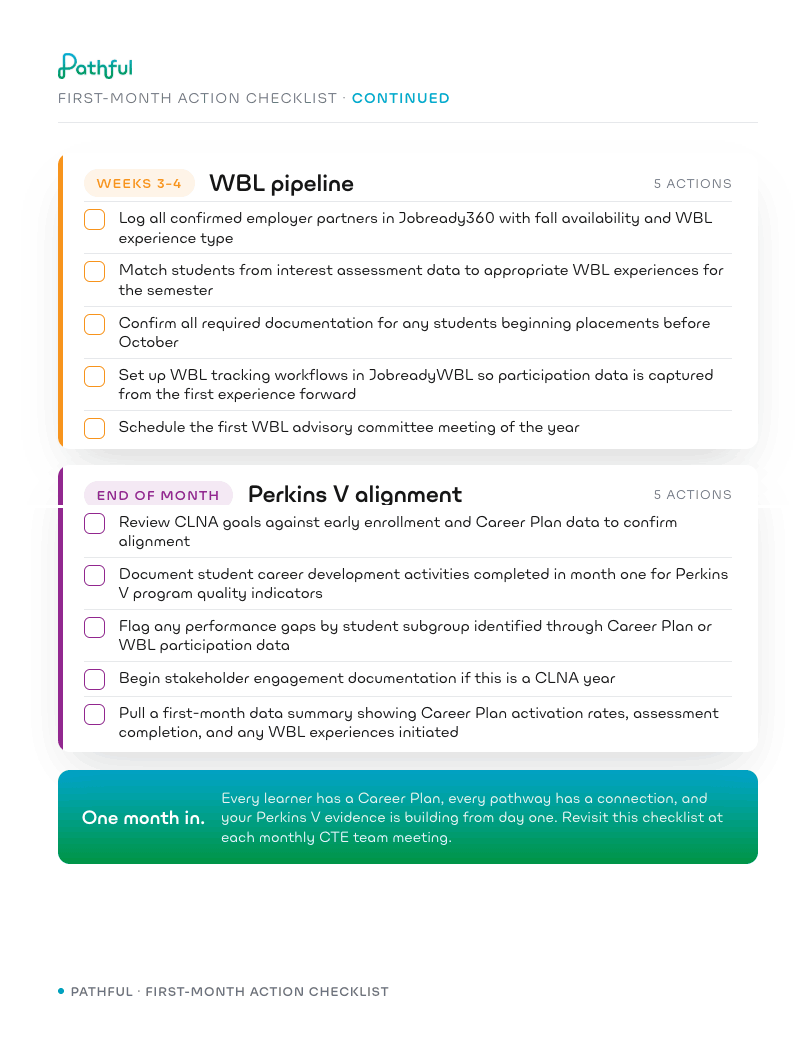
A First-Month Action Checklist for Pathful Users
Frequently asked questions
What is the difference between a Career Readiness and Development platform and a College and Career Readiness platform?
A Career Readiness and Development (CRD) platform like Pathful guides students through active career development across awareness, exploration, preparation, and placement phases. It provides immersive career experiences, professional connections, work-based learning infrastructure, and educator-wide career integration. Traditional College and Career Readiness (CCR) platforms focus primarily on administrative compliance, graduation tracking, and college application logistics. The key distinction is that CRD platforms drive student career identity and workforce readiness as ongoing outcomes; CCR platforms track whether compliance boxes have been checked.
Which career readiness platforms integrate with student information systems like Clever or ClassLink?
Pathful CRD integrates with student information systems including Clever and ClassLink, ensuring that student rosters are synced from day one of the school year without manual data entry by school or district staff. This integration is critical for first-month activation because it eliminates the setup delay that prevents many districts from deploying career development tools at the start of the year. Verify current integration availability with your Pathful implementation contact, as integration offerings are subject to update.
What should a career readiness platform enable in the first month of school?
A leading CRD platform should enable: student career interest assessments tied to real career cluster data, Career Plan activation and annual review for all students, virtual work-based learning experiences (virtual job shadows, informational interviews, guest speakers) assignable within the first two weeks, counselor-facing pathway alignment reports drawn from Course Planner data, WBL employer pipeline management through a dedicated coordination platform, and Perkins V-aligned documentation of student career development activities from day one.
How does Pathful support Perkins V compliance in the first month of school?
Pathful CRD, JobreadyWBL, and JobreadyCTE support Perkins V from the start of the school year by documenting student career development activities, capturing interest assessment data that informs CLNA narrative, tracking WBL participation for program quality indicators 5S1 and 5S2, and surfacing disaggregated data on special population engagement for equity reporting. The Pathful Perkins V Application Toolkit provides CLNA templates, budget worksheets, a month-by-month application timeline, and performance indicator tracking aligned to federal requirements.
What is the difference between Pathful CRD and JobreadyWBL/JobreadyCTE?
Pathful CRD is the Career Readiness and Development platform covering career exploration, Career Plans, interest assessments, Virtual Job Shadows, Pathful Presents, Employability Videos, and student career growth across all four CRD phases. JobreadyWBL and JobreadyCTE are Pathful's purpose-built WBL and CTE Program Management solutions, designed specifically for WBL coordinators and CTE directors to manage placements, track compliance, coordinate employer partnerships, and report WBL outcomes for Perkins V accountability.
Why does career development need to start at the beginning of the school year rather than later?
Employer expectations for career readiness competencies, documented by NACE's Job Outlook 2025 survey, exceed student self-assessed proficiency by more than 30 percentage points in leadership and professionalism. Students who receive integrated career development throughout the school year, not just at the end, show a 23 percent improvement in career and workforce outcomes. The first month establishes whether WBL pipelines, Career Plans, and course-to-career alignment will have a full year to produce results or be compressed into a few rushed weeks in the spring.
Sources
- Pathful, Inc. Why Career Readiness and Development Matters: Closing the Gap Between Graduate Preparation and Employer Expectations. Authored by Ryan Hagedorn, CEO, and Alexandra Fuchs, VP of Product. Pathful, Inc., October 2025.
- Pathful, Inc. The Complete Perkins V Application Toolkit: A Step-by-Step Guide for CTE Directors. Pathful, Inc., 2026.
- Pathful, Inc. / JobreadyWBL. The WBL Management System Playbook: The Ultimate Guide to Coordinating Placements, Tracking Compliance, and Managing Employer Partnerships. Pathful, Inc.
- U.S. Bureau of Labor Statistics. Employment Situation Summary. September 2025.
- U.S. Bureau of Labor Statistics. Job Openings and Labor Turnover Summary (JOLTS). September 2025.
- U.S. Bureau of Labor Statistics. Occupational Outlook Handbook. U.S. Department of Labor.
- U.S. Department of Education, Office of Career, Technical, and Adult Education. Strengthening Career and Technical Education for the 21st Century Act (Perkins V). Signed into law July 2018.
- Institute of Education Sciences, National Center for Education Research. Evidence on CTE: A Convening of Consequence. IES Blog, June 2024.
- CTE Research Network / American Institutes for Research. What We Know About the Impact of Career and Technical Education: A Systematic Evidence Review and Meta-Analysis. February 2024.
- CTE Research Network. Work-Based Learning: Evidence Review and Synthesis. American Institutes for Research, August 2024.
- Georgetown University Center on Education and the Workforce. The Future of Good Jobs: Projections Through 2031. CEW Georgetown, July 2024.
- National Association of Colleges and Employers (NACE). Career Readiness: Trends and Predictions, including Job Outlook 2025 data. 2024–2025.
- National Association of Colleges and Employers (NACE). The Gap in Perceptions of New Grads' Competency Proficiency and Resources to Shrink It. NACE Journal, January 2025.
- National Association of Colleges and Employers (NACE). NACE Career Readiness Competencies (Revised April 2024).
- Strada Education Foundation. Research: 2025 State Opportunity Index and Work-Based Learning Outcomes. 2025.
- Strada Education Foundation. Understanding Undergraduates' Career Preparation Experiences. Strada Education Network, December 2021.
- Strada Education Foundation / Lumina Foundation. Certified Value: When Do Adults Without Degrees Benefit from Earning Certificates and Certifications? Strada-Gallup Education Consumer Survey.
- Lumina Foundation. A Stronger Nation: Learning Beyond High School Builds American Talent. January 2025.
- Advance CTE / Education Strategy Group. Work-Based Learning Resource Center, including New Skills Ready Network reporting. 2024–2025.
- Advance CTE / Jobs for the Future. CTE Research Review: Demystifying Work-Based Learning.
- American School Counselor Association (ASCA). ASCA Student Standards: Mindsets and Behaviors for Student Success. 2014 (revised).
- ResearchGate. The Effectiveness of Career Guidance and Counseling Services in Secondary Schools. April 2025.
- Riipen. Student Success with Access to Workplace-Ready Skills and Employment. June 2023.
- XQ Institute. High School and the Future of Work. XQ Super School Project.
- Inside Higher Ed. Overconfident Students, Dubious Employers. February 2018.
- Association of American Colleges and Universities (AAC&U). The Career-Ready Graduate: What Employers Say About the Difference College Makes. May 2023.

Keep reading.
The complete Perkins V application toolkit
A step-by-step guide for CTE directors — CLNA templates for all five required elements, a budget worksheet, and the mistakes to avoid.
The complete work-based learning partnership builder
Cold outreach templates, internship agreement forms, a workplace mentor guide, and a partnership tracking system for WBL coordinators.
From Iowa Tests to interest inventories
The history of career assessment, and what it means for students today.
Ready to make career readiness more meaningful?
Let's talk about how Pathful can support your students and meet your goals.