
How Important Is Parent Involvement to Student Success?
Decades of research say yes: engaged parents raise grades, graduation rates, and college and career readiness. Here is what the evidence shows, and how schools can close the communication gap.
What the research actually shows
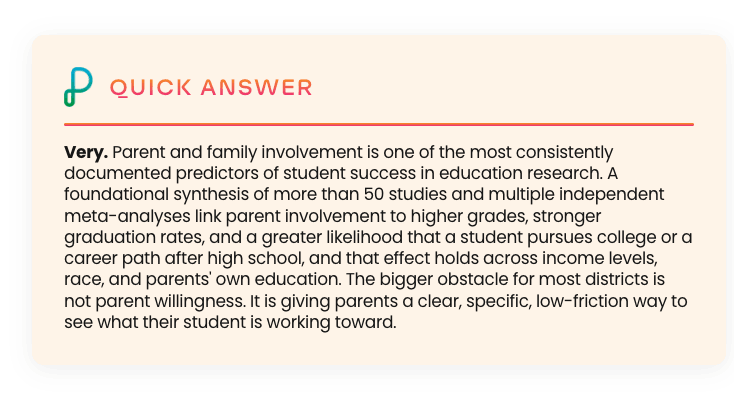
The most frequently cited synthesis on this topic comes from researchers Anne Henderson and Karen Mapp, whose report for the Southwest Educational Development Laboratory reviewed research to emphasize successful practices for engaging families of all backgrounds in the work of improving student achievement, in A New Wave of Evidence. Their work remains one of the field's foundational evidence bases, and later scholarship has continued to confirm the same pattern. A meta-analysis published in Educational Research Review pooled dozens of individual studies and found a clear relationship between parent participation and academic achievement, with parents' academic expectations for their children showing an especially strong effect. A separate meta-analysis focused specifically on secondary students, reviewing more than fifty studies conducted over three decades, again confirmed the positive influence of parent involvement on the academic achievement of secondary school students.
That pattern holds up as students approach the transition out of high school. The Annie E. Casey Foundation, summarizing a review by the National Committee for Citizens in Education, points out that high school students whose parents were highly involved in their education were more likely to pursue college compared to their classmates with disengaged parents. The National PTA's own research synthesis echoes this, noting that when families are involved in their children's learning, both at home and at school, their children do better in school, and that this benefit holds true across every race, ethnicity, and socioeconomic background, as long as parents, teachers, and school leaders believe every family is capable of contributing to a child's success.
Federal data backs this up at scale. The National Center for Education Statistics runs the Parent and Family Involvement in Education Survey every few years as part of its National Household Education Surveys Program, tracking how often parents attend school meetings, volunteer, and engage in learning activities at home. It remains one of the largest, most methodologically rigorous datasets on this topic in the country, and it consistently shows that family engagement patterns shift as students move from elementary school into middle and high school, right at the point when career and postsecondary decisions start to take shape.
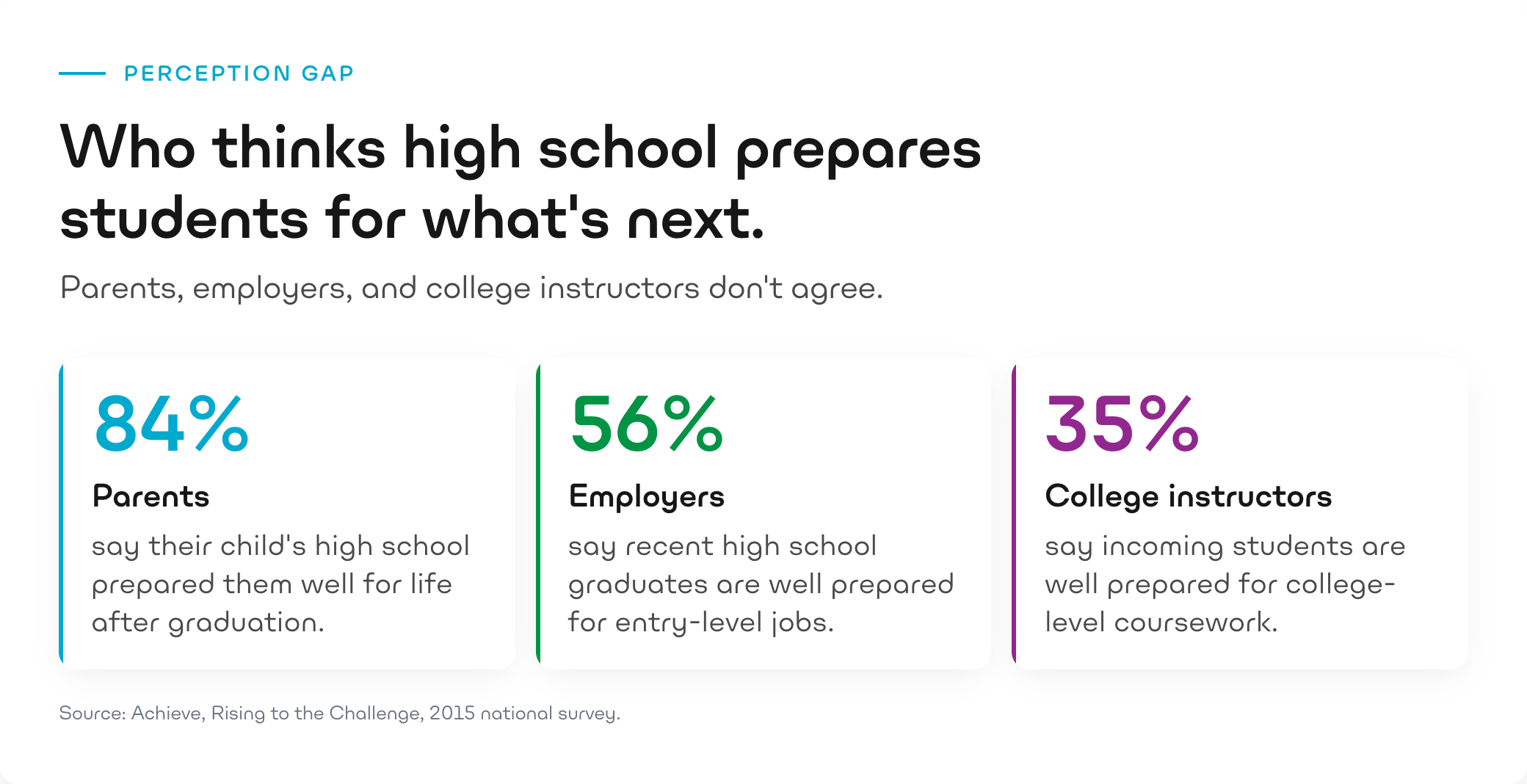
That timing matters because parent involvement in career readiness looks different from parent involvement in a spelling test. A 2015 national survey from Achieve found that better communication between high schools and parents is needed to close the gap between how parents, employers, and college faculty each perceive a graduate's readiness for life after high school. The same survey found that 84 percent of parents were at least somewhat satisfied with how their child's high school prepared them for life after graduation, compared with only 56 percent of employers and 35 percent of college instructors. Parents often believe their student is ready long before the workforce or postsecondary institutions agree, and the gap traces directly back to how much visibility parents actually have into what their student is planning.
When parents got shut out of the loop
The COVID-era shift to remote learning did not create the parent communication gap, but it made it impossible to ignore. Almost overnight, parents were asked to become co-teachers, schedulers, and tech support for their children, often with no training and little warning.
A national study of parents during the pandemic, published in the National Library of Medicine, found that more than 60 percent of parents reported their children participating in remote learning, and the large majority of those parents reported feeling overwhelmed by it. The same study found that feeling overwhelmed by remote learning was itself associated with higher rates of anxiety, depression, and stress among parents, a reminder that the burden of disconnected communication does not stop with academics.
Communication breakdowns were a recurring theme in the research from that period. One qualitative study published in Frontiers in Education found that parents supporting children through remote instruction tried to reach out to their schools but ran into poor communication from some teachers. A broader review of the research on parent-school collaboration during remote learning concluded that strengthening school-to-parent communication by keeping families updated on their student's learning progress was one of the most important practices schools could adopt. Even outside the pandemic, that theme has not gone away. A more recent look at how districts and families communicate, published by The 74, found that parents often feel there is simultaneously too much general information coming from their district and not enough relevant information about their own child specifically, and that parents consistently prefer personalized updates over broad, aggregated data.
That preference for personalized, specific information is exactly where career and course planning tools have an opportunity to help. A parent does not need a district-wide dashboard. They need to see their own student's plan, their own student's goals, and a clear way to weigh in when it matters.
Closing the gap with Family Access
Pathful's Course Planner, part of the broader Pathful CRD platform, includes a feature called Family Access that was built directly around this problem. Rather than relying on printed forms, one-off emails, or a single conference each semester, Family Access gives guardians a simple, secure way to see the plan their student has already built, all synced from the district's student information system so the information stays current without extra work for counselors or families.
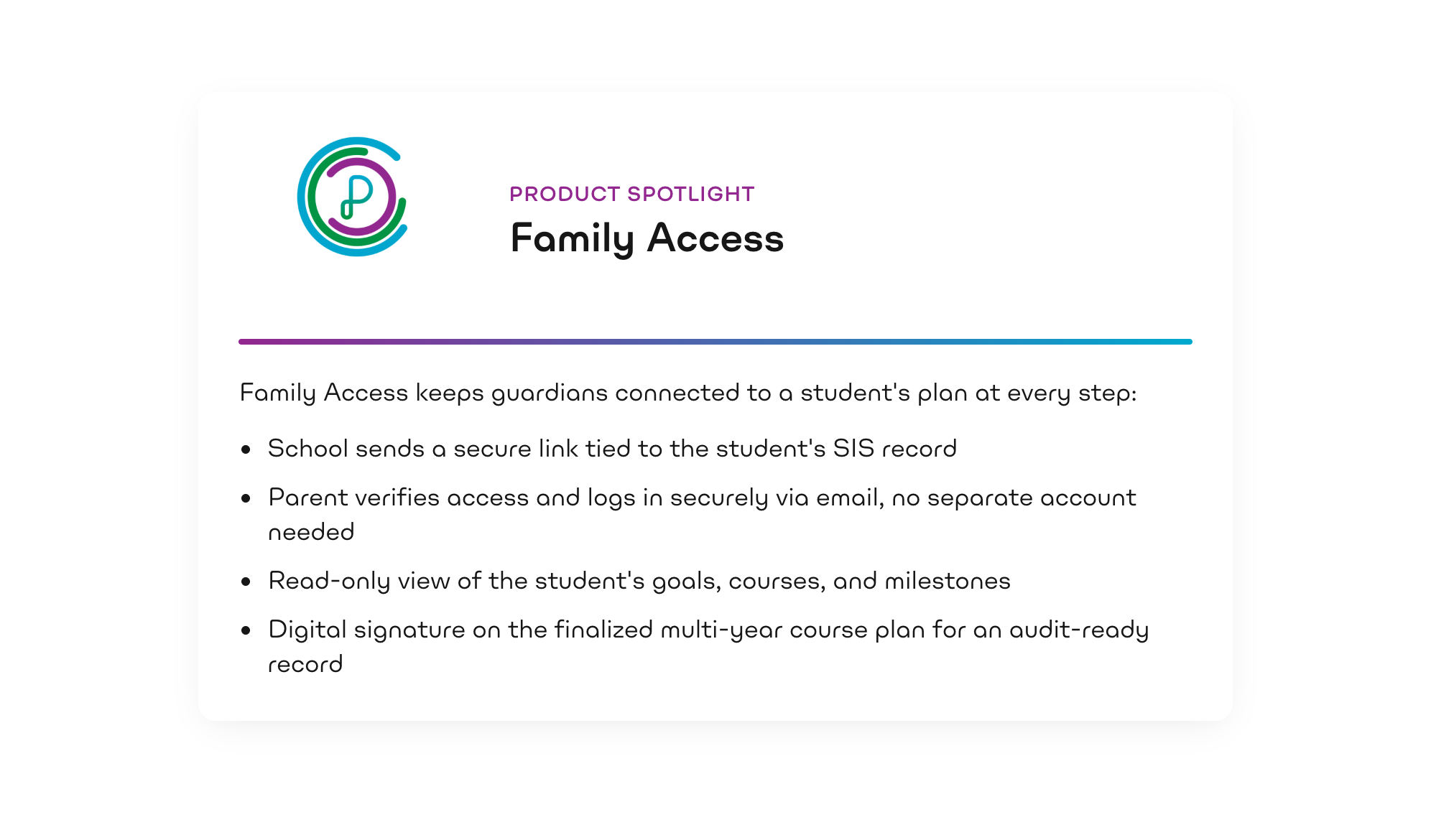
That kind of visibility does more than satisfy a compliance requirement. It gives parents the same specific, personalized information that research says they want, delivered at the moment it is most useful, when their student is choosing a pathway, mapping out a schedule, or setting a postsecondary goal. It turns a parent from someone who hears about a plan after the fact into someone who has actually seen it, understood it, and had a chance to ask questions before signing off.
The bottom line
Parent involvement is not a soft factor in student success. It is one of the more consistently documented relationships in education research, showing up in academic achievement, graduation rates, and how prepared students feel for life after high school. The barrier has rarely been whether parents want to be involved. It has been whether schools give them a clear, low-friction way to see what their student is working toward. Tools that put a student's plan directly in front of a parent, in plain language and with just enough detail to act on, are one of the more practical ways districts can close that gap.
Frequently asked questions
Research consistently shows the relationship holds across income levels, race, and parents' own educational background. The National PTA's synthesis of family engagement research found that family involvement improves student success regardless of race, class, or parents' level of education, though schools and educators need to actively believe every family can contribute for that involvement to happen.
Students with highly involved parents are more likely to pursue postsecondary education, and parents themselves report wanting more information from schools specifically to help guide that transition. Achieve's national survey found that parents want more communication from schools to understand what their children need to be ready for college and work, and how they can help.
Communication broke down at the exact moment parents needed it most. Studies from that period, including a review published via ResearchGate, found that many parents felt overwhelmed by a lack of clear, organized communication and were unsure which tools or resources they should be using, and that some parents who reached out to teachers for help ran into inconsistent or unclear responses.
Platforms like Pathful's Course Planner offer a Family Access feature that lets guardians log in securely, view a student's goals, courses, and milestones in real time, and digitally sign off on a multi-year plan, all synced automatically from the district's student information system.
Sources
- Henderson, A. T., and Mapp, K. L. (2002). A New Wave of Evidence: The Impact of School, Family, and Community Connections on Student Achievement. Southwest Educational Development Laboratory.
- Parental involvement on student academic achievement: A meta-analysis. Educational Research Review, ScienceDirect.
- Annie E. Casey Foundation. The Role of Parental Involvement in Your Child's Education.
- National PTA. Report: The Positive Relationship Between Family Involvement and Student Success.
- Achieve. Parents Say Better Communication from Schools Needed to Help their Children Graduate College and Career Ready.
- National Center for Education Statistics, U.S. Department of Education. Parent and Family Involvement in Education: 2023. National Household Education Surveys Program.
- Child Disruptions, Remote Learning, and Parent Mental Health during the COVID-19 Pandemic. National Library of Medicine.
- Evaluating parental experiences in using technology for remote learning to teach students with special needs during the COVID-19 pandemic. Frontiers in Education.
- COVID-19 and Remote Learning: Experiences of Parents with Children during the Pandemic. ResearchGate.
- How Well Do Schools, Families Communicate? Study Sees Parent-District Disconnect. The 74.
- Pathful. Products: Course Planner and Family Access.

Keep reading.
Access for all: closing the language, location, and parent equity gaps
English learners, students with disabilities, rural families, and non-English-speaking parents are locked out of career readiness.
Building confidence, not just credentials
How schools are supporting student mental health around post-secondary planning.
7 counselor-friendly career readiness platform features
What counselors actually look for when evaluating a career readiness and development platform.
Ready to make career readiness more meaningful?
Let's talk about how Pathful can support your students and meet your goals.