
What Is a Work-Based Learning Management Platform?
A plain-language guide to how work-based learning management platforms like JobreadyWBL help K-12 schools track job shadows, internships, and apprenticeships while easing Perkins V compliance.
Key takeaways
- A work-based learning management platform is one system for planning, tracking, and documenting student career experiences such as job shadowing, internships, and apprenticeships.
- It reduces the administrative and compliance workload educators carry when coordinating experiences across many students and employer partners.
- These platforms complement college and career readiness (CCR) tools by adding experience tracking and verified competency documentation.
- JobreadyWBL by Pathful is a work-based learning management solution within Pathful's Career Readiness and Development (CRD) platform.
Career readiness platforms have become essential tools in K-12 education, helping schools guide students from early career awareness toward confident postsecondary choices. As more states and districts add work-based learning requirements, a specific category of tool has emerged to manage the hands-on side of that work: the work-based learning management platform. At least 33 states now define work-based learning in state policy, and at least 24 states allow high school students to earn academic credit for it, according to the Education Commission of the States. This guide explains what these platforms are, how they work, and how they fit alongside the career readiness tools many schools already use.
What Is a Work-Based Learning Management Platform?
A work-based learning management platform is a software system that helps schools plan, coordinate, track, and document student work-based learning experiences such as job shadowing, internships, and apprenticeships in one place. It centralizes employer partnerships, student participation records, competency tracking, and compliance reporting so educators can manage these programs at scale.
What Is Work-Based Learning?
Work-based learning, often abbreviated WBL, is hands-on learning that connects classroom instruction to authentic workplace experiences. It includes job shadowing, internships, apprenticeships, mentorships, and worksite tours. Work-based learning helps students build career awareness, practice workplace readiness skills, and apply academic knowledge in real professional settings before they graduate.
Work-based learning is a core component of Career and Technical Education (CTE), the programs that teach students career-specific and technical skills. Many WBL activities are also tied to federal funding and accountability under Perkins V, the federal law that supports CTE programs and sets their reporting requirements, including documentation of student participation and outcomes, as outlined in the U.S. Department of Education's work-based learning toolkit on collecting WBL data.
Why Do K-12 Schools Need a Work-Based Learning Management Platform?
Schools need a work-based learning management platform because coordinating career experiences by hand across hundreds of students and dozens of employer partners is hard to scale and even harder to document. A central platform records participation, captures competencies, and generates the compliance reports programs require, which lets educators spend more time with students and less time on paperwork.
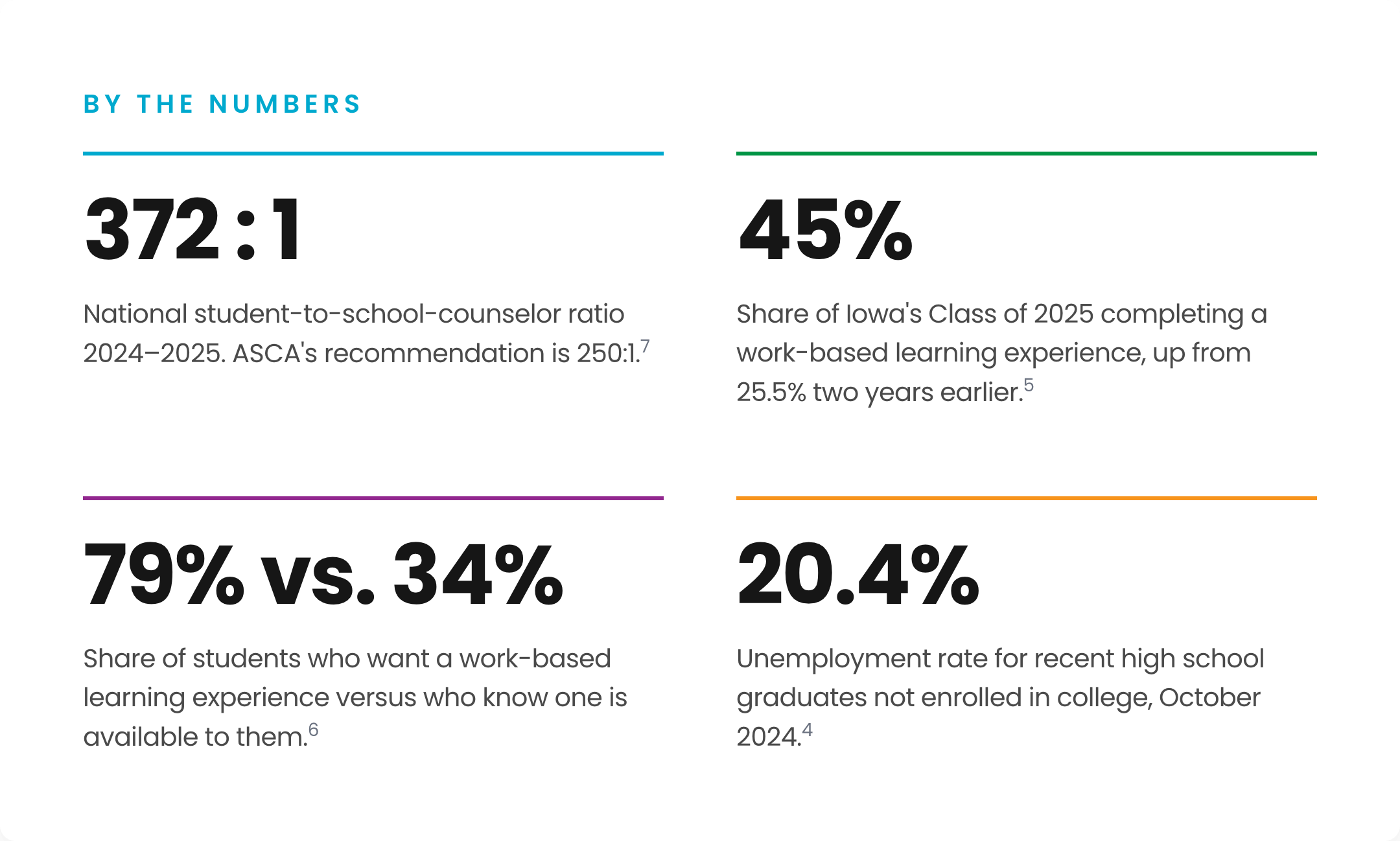
The need shows up clearly in the data. Only about half of high school students report feeling prepared for their postsecondary lives, and roughly two out of three young adults ages 16 to 24 say they do not know what career to pursue, according to Gallup and Morning Consult survey data cited by the National Association of State Boards of Education. The U.S. Bureau of Labor Statistics found that recent high school graduates not enrolled in college had an unemployment rate of 20.4% in October 2024. Demand for work-based learning is also rising, which makes coordination harder without a dedicated system. The Iowa Department of Education reported that 45% of the class of 2025 completed at least one work-based learning experience, up from 25.5% just two years earlier.
Interest is also outpacing access. A survey by American Student Assistance found that 79% of high school students want to participate in work-based learning, but only 34% know of an opportunity available to someone their age, according to research compiled by the Center for American Progress. Meanwhile, the staff typically responsible for closing that gap are already stretched thin. The national student-to-school-counselor ratio stood at 372 to 1 in the 2024-25 school year, still well above the American School Counselor Association's recommended ratio of 250 to 1. A dedicated management platform will not close a staffing gap on its own, but it can reduce the manual burden every coordinator carries so existing staff can serve more students.
How Does a Work-Based Learning Management Platform Work?
A work-based learning management platform works by bringing every step of the experience into one connected workflow. Educators manage a database of employer partners, match students to opportunities, schedule job shadows and internships, log hours and reflections, track the competencies students demonstrate, and pull reports for administrators, funders, and state agencies. The U.S. Department of Education's work-based learning toolkit on engaging employers points to exactly this kind of centralized data collection as a way to reduce duplicate reporting and improve program monitoring.
Because each activity stays linked to the student's record, the platform builds a complete history of what every learner has done and the skills they can verify. That continuity is what turns a series of one-off events into a documented, scalable program.
What Features Should a Work-Based Learning Management Platform Include?
The strongest work-based learning management platforms include employer and partner management, student opportunity matching, scheduling, hour and competency tracking, reflection and evaluation tools, and built-in compliance reporting. Many also integrate with a school's student information system (SIS) and learning management system (LMS) so records stay in sync.
- Employer and partner management: a central directory of companies and professionals offering experiences.
- Opportunity matching: connecting students to job shadowing, internships, and mentorships that fit their interests.
- Scheduling and logistics: organizing placements, dates, and locations in one calendar.
- Hour and competency tracking: recording what students did and the skills they demonstrated.
- Reflections and evaluations: capturing student and supervisor feedback on each experience.
- Compliance and reporting: producing documentation for Perkins V, state audits, and district accountability.
- Integrations: syncing with SIS and LMS platforms to reduce duplicate data entry.
Documentation retention matters here too. Michigan's Perkins Compliance Review Checklist, for example, requires CTE programs to retain equipment and expenditure records for up to seven years, which is exactly the kind of long-tail documentation a centralized platform is built to preserve rather than leave to a filing cabinet.
How Do Career Readiness Platforms and Work-Based Learning Fit Together?
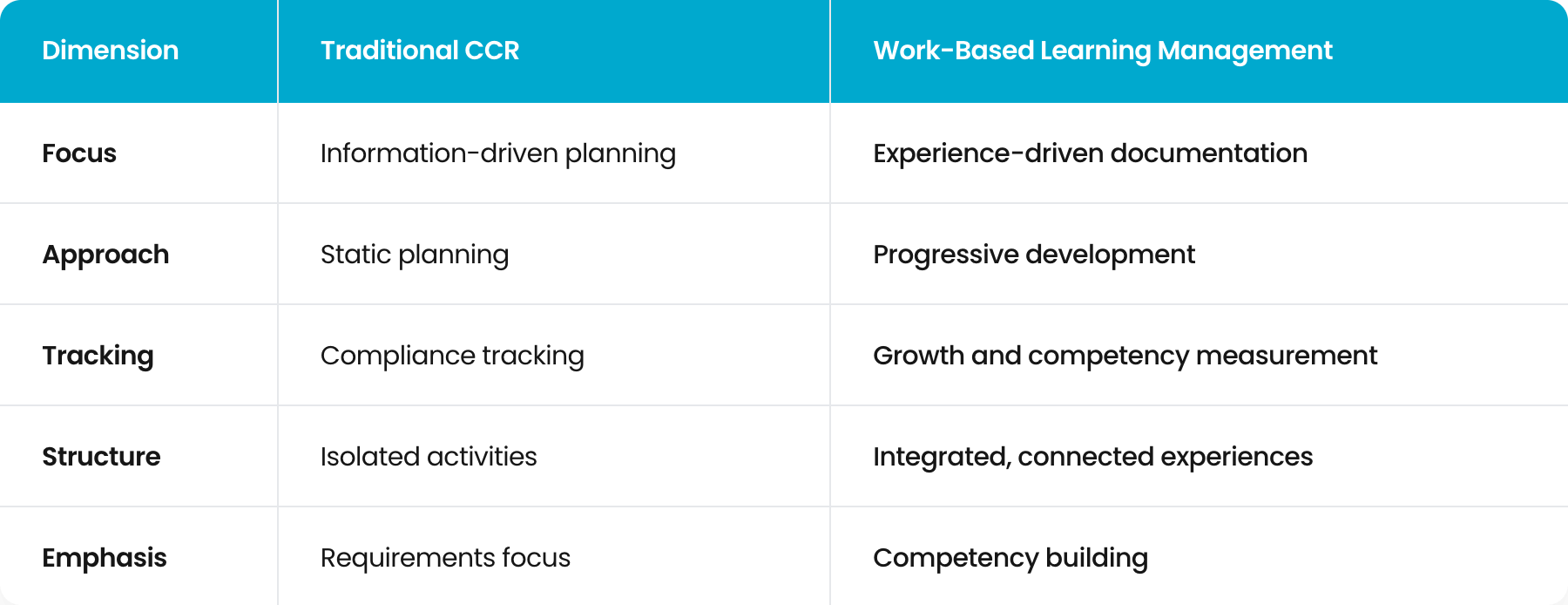
Career readiness platforms and work-based learning management work best together, not in competition. College and career readiness (CCR) tools such as Naviance, Xello, and SchooLinks help students plan, explore interests, and stay on track for graduation. A work-based learning management platform adds the experiential layer: the real activities and documented competencies that turn plans into practice.
Employer partnerships are often the hardest part of that experiential layer to sustain. Forty percent of CTE programs report struggling to find employer partners for real-world learning experiences, according to research reported by K-12 Dive, even as 83% of employers who already recruit from CTE programs say the relationship has a positive impact on their bottom line, according to Advance CTE. That gap between employer willingness and program capacity is precisely the kind of partner management challenge a dedicated WBL platform is designed to close.
Pathful organizes this full journey into a continuous Career Readiness and Development (CRD) cycle with four phases. In Awareness, students spark initial career interests. In Exploration, they transform interests into concrete plans. In Preparation, they develop the skills and connections to excel. In Placement, they launch confidently into their chosen careers. Traditional CCR tools are strong in the planning stages, while work-based learning management strengthens preparation and placement.
Addressing the Access Gap
The dual approach matters most for equity. Black, Latino, first-generation students, and those from low-income households are less likely to participate in internships, and when they do participate, they are less likely to be paid for their work. Sixteen percent of first-generation college students participate in internships, compared with 23% of other students, and among participants, 54% of first-generation students receive compensation, versus 62% of their peers, according to the Education-to-Workforce Indicator Framework. A centralized work-based learning management platform helps close that gap by giving every student, regardless of family network or transportation access, the same visibility into available opportunities and the same documented pathway from interest to placement.
[Quote placeholder — Client Advocacy to source and approve a quote from a WBL coordinator, CTE director, or district partner before publication.]
[Attribution — TBD]
Bringing It All Together
Career experiences should not depend on which student happens to find an opportunity or which educator has time to track it by hand. A work-based learning management platform makes those experiences scalable, documentable, and equitable. As part of Pathful's Career Readiness and Development (CRD) platform, JobreadyWBL helps schools prepare every learner for careers that actually exist with the skills employers actually need.
Frequently Asked Questions
What Is the Difference Between a Career Readiness Platform and a Work-Based Learning Management Platform?
A career readiness platform generally helps students plan, explore interests, and prepare for postsecondary paths. A work-based learning management platform focuses specifically on coordinating, tracking, and documenting hands-on experiences like job shadowing and internships. Many schools use both, since they serve complementary parts of the same journey.
What Types of Work-Based Learning Can Schools Manage in One Platform?
Schools can manage job shadowing, internships, apprenticeships, pre-apprenticeships, mentorships, worksite tours, and simulated or project-based experiences. A single platform keeps participation, hours, competencies, and evaluations for each activity connected to the student's record.
How Does a Work-Based Learning Management Platform Support Compliance?
It supports compliance by documenting student participation, competencies, and hours in a reportable format. This helps schools meet Perkins V requirements, respond to state audits, and demonstrate program outcomes without maintaining separate binders or spreadsheets.
How Long Do Schools Need to Keep Work-Based Learning Records for Compliance?
Retention requirements vary by state, but Michigan's Perkins Compliance Review Checklist calls for equipment and expenditure records to be kept for as long as seven years. A centralized platform makes that long-term recordkeeping far more manageable than paper files.
Can a Work-Based Learning Management Platform Work Alongside Naviance, Xello, or SchooLinks?
Yes. These college and career readiness tools handle planning and goal setting, while a work-based learning management platform handles the experiences and competency documentation. Used together, they give schools a complete picture from early career awareness through placement.
What Is the Difference Between JobreadyWBL and JobreadyCTE?
JobreadyWBL focuses on coordinating and documenting work-based learning experiences such as job shadowing, internships, and apprenticeships. JobreadyCTE focuses on broader Career and Technical Education program management. Together, they make up Pathful's two purpose-built Jobready solutions.
Who Uses a Work-Based Learning Management Platform?
Work-based learning coordinators, CTE directors, school counselors, and administrators are the primary users. Employer partners and student participants also interact with the system to schedule activities, log hours, and submit evaluations.

Keep reading.
From Iowa Tests to interest inventories
The history of career assessment, and what it means for students today.
The students running CTSOs today are running companies tomorrow
The quiet pipeline that's producing America's most work-ready graduates.
From vision to verified
A planning guide for state CTE directors on career development and Perkins V.
Ready to make career readiness more meaningful?
Let's talk about how Pathful can support your students and meet your goals.