
Don't wait until October: how counselors and CTE educators can build career momentum now
The first month of school is a compressed window to reach students before they drift without direction. Here is what the research says about early intervention, and a practical framework for using interest assessments, career plans, and caseload dashboards from day one.
The first month of school sets the tone for everything that follows. For counselors and CTE educators, those early weeks are a compressed opportunity: schedule conversations before they become urgent, identify students who are drifting without direction, and put tools in students' hands that will serve them all year long. When that window closes, it rarely reopens with the same urgency.
After more than 13 years working in and around Career and Technical Education, I have seen first-month momentum make or break a student's entire trajectory. The students who enter October with a clear sense of where they are headed and why their coursework matters show up differently than students who are just moving through the schedule. The gap between those two groups is rarely about aptitude. It is almost always about access to the right information at the right time.
This post is for the counselors and CTE educators who want to make the most of that first month. It covers what the research tells us about early intervention, how interest assessments connect to meaningful course and career planning, how caseload management tools help counselors move from reaction to proactive impact, and what a practical first-month framework looks like in schools that are doing this well.
Why the first month matters more than any other
The transition back to school is not just logistical. For many high school students, particularly those in grades nine and ten, the first weeks represent the first real chance to connect academic choices with life after graduation. Yet research consistently shows that most schools provide career-connected experiences to only 10 to 15 percent of their student population, according to data from XQ Super School. For the students who do not land in that window, the school year can pass without a single meaningful conversation about what comes next.
Counselors already know this. The challenge is structural. When a counselor carries a caseload of 400 or more students, proactive outreach in August and September requires both a clear strategy and scalable tools. Without those, the calendar fills with reactive conversations, and the students who most need early guidance often get it last, if at all.
CTE educators face a parallel challenge. Their classrooms often attract students with strong career interest, but without formal structures for documenting and building on that interest, the program can feel isolated from the broader academic experience. Students complete rigorous coursework without a career plan that connects what they are doing in the CTE lab to their four-year course sequence, postsecondary options, or future employment pathway.
The first month is the moment to close that gap. Intentional use of interest assessments and career planning tools in August and September creates a foundation that every subsequent conversation can build on.
The visibility problem: why reactive counseling falls short
One of the most honest conversations I have with counselors is about the reality of their caseload. Counselors are operating without the visibility they need to support every student. When students look equally fine on the surface, it is nearly impossible to know who is quietly slipping behind on credits, who has not started thinking about life after graduation, or who needs a nudge before it is too late to course-correct.
Without data, counselors default to whoever walks through the door, which means the students who most need proactive outreach are the least likely to receive it. This is not a personal failing. It is a structural one, and it requires a structural solution.
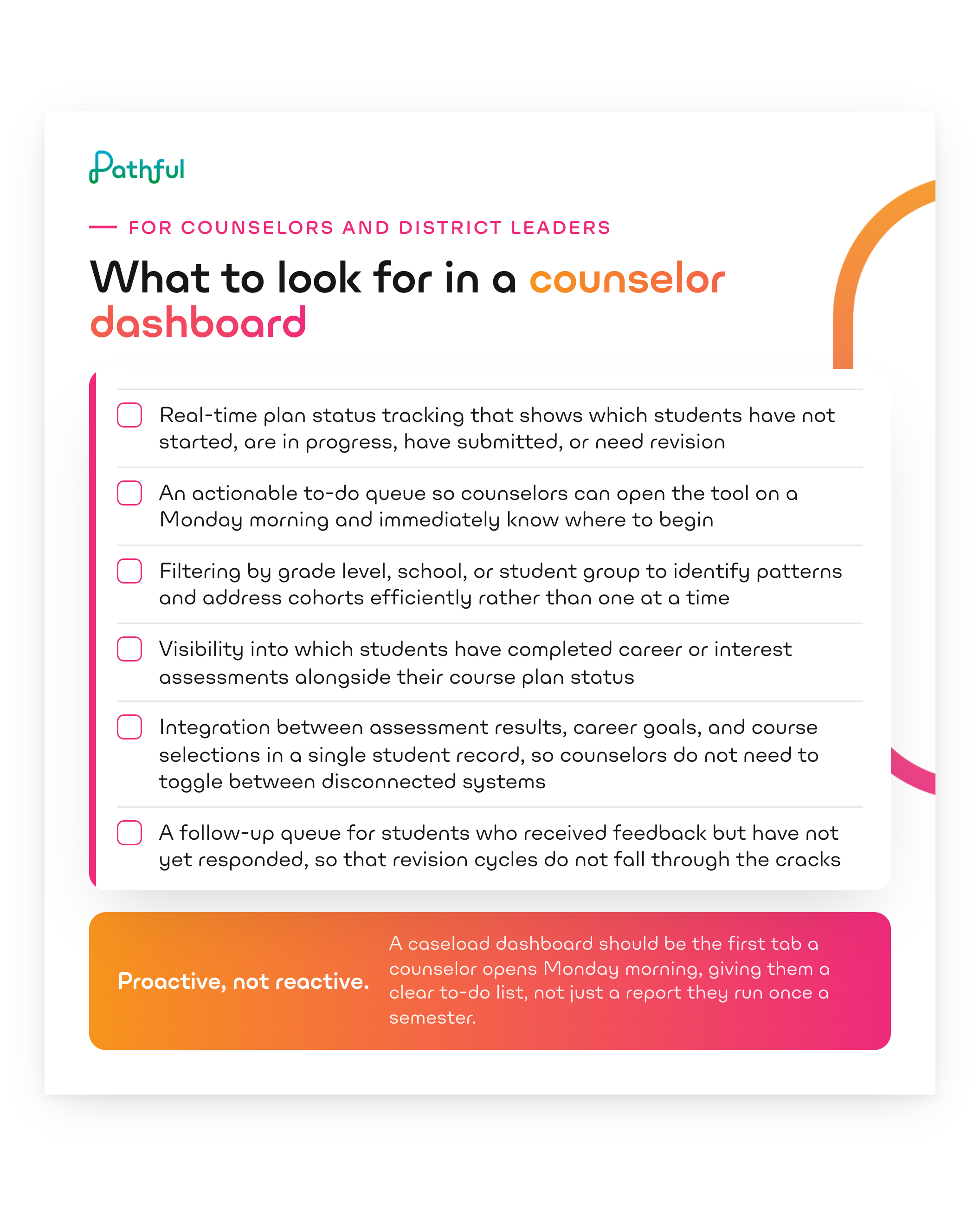
The most effective counseling programs I have seen address this by building their workflow around a caseload dashboard rather than an appointment calendar. A well-designed course planning dashboard surfaces a real-time breakdown of where every student stands in the planning process: who has not started, who has a plan in progress, who has submitted for review, and who needs follow-up after receiving feedback. Those first two categories represent the priority list for any counselor heading into a new school year.
A student who has not started a course or career plan is a student without a roadmap. A student who has started but never followed through may be stuck, unsure, or simply waiting for someone to check in. Neither of those students will walk into the counseling office unprompted, but a dashboard will make them visible. That shift from reactive to proactive is not just an efficiency gain. It is an equity gain. The students who do not advocate for themselves, who do not have a parent calling the office on their behalf, are exactly the students a well-structured caseload view is designed to protect.
Effective caseload dashboards also allow counselors to filter by school, grade level, or student group, making it possible to identify clusters of students who share the same gap and address them collectively. One well-designed group session can address what would otherwise require 15 individual appointments. Counselors can reserve one-on-one time for students who genuinely need it: those navigating pathway conflicts, uncertain post-graduation plans, or circumstances that require a real conversation.
Interest assessments: the starting point, not the endpoint
Interest assessments are one of the most underutilized tools in secondary education. When deployed thoughtfully, they give students a structured way to examine what they find meaningful, what environments energize them, and which career clusters align with those preferences. More importantly, they give counselors and CTE educators a shared reference point for every conversation that follows.
The research case for early assessment is strong. A 2025 study published in ResearchGate found that structured career development interventions can reduce career decision-making difficulties by 50 percent. Separate data from XQ Super School shows that 77 percent of students say they would have been more engaged in school if they had a better understanding of their own strengths and career options. The assessment is not the answer in itself. But it is often the first time a student has been asked to think systematically about what matters to them.
There is an important distinction between an assessment that generates a list of job titles and one that generates a genuine planning moment. The former is a checkbox. The latter is a conversation starter. What separates them is how the data is used afterward.
When a student completes a career interest survey and the results go directly into a documented career plan that their counselor can review, the assessment becomes actionable. When a CTE educator can see which career clusters a student has identified as high-interest and align that to available pathways and course sequences, the assessment becomes programmatically useful. That is the difference between career exploration as an isolated activity and career exploration as part of a coherent student experience.
Read more about career assessments in our post, From Iowa Tests to Interest Inventories: The History of Career Assessment and What It Means for Students Today.
What makes an interest assessment educationally meaningful
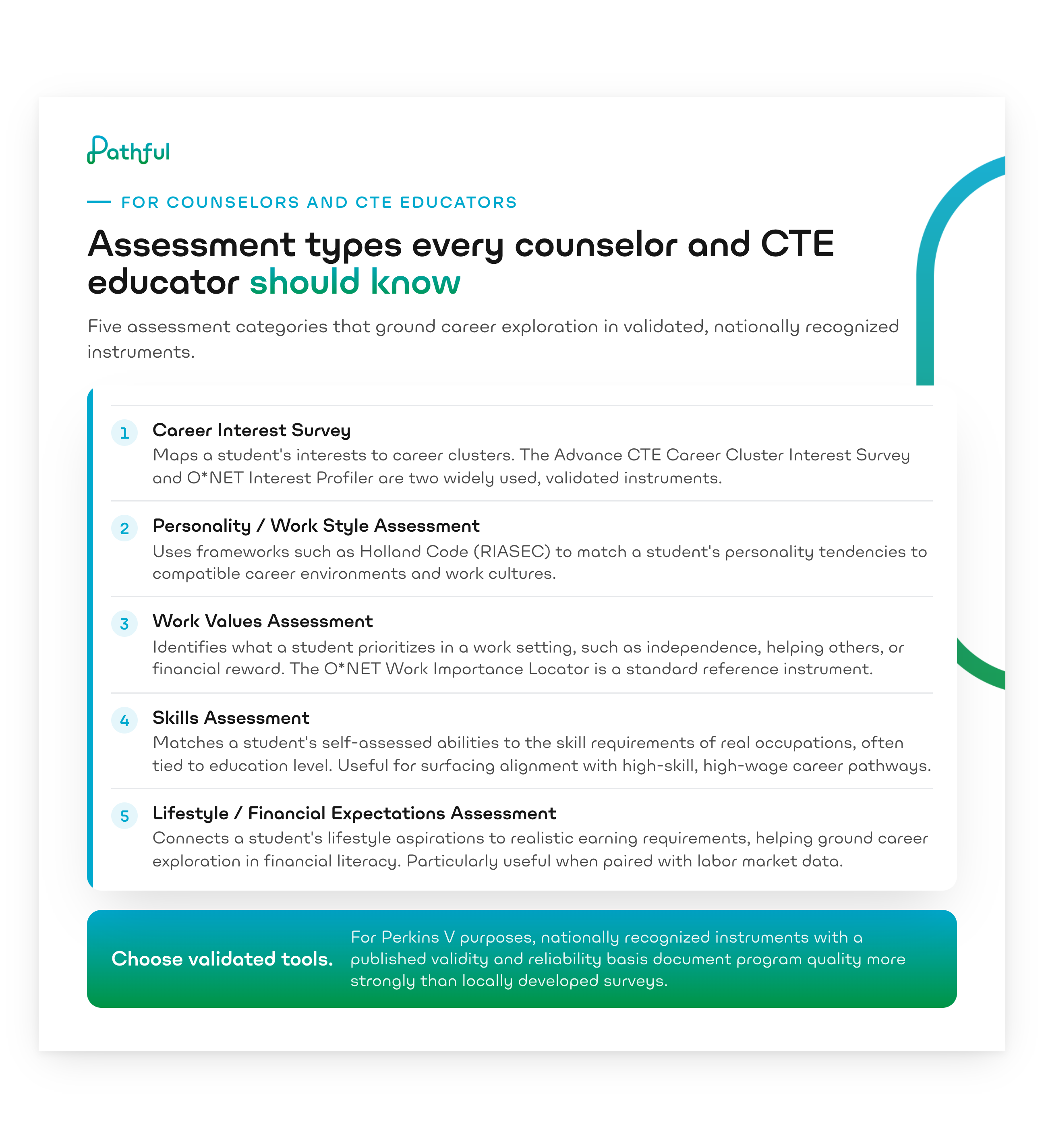
Not all career interest surveys are built the same way. The strongest assessments used in K-12 settings are grounded in nationally recognized research frameworks, such as the Holland Code or RIASEC model for career matching, the O*NET Interest Profiler and Work Importance Locator for connecting interests and values to real occupational data, and the Advance CTE Career Cluster Interest Survey for aligning student interests to the 16 national career clusters. These instruments have peer-reviewed validity behind them, which matters when counselors and CTE educators are using results to guide high-stakes decisions like course selection and pathway enrollment.
A complete interest and career assessment approach typically covers more than a single dimension. The most useful programs assess at minimum a student's career interests, personality tendencies as they relate to work environment, and the values a student holds about the kind of work they want to do. Some programs also assess skills and connect those to education level requirements, giving counselors a more nuanced picture than interest alone can provide.
Equally important is whether assessment results are preserved and visible. Assessments that generate a PDF report or a one-time summary the student prints and loses are not useful at scale. The most effective implementations are those where assessment results live in a shared student record that the counselor, the CTE educator, and the student can all access, update, and refer back to across multiple years.
Connecting assessments to course and career plans
One of the most common frustrations I hear from CTE directors is that students select courses without understanding how those choices connect to their broader career goals. A student who is genuinely interested in healthcare careers but has never been shown how a health science CTE pathway connects to their four-year plan, dual enrollment opportunities, or postsecondary options will often make scheduling choices based entirely on what their friends are taking or what fits conveniently into the day.
Interest assessments, when connected to a career plan and a course planning tool, solve this problem structurally rather than conversationally. When a student's assessment results suggest strong alignment with a particular career cluster, the career plan can surface relevant CTE pathways, flag credential opportunities, and connect to course selection tools so the counselor can help map that interest into an actual schedule. The student is not just told that a certain career field might suit them. They can see the path.
This kind of structural connection also supports the equity goals embedded in Perkins V. The Comprehensive Local Needs Assessment requires districts to examine whether all student populations, including those from economically disadvantaged families, English learners, students with disabilities, and students preparing for nontraditional fields, have equitable access to high-quality CTE programs. A digital career plan with documented assessment results gives counselors a consistent, replicable way to ensure that access is not left to chance or personal advocacy.
The American School Counselor Association's framework for student development, particularly around the Mindsets and Behaviors for Student Success standards, provides a useful structure for connecting assessment outcomes to broader developmental goals. Counselors who anchor their first-month career planning work to the ASCA framework have a built-in rationale for the practice that connects to professional standards and supports program justification at the district level.
A first-month framework for counselors and CTE educators
Based on what I have seen work in districts across the country, here is a practical framework for how counselors and CTE educators can structure the first four weeks to set students up for a year of purposeful planning.
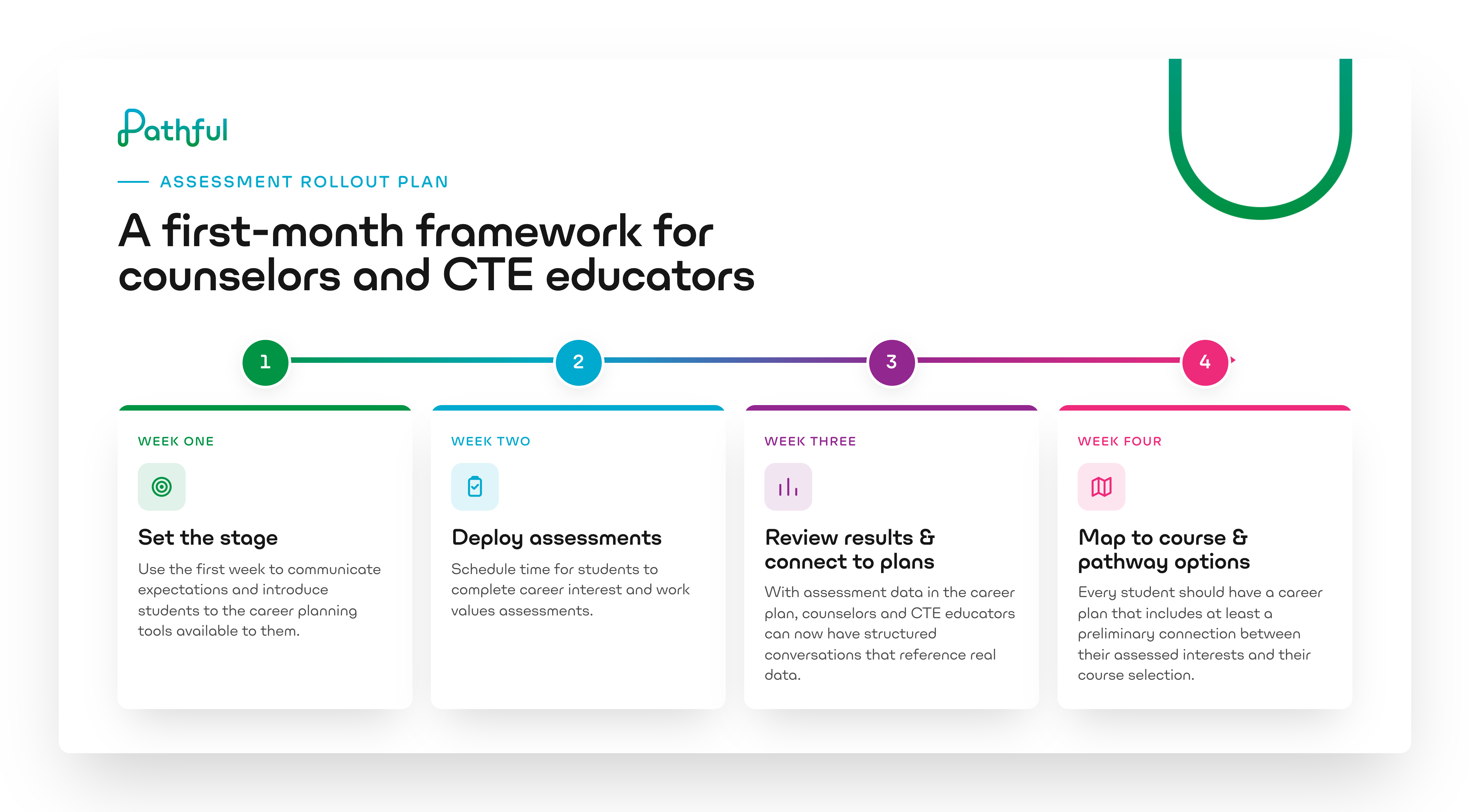
Week 1: Set the stage. Use the first week to communicate expectations and introduce students to the career planning tools available to them. A brief classroom visit from the counselor, a CTE pathway overview from the instructor, or a simple guided activity that orients students to their career planning environment all accomplish the same goal: they signal that Career Readiness and Development is part of the school experience, not a side activity. Counselors should also open their caseload dashboard at the start of the week to establish a baseline, understanding who is in their caseload, which students have existing plans from prior years, and which are starting fresh. That baseline sets the priority list for the weeks ahead.
Week 2: Deploy interest assessments. Schedule time for students to complete career interest and work values assessments. In a CTE classroom, this can be built directly into the first unit as a reflection and goal-setting exercise. For counselors working across a grade level or caseload, coordinating with teachers to build in a 30-minute assessment block is far more effective than waiting for individual appointments. Research from the WBL Management System Playbook published by Pathful confirms that career planning is most effective when it begins before students enter any work-based learning activity. Early-year assessments are not optional. They are foundational.
Week 3: Review results and connect to plans. With assessment data in the career plan, counselors and CTE educators can now have structured conversations that reference real data. A counselor reviewing their caseload can quickly identify students whose assessment results suggest strong interest in a career cluster that their current course selection does not reflect, then reach out proactively. A CTE educator can use aggregated results to understand the range of interests in the classroom and tailor early-semester projects accordingly. This is the week when the assessment moves from an exercise into a planning instrument.
Week 4: Map to course and pathway options. By the end of the first month, every student should have a career plan that includes at least a preliminary connection between their assessed interests and their course selection. Counselors can help students visualize how their current schedule maps to their stated goals and identify any gaps or misalignments before they become scheduling problems in subsequent years. For students enrolled in CTE pathways, this is also the time to ensure that the pathway they are pursuing aligns with both their interest assessment results and their postsecondary intentions, whether that means a two-year credential, a bachelor's degree program, or direct workforce entry.
The WBL and Perkins V connection: why career plans are a compliance asset
For CTE directors and WBL coordinators, a student's career plan is not just a counseling tool. It is a compliance asset. Perkins V's performance indicators include postsecondary placement, credential attainment, and program quality metrics tied to work-based learning participation. Each of those outcomes is strengthened when students enter their CTE programs with a documented sense of purpose and a plan that connects their coursework to their postsecondary goals.
The Perkins V Application Toolkit published by Pathful on the Compass makes this explicit: districts that treat the Comprehensive Local Needs Assessment as a genuine strategic planning tool, rather than a compliance checkbox, are better positioned to align budget allocations, program development, and student support services in ways that actually move performance indicators. Career plans populated through interest assessments and maintained by counselors throughout the year provide the longitudinal data that makes CLNA reporting meaningful rather than retrospective.
Similarly, the WBL Management System Playbook recommends that student career plans be created before any work-based learning activity begins, specifically because the purpose of WBL is to deepen and test the career interest that has already been identified through exploration and planning. A student who enters a job shadow or internship without a career plan is experiencing an isolated activity. A student who enters that same experience with documented goals and a pathway in mind is building toward something that connects to a larger arc.
Districts investing in Perkins V funding for career exploration tools and digital career planning infrastructure should document that investment explicitly in the CLNA as a response to identified needs around program quality and student engagement. That documentation strengthens the justification for continued or expanded funding in subsequent years.
Supporting all students from day one
Equity-focused practitioners will recognize that the first-month framework described here is particularly important for students who do not come into school with existing professional networks or family context about career pathways. First-generation students, students from rural and low-income communities, and students from historically underserved populations are statistically less likely to receive proactive career guidance and less likely to access work-based learning opportunities, according to data from Strada Education Network and the National Association of Colleges and Employers.
Career planning tools that are integrated into the school day, rather than dependent on a student's initiative to seek out the counseling office, change that dynamic. When interest assessments are deployed at scale in the first month, when career plans are built into the CTE classroom experience, and when counselors can monitor engagement across an entire grade level using a caseload dashboard rather than waiting for individual appointments, the students who most need support are the ones most likely to get it.
The Why Career Readiness and Development Matters white paper published by Pathful makes the case clearly: there is not a lack of workers in the United States, there is a lack of career-ready graduates. Closing that gap begins in K-12, and the most impactful point of intervention is the beginning of the school year, when students and educators are both oriented toward what comes next.
Counselors and CTE educators who build a first-month career planning practice are not just doing their students a favor. They are building the institutional infrastructure that makes a school's career development program systematic, documentable, and equitable at scale.
Start strong. Build all year.
The first month of school will pass whether or not it is used intentionally. For the counselors and CTE educators who are given the resources to use it well, the return on that investment compounds across the entire academic year. Students who understand their interests, have a career plan in place, and can see a connection between their coursework and their goals show up as more engaged learners, more purposeful course selectors, and better-prepared candidates for work-based learning.
The research, the compliance frameworks, and the practitioner experience all point in the same direction: the first four weeks are not too early to begin. They are exactly the right time. A caseload dashboard that surfaces who needs outreach. A validated interest assessment that gives students a real starting point. A career plan that grows with the student across every year of secondary education. These are not supplemental activities. They are the foundation of a career development program that actually works.
If your district is heading into the new school year without a structured first-month career planning strategy, now is the time to build one. Start with your data, deploy assessments early, connect the results to plans and course selections, and use a caseload view to make sure every student, not just the ones who show up at the door, gets the guidance they need.
Frequently asked questions
By building their workflow around a caseload dashboard instead of an appointment calendar, counselors can immediately see which students have not started a career plan and which started but never followed through, then reach out to those students first rather than waiting for them to walk through the door.
When an interest assessment feeds directly into a documented career plan, results can surface relevant CTE pathways and connect to course selection tools, so a student's assessed interests translate into an actual schedule rather than staying a one-time exercise.
A practical framework is to set the stage and establish a caseload baseline in week one, deploy interest and work values assessments in week two, review results and connect them to plans in week three, and map assessed interests to course and pathway options by week four.
A caseload dashboard surfaces a real-time breakdown of where every student stands in the planning process, including who has not started, who is in progress, who has submitted, and who needs follow-up, so counselors can prioritize outreach instead of waiting for students to self-advocate.
Sources
- XQ Institute. High School and the Future of Work: A Guide for State Policymakers.
- Strada Education Foundation. Understanding Undergraduates' Career Preparation Experiences. December 2021.
- National Association of Colleges and Employers (NACE). Job Outlook 2023.
- The Effectiveness of Career Guidance and Counseling Services in Secondary Schools: Evaluating Their Role in Enhancing Student Career Choices and Academic Success. Voyage Journal of Educational Studies. April 2025.
- American School Counselor Association (ASCA). Student Standards: Mindsets and Behaviors for Student Success. 2021.
- Pathful. The Complete Perkins V Application Toolkit. 2026.
- Jobready360 by Pathful. The WBL Management System Playbook. v1.0.9. September 2025.
- Pathful. Why Career Readiness and Development Matters: Closing the Gap Between Graduate Preparation and Employer Expectations. October 2025.
- U.S. Bureau of Labor Statistics. Job Openings and Labor Turnover Summary. September 2025.
- Riipen. Measuring and Evaluating Work-Based Learning: The Student Impact Survey. June 2023.
- Pathful. From Iowa Tests to Interest Inventories: The History of Career Assessment and What It Means for Students Today. 2026.

Keep reading.
How important is parent involvement tied to student success?
Decades of research say yes. Here is what the evidence shows, and how schools can close the parent communication gap.
From Iowa Tests to Interest Inventories
The history of career assessment, and what it means for students today.
The Complete Perkins V Application Toolkit
A step-by-step guide for CTE directors navigating the Perkins V application process.
Ready to make career readiness more meaningful?
Let's talk about how Pathful can support your students and meet your goals.