
Beyond the interpreter: why bilingual skills are a career advantage in every field
Published during Hispanic Heritage Month, Sept. 15 to Oct. 15. Millions of students already speak, read, or think in more than one language — here is how directly that ability translates into hiring across healthcare, business, education, and more.
A skill millions of students already have
Hispanic Heritage Month, observed September 15 through October 15, is a fitting moment to highlight a skill millions of students already carry with them: the ability to speak, read, or think in more than one language. For many students, especially in Spanish-speaking households, that ability is simply part of growing up. What gets less attention is how directly it translates into the workplace, opening career doors that go well beyond the ones students usually picture.
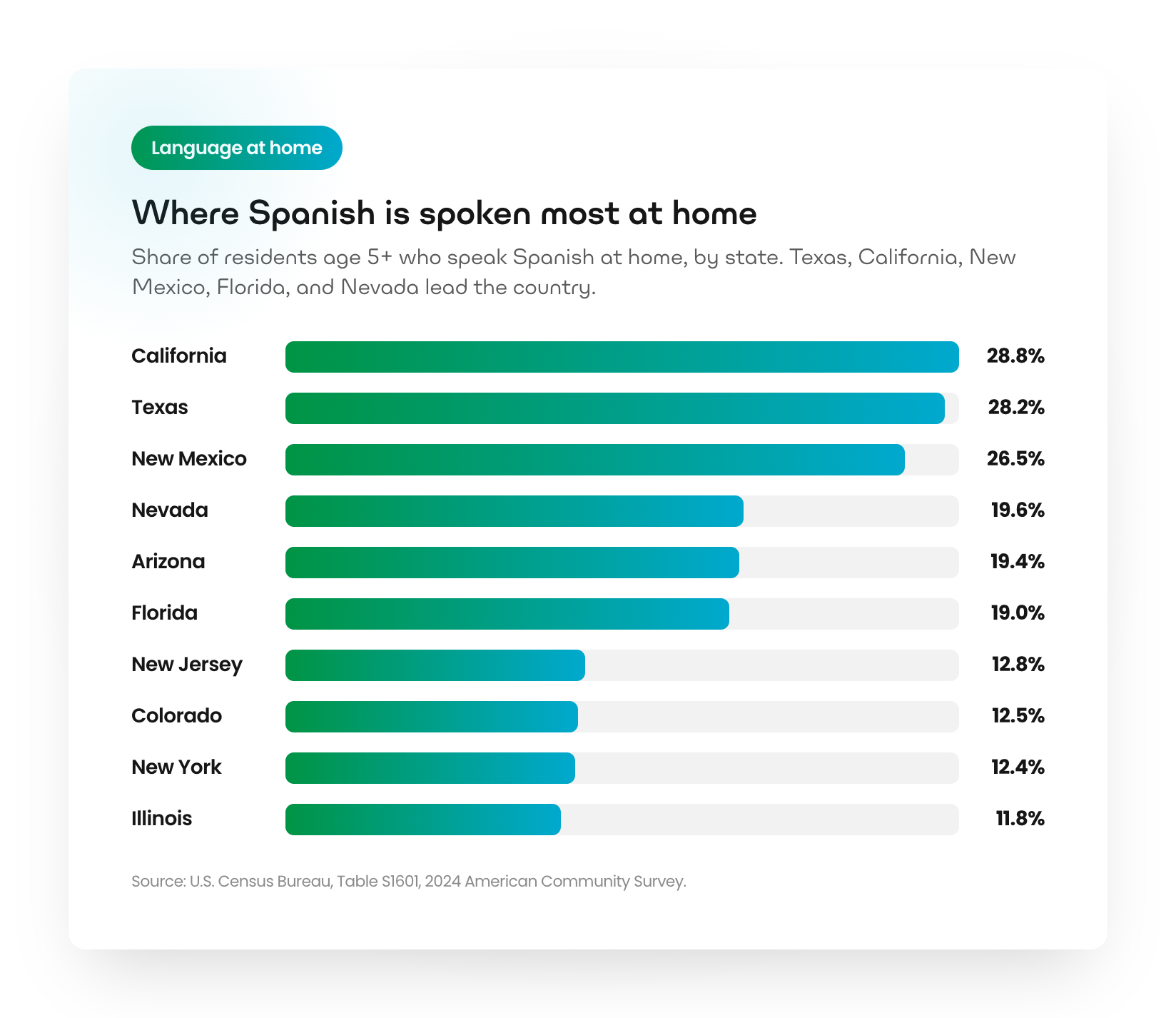
The United States is home to a growing number of bilingual households, and employers have noticed. U.S. Census Bureau data shows Spanish is spoken at home by roughly a quarter of the population in states like California and Texas, among the highest shares in the country, and by nearly 45 million people nationwide. Companies in those regions and beyond want to reach more customers, serve their communities well, and compete in markets that cross language lines. Employees who can operate in more than one language help them do exactly that.
Why employers are paying attention
The demand is not new, and it is not slowing down. A 2019 ACTFL survey of 1,200 U.S. employers found that nine in ten already rely on employees who speak a language other than English, and more than half expected that need to grow over the following five years. About one in four employers in the same survey said they had lost business because they lacked staff who could communicate in a client's language.
That demand shows up directly in hiring activity. Research from New American Economy found that job postings aimed at bilingual workers more than doubled between 2010 and 2015, climbing from roughly 240,000 to about 630,000, with Spanish, Chinese, and Arabic speakers most sought after.
Bilingual ability doesn't just point toward becoming an interpreter or translator, though that field is growing too. The U.S. Bureau of Labor Statistics points to a more diverse population, expanding global trade, and an ongoing need for language support in public safety and government roles as drivers of demand for interpreters and translators specifically, and those same forces show up as a hiring advantage across dozens of other job titles, not just the ones with “interpreter” in the name.
Where bilingual skills show up across industries
Healthcare: Clear communication can be the difference between a patient understanding a diagnosis and leaving confused. Roughly 25.5 million people in the United States, about 9 percent of the population, have limited English proficiency, and a systematic review of clinical research found that professional interpreters are associated with meaningfully better communication, outcomes, and satisfaction for those patients. Bilingual nurses, medical assistants, and health information specialists help patients feel heard and cared for, and hospitals actively seek staff who can bridge language gaps in emergency rooms, patient intake, and everyday care.
Business and customer service: Companies that serve Spanish-speaking customers need employees who can build trust in that customer's own language. Bilingual sales representatives, account managers, and customer service teams often become a company's strongest connection to new markets, which is a large part of why bilingual job postings have grown so quickly.
Education: More than 5 million English learner students attend U.S. public schools, and bilingual teachers and instructional aides help them keep pace with their classmates while staying connected to their families. That demand has outpaced supply. Districts across the country report persistent shortages of certified bilingual and ESL teachers, and researchers point to bilingual teacher pipeline reforms as one of the clearest ways to close the gap. For students weighing a teaching career, bilingual ability is a genuine hiring edge, not just a nice-to-have.
Hospitality and tourism: Hotels, restaurants, and travel companies depend on staff who can welcome guests from different backgrounds. A bilingual front desk associate or tour guide often shapes a visitor's entire impression of a destination.
Government and public service: From court interpreters to social workers, public agencies rely on bilingual staff to make sure every resident can access the services they are entitled to, regardless of what language they speak at home. This is also where equity and compliance intersect. English learners are named as a protected special population under Perkins V, and districts completing a Comprehensive Local Needs Assessment are asked to show real progress serving them, which makes bilingual CTE staffing a genuine program need, not just a nice addition.
Technology and media: As companies build apps, websites, and content for global audiences, they need bilingual professionals to localize products, test user experience, and create content that resonates across cultures.
Skilled trades, manufacturing, and logistics: On construction sites, warehouses, and factory floors, bilingual project managers and supervisors keep teams safe and on schedule by giving clear instructions in more than one language. That skill can prevent costly mistakes, and it often opens leadership roles for workers who might otherwise get passed over for promotion.
Turning a skill into a career plan
Being bilingual isn't just something to mention in passing on a resume. It's a qualification that can be developed, certified, and built into a career plan.
- Advanced coursework in a student's second language builds the vocabulary needed for professional conversation, not just everyday conversation.
- Industry certifications, such as those offered through the American Translators Association or state and court interpreter credentialing programs, turn a skill learned at home into a formal, resume-ready qualification.
- CTE pathways in healthcare, business, education, and hospitality often list bilingual ability as a preferred or required qualification, which is worth flagging when students are comparing programs.
- Job shadowing or interning alongside bilingual staff shows students what the skill looks like in practice before they commit to a path.
Classroom connection: supporting this skill beyond world language class
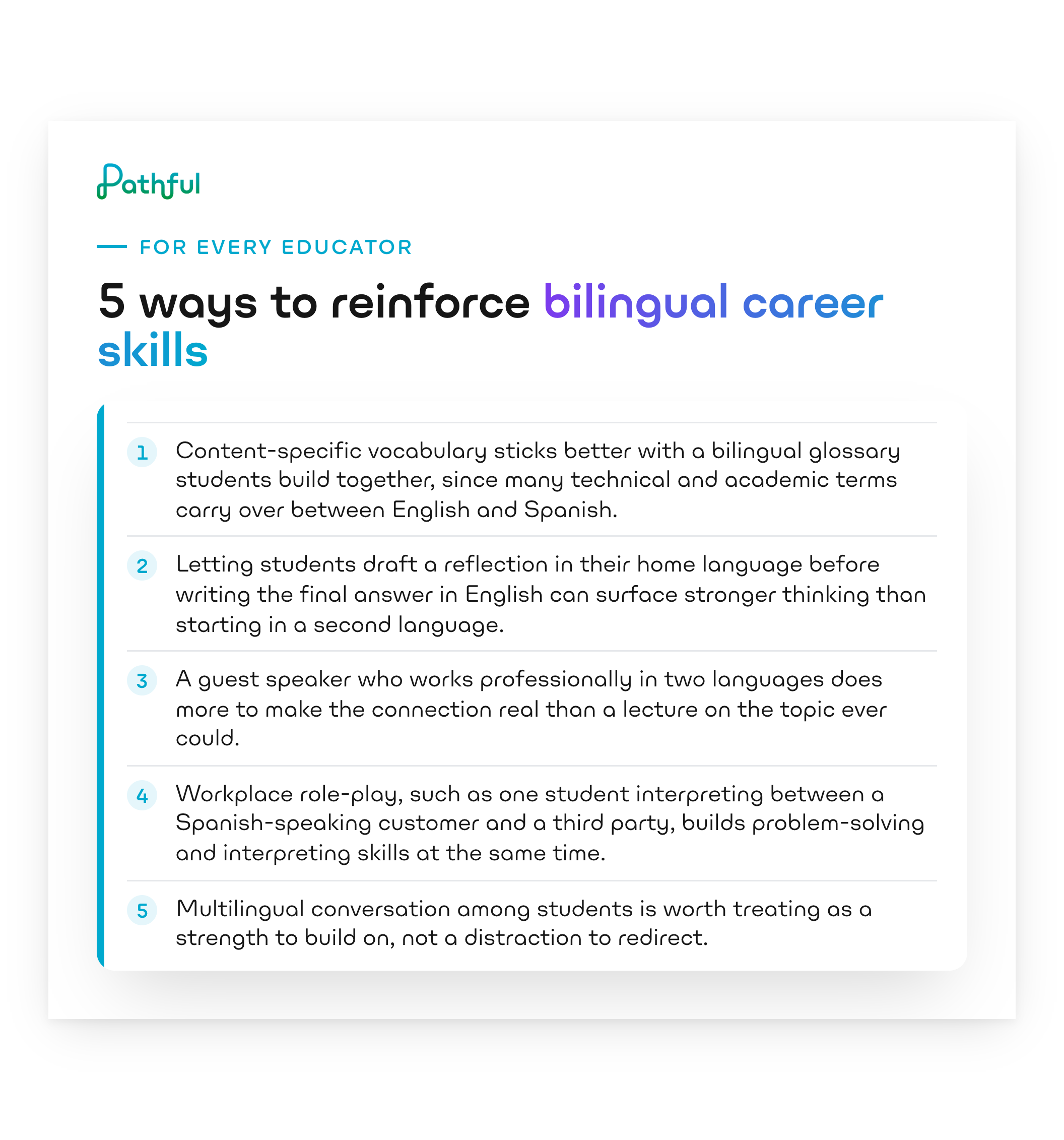
Bilingualism is often treated as something that belongs only in the world language classroom. In reality, teachers in any subject can reinforce it as an academic and professional asset.
- Content-specific vocabulary sticks better with a bilingual glossary students build together, since many technical and academic terms carry over between English and Spanish.
- Letting students draft a reflection in their home language before writing the final answer in English can surface stronger thinking than starting in a second language.
- A guest speaker who works professionally in two languages does more to make the connection real than a lecture on the topic ever could.
- Workplace role-play, such as one student interpreting between a Spanish-speaking customer and a third party, builds problem-solving and interpreting skills at the same time.
- Multilingual conversation among students is worth treating as a strength to build on, not a distraction to redirect.
A skill worth building on, all year
Bilingualism is often treated as a personal or cultural trait rather than a professional one. Hispanic Heritage Month is a good moment to widen that view, but the case for treating a second language as a career asset holds up the other eleven months too. For students who move between two languages every day, that ability isn't just part of their identity. It shows up as a hiring qualification across healthcare, business, education, hospitality, government, technology, the trades, and more, and the data suggests employers are only going to want more of it.
Frequently asked questions
Healthcare, business, education, hospitality, government, technology, and skilled trades roles all list a second language as a preferred or required qualification, well beyond dedicated interpreting and translation positions.
Multiple employer and wage studies point to a measurable premium, though estimates vary by industry, region, and language pair. What is consistent is that nine in ten U.S. employers already rely on non-English-speaking employees in some capacity.
Through advanced coursework in the second language, industry certifications such as a medical or court interpreter credential, CTE pathway alignment in fields like healthcare or business, and job shadowing alongside bilingual professionals.
It falls September 15 through October 15 and gives schools a natural moment to highlight a skill many students already carry and connect it to concrete career pathways, though the conversation is worth having all year.
By building bilingual glossaries for technical vocabulary, inviting bilingual guest speakers, allowing reflection in a student's home language before a final English answer, and treating multilingual conversation in class as a strength rather than a distraction.
Sources
- Hispanic Heritage Month, official dates and history
- U.S. Census Bureau, “Stats for Stories: Hispanic Heritage Month”
- U.S. Census Bureau, Table S1601, Language Spoken at Home, 2024 American Community Survey
- U.S. Census Bureau, Language Use topic page
- USAFacts, “How many people speak Spanish at home?”
- U.S. Bureau of Labor Statistics, Occupational Outlook Handbook: Interpreters and Translators
- ACTFL, “Making Languages Our Business: Addressing Foreign Language Demand Among U.S. Employers”
- American Immigration Council / New American Economy, “Not Lost in Translation: The Growing Importance of Foreign Language Skills in the U.S. Job Market”
- NCELA, U.S. Department of Education Office of English Language Acquisition, “The Economic Benefits of Multilingualism”
- PMC/National Institutes of Health, “Monitoring Use of Language Interpreting Services for Patients with Limited English Proficiency”
- PubMed, “Do Professional Interpreters Improve Clinical Care for Patients with Limited English Proficiency? A Systematic Review of the Literature”
- National Center for Education Statistics, “English Learners in Public Schools”
- Education Week, “Dual-Language Programs Are Hobbled by a Catch-22”
- The Century Foundation, “How to Grow Bilingual Teacher Pathways: Making the Most of U.S. Linguistic and Cultural Diversity”
- American Translators Association, Certification program
- U.S. Bureau of Labor Statistics, wage data update on interpreters and translators via Slator
- Pathful, Perkins V Application Toolkit
- Pathful, Product Lineup and Career Search / Career Profiles tools
- Pathful video library, AI-translated content and accessibility features

Keep reading.
The Connected Path is open: how state CTE leaders can turn vision into practice
Advance CTE's new shared vision names the tension every state CTE director feels. Here is what it takes to move a state's CTE system a step closer to it.
How Pathful protects student data: inside our SOC 2 Type 2 audit, Trust Center, and secure SIS integration
What our SOC 2 Type 2 audit verifies, what the Trust Center makes available to districts, and how our SIS integrations reduce risk.
Don't wait until October: how counselors and CTE educators can build career momentum now
How counselors and CTE educators can use interest assessments, career plans, and caseload dashboards to support every student in the critical first month of school.
Ready to make career readiness more meaningful?
Let's talk about how Pathful can support your students and meet your goals.