
The Connected Path is open: how state CTE leaders can turn vision into practice
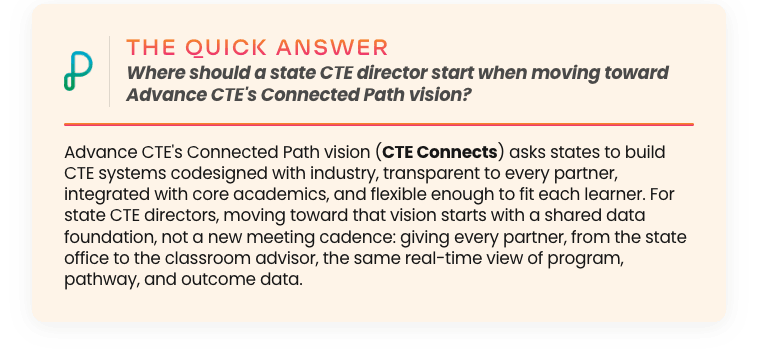
Advance CTE's new shared vision names the tension every state CTE director feels. Here is what it takes to move a state's CTE system a step closer to it, with a real state example.
Every state CTE director knows the feeling of holding two jobs at once. One job is visionary: building a system that prepares every learner for a career of their choosing. The other is operational: making that vision survive contact with legacy data systems, uneven local capacity, and a legislative session that moves faster than any program redesign.
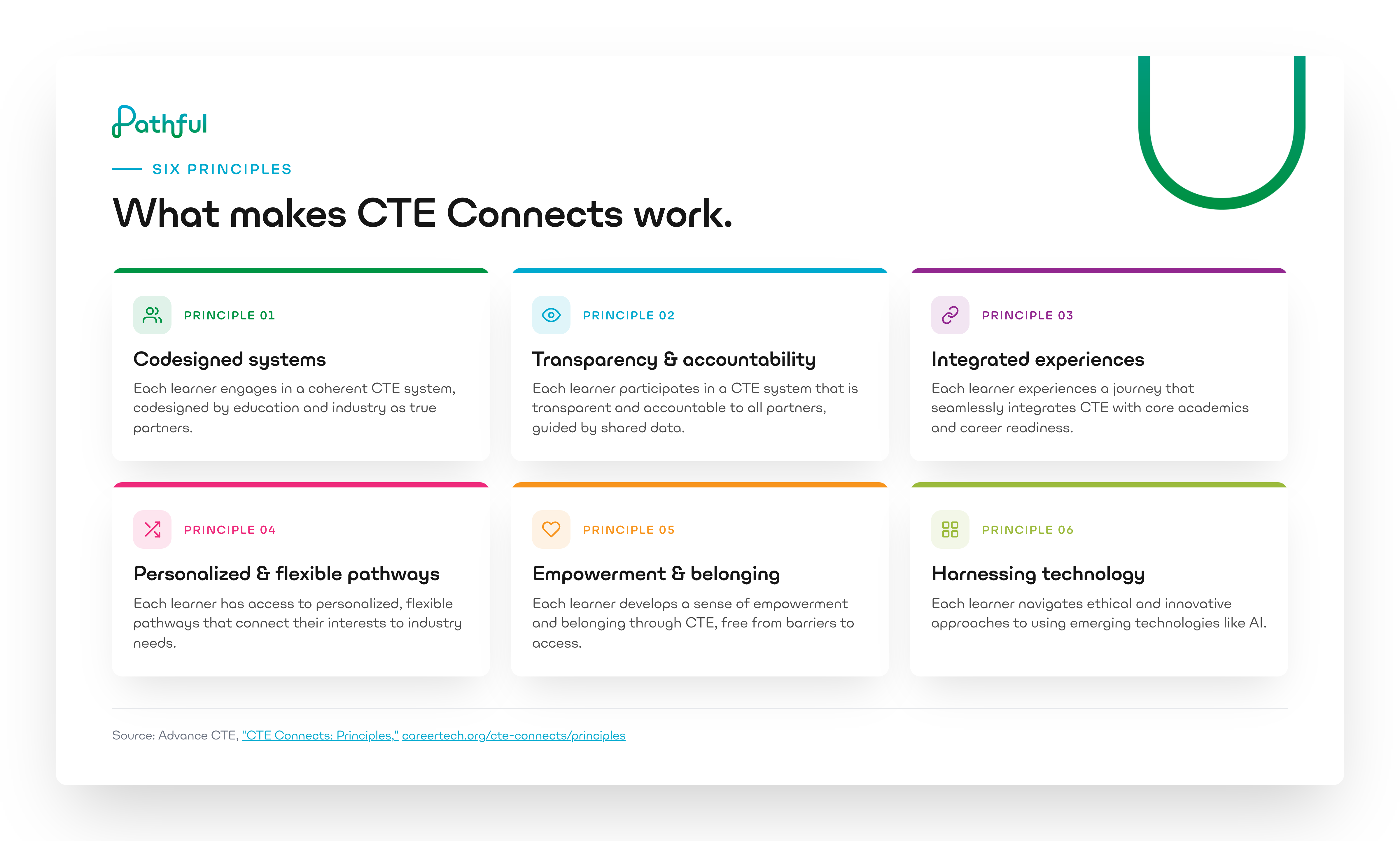
Advance CTE's new shared vision, The Connected Path: A Shared Vision for Opportunity and Empowerment Through CTE (also known as CTE Connects), names that tension directly. Developed with input from more than 200 national, state, and local leaders, the vision calls for a CTE system codesigned by education and industry, transparent and accountable to every partner, seamlessly integrated with core academics, flexible enough to fit each learner's pathway, built around belonging and confidence, and thoughtful about how emerging technology gets used. Forty national organizations have signed on in support, making it the field's clearest statement yet of what "good" looks like.
None of that is controversial among state leaders. The harder question is what it takes on a Tuesday afternoon in a state office to move a CTE system a step closer to that vision. That is the question this post is here to answer.
Why codesigning CTE systems with industry is a data problem first
CTE Connects asks education and industry to codesign CTE systems together, not just consult with each other once a year. In practice, codesign breaks down for a mundane reason: the people at the table are looking at different pictures of the same program. Industry partners see labor market demand. Local administrators see enrollment and completion. State offices see compliance reporting. Advisors see individual learner plans. When none of those views share a common data spine, codesign becomes a meeting instead of a system.
Advance CTE's own reflections on the vision point to the same fragmentation: state agencies and local institutions each tend to hold a fragmented piece of the evidence, whether that is outcomes data, competencies gained, or a credential record, making it hard to see a learner's full story in one place. States furthest along have usually solved this by giving every partner, from the state office down to the classroom advisor, a shared view of the same program and pathway data, in the format each of them actually needs. That is less a philosophical shift than an infrastructure one, and it is exactly the kind of unglamorous work that determines whether a shared vision becomes a shared practice.
How is the National Career Clusters Framework adapting to AI?
Advance CTE's modernized National Career Clusters Framework, released in October 2024 after a two-year validation process involving more than 4,000 CTE professionals, is the backbone most states use to organize programs of study. The update consolidated the Framework into 14 Career Clusters and 72 Sub-Clusters, folded fields like Information Technology into a broader Digital Technology cluster, and combined others, all without eliminating any career field. States are now required to align their Perkins data reporting to the modernized Framework beginning with the 2025-26 academic year.
The Framework's newest companion resource, Responsive By Design: Integrating Artificial Intelligence Across the National Career Clusters Framework, maps concrete examples of how AI is already reshaping the industries behind all 14 clusters, and it asks state leaders to build AI literacy into standards and program guidance now rather than waiting for a future revision cycle.
For state leaders, this lands as a familiar kind of urgency: standards work that used to happen on a multi-year cadence now needs to keep pace with a labor market that is changing inside a single budget cycle. The states handling this well are not writing an "AI standard" and calling it done. They are building AI literacy as a transferable skill that shows up across clusters, in course planning tools, and in the way work-based learning experiences are structured, so it ages with the workforce instead of against it.
What do recent state policy trends mean for CTE funding?
Every year, Advance CTE and the Association for Career and Technical Education (ACTE) track the legislation, executive orders, and budget actions shaping CTE nationally in their State Policies Impacting CTE: Year in Review report. In 2025, 49 states enacted 172 CTE-related policies, the highest number recorded since before the pandemic, with funding and industry partnerships/work-based learning tying as the top policy categories at 67 enactments each. The year before, funding policies alone climbed to the top spot for the first time since 2023, with 63 funding policies enacted across 26 states.
That trend puts state CTE offices in an uncomfortable spot. Lawmakers are funding CTE, but funding is increasingly tied to demonstrated outcomes, program quality, and clear connections to workforce needs, not just seat counts. At the federal level, the same scrutiny is showing up in appropriations debates, where Advance CTE and ACTE have jointly pressed for CTE-specific funding increases even as broader education and workforce budgets face proposed cuts.
The systems built to track compliance were not built to tell a fast, credible story about outcomes to a budget committee with limited time and even less patience for spreadsheets. Most states still find out how a program year actually went the same way: an annual report, assembled months after the fact, well after the budget or policy decision it should have informed. Closing that gap, being able to show in real time how a program of study connects to a credential, a work-based learning experience, a wage outcome, and local labor market data, is quietly becoming the difference between a program that gets funded and one that gets questioned.
How are states already putting a Connected Path into practice?
Houston offers a live example of what a connected path can look like when every partner shows up in the same system. Ready Set Next, built for Houston by the Greater Houston Partnership and powered by Pathful, is an AI-powered career navigation platform that connects career discovery, education pathways, work-based learning, community support, and employer opportunities into one guided experience for an entire region, not a single district. The Partnership leads the regional strategy and partner engagement, while Pathful brings the platform and career exploration technology.
A $17 million grant from Bloomberg Philanthropies is helping extend Ready Set Next to more than 1,350 CTE students over three years, connecting them to work-based learning, pre-apprenticeship, and apprenticeship opportunities in fields like electrical work, plumbing, welding, HVAC, industrial maintenance, and carpentry. The initiative sits inside UpSkill Houston, the Partnership's decade-long effort to align employers, educators, and community organizations around a shared regional workforce strategy.
Ready Set Next is not a generic template. It is a live example of the same principle behind CTE Connects: when state and regional agencies build around a shared data foundation instead of a stack of disconnected tools, codesign stops being a meeting and starts being a system.
Where Pathful fits into your Connected Path work
Pathful was built because we spent decades on the other side of the state director's desk, as CTE teachers, principals, district supervisors, and CTE directors, before we ever sold a platform. That vantage point shaped a simple belief: state leaders do not need another vision statement. They need tools that make an existing vision executable at scale.
The core design problem we set out to solve is the silo problem itself. Every layer of a state's systems and agencies, the state offices, district directors, counselors, teachers, advisors, and families, tends to work out of a different tool, holding a different, partial picture of the same learner or the same program. Pathful gives all of them one login and one shared place to work instead, so a program's data means the same thing whether a teacher, a district administrator, or a state analyst is the one looking at it. Because a shared home is only useful if it fits the state using it, every deployment is configured around your state's own structure, credentials, reporting requirements, and terminology rather than asking your state to adapt to ours.
That same shared data foundation is what makes real-time impact reporting possible. Instead of waiting for an end-of-year report to learn what already happened, state leaders can pull current enrollment, program of study, work-based learning, and outcome data on demand, in time to inform a budget hearing, a superintendent's question, or a midyear course correction, rather than a postmortem.
Here is how that plays out across the pieces of the system state leaders are actually responsible for, bringing career readiness and development to life from kindergarten through career:
- Pathful is the student-facing engine and the core of the platform. Within Pathful, students move through four phases of career readiness and development: awareness, exploration, preparation, and placement. Pathful's Course Planner helps learners and counselors build genuinely flexible, personalized pathways instead of forcing a single track, mapping courses to a four- or six-year plan. Students also cover career exploration, build portfolios, and track credentials against program of study alignment, all visible in the same real-time dashboards your state and district teams already need for reporting.
- JobreadyCTE is purpose-built and customizable for program management, tracking competencies by state, CTSO participation, advisory management, asset management, articulation agreements, and more. It aligns program of study data, course sequencing, and reporting to the same Career Clusters structure your state has already adopted, so state and local teams are finally looking at the same picture.
- JobreadyWBL gives state offices visibility into work-based learning placements and outcomes at a scale that a spreadsheet or a phone tree cannot match, which matters directly to the funding-and-outcomes trend above. It also provides workflows that make it easy for students and WBL coordinators to track participation.
- Pathful Junior extends career exploration down to elementary and middle grades, so belonging and confidence in a career identity start well before a learner ever registers for a first CTE course.
- And Ready Set Next, built with the Greater Houston Partnership and powered by Pathful, is a live example of what it looks like when everyone who impacts workforce readiness comes together, connecting career discovery, education pathways, work-based learning, community support, and employer opportunities into one guided experience built around a specific region's labor market and existing partners, rather than a generic template.
We are not positioning any of this as a replacement for the leadership work state directors do. CTE Connects is Advance CTE's vision, and it should stay that way. But visions get built one operational decision at a time, and after decades on both sides of that work, we would rather spend our time helping state leaders bring those visions to life.
If your state is working through what The Connected Path, the modernized Career Clusters Framework, or this year's funding conversations mean for your next planning cycle, we would welcome the chance to compare notes.
Frequently asked questions
CTE Connects is Advance CTE's shared national vision for CTE, calling for systems that are codesigned by education and industry, transparent and accountable to every partner, integrated with core academics, flexible for each learner's pathway, centered on belonging, and thoughtful about emerging technology.
CTE Connects is backed by 40 national education, career readiness, and workforce organizations, and was developed with input from more than 200 national, state, and local leaders across K-12, postsecondary, workforce development, business and industry, and philanthropy.
The National Career Clusters Framework is the structure most states use to organize CTE programs of study. Advance CTE released a modernized version in October 2024 after a two-year validation process, consolidating the Framework into 14 Career Clusters and 72 Sub-Clusters aligned to current industry structure.
Advance CTE's companion resource, Responsive By Design, maps concrete examples of how AI is reshaping the industries behind all 14 Career Clusters and encourages states to build AI literacy into standards and program guidance now, rather than waiting for the next major revision cycle.
In 2025, 49 states enacted 172 CTE-related policies, the most since before the pandemic, with funding and work-based learning tying as the top categories. Funding is increasingly tied to demonstrated outcomes and workforce alignment rather than enrollment alone.
Pathful gives every partner in a state's CTE system, from the state office to the classroom advisor, one shared, real-time view of program, pathway, and outcome data through Pathful, JobreadyCTE, JobreadyWBL, and Pathful Junior, configured around each state's own structure and reporting requirements.
Sources
- Advance CTE, CTE Connects: overview; “The Connected Path” shared vision resource; 40-organization support statement
- Advance CTE, CTE Connects implementation resources: Slide Deck; “Building the Connected Path: Industry-Led and Learner-Centered”
- Advance CTE, National Career Clusters Framework: initiative overview; About page; Advancing the Framework; Modernized Framework Guidebook; Frequently Asked Questions
- ACTE CTE Policy Watch, “Advance CTE Releases Modernized Career Clusters Framework”
- Minnesota CTE, Career Clusters Framework
- Advance CTE, AI and the Career Clusters Framework: Responsive By Design: Integrating Artificial Intelligence Across the National Career Clusters Framework; Applied Co-Intelligence: Preparing CTE Learners for an AI-Driven Workforce
- Advance CTE & ACTE, State Policies Impacting CTE: Year in Review series; 2025 Policy Examples; FY26 appropriations statement
- Community College Daily, “A Review of CTE Policy Actions Among States”
- Advance CTE, State Resources
- Greater Houston Partnership, Ready Set Next: platform overview; launch announcement; Bloomberg Philanthropies investment; UpSkill Houston
- Education Week, “The Job Market Is Changing. How Career and Technical Education Can Keep Up”
- U.S. Department of Education, Perkins V
- Pathful, Products

Keep reading.
How Pathful protects student data: inside our SOC 2 Type 2 audit, Trust Center, and secure SIS integration
What our SOC 2 Type 2 audit verifies, what the Trust Center makes available to districts, and how our SIS integrations reduce risk.
Don't wait until October: how counselors and CTE educators can build career momentum now
How counselors and CTE educators can use interest assessments, career plans, and caseload dashboards to support every student in the critical first month of school.
How important is parent involvement tied to student success?
Decades of research say yes. Here is what the evidence shows, and how schools can close the parent communication gap.
Ready to make career readiness more meaningful?
Let's talk about how Pathful can support your students and meet your goals.